

BCIwiki (bciwiki.com) — Wireless electroencephalography (EEG) use in research on children with developmental disabilities is on the rise, with brain-computer interface (BCI) technology accounting for 28.1% of included studies, according to a scoping review published in the Journal of Medical Internet Research on August 25, 2026, by researchers from Yonsei University and the University of Toronto.
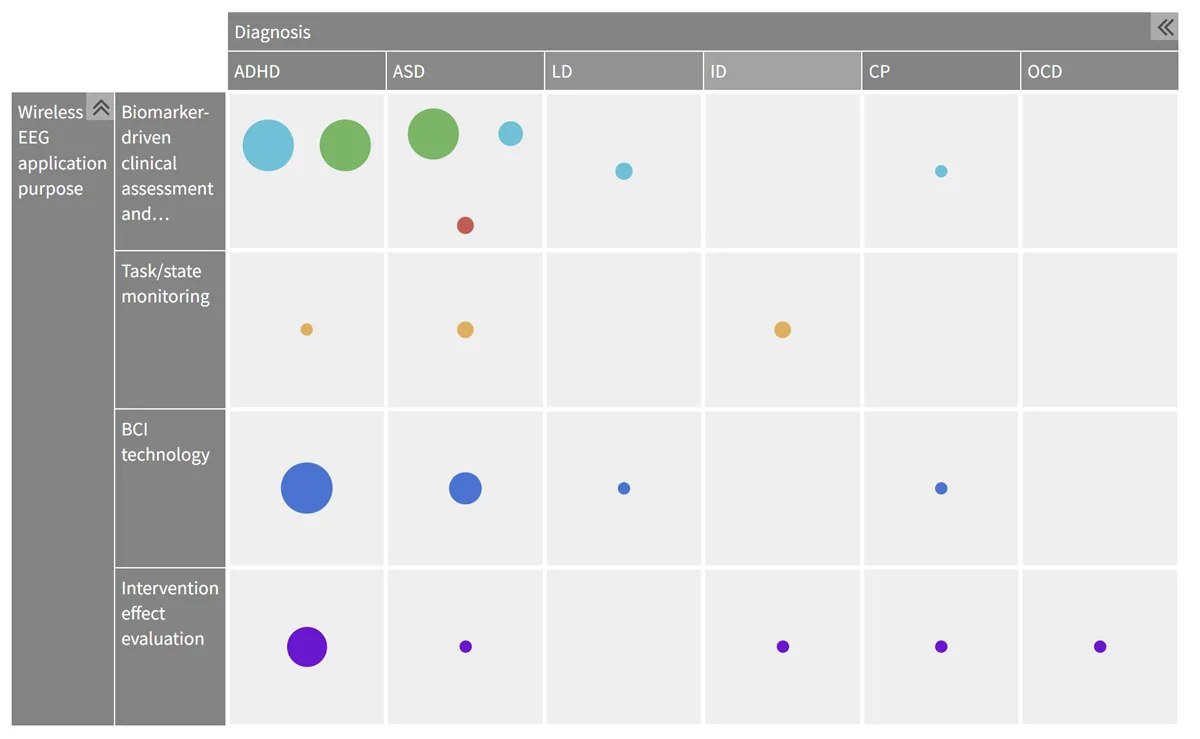
The review searched 7 databases from inception through December 2025, identifying 64 studies with 3103 participants published between 2005 and 2025, showing an increasing trend in both publications and sample sizes. Attention-deficit/hyperactivity disorder (59.4%) and autism spectrum disorder (31.3%) were the most frequently studied conditions. Primary application domains were biomarker-driven assessment and diagnosis (51.6%), BCI technology (28.1%), intervention evaluation (12.5%), and task or state monitoring (7.8%).
Consumer-grade devices predominated (47.7%), followed by research-use-only (29.2%) and medical devices (23.1%). BCI studies favored low-channel, dry-electrode, consumer-grade devices, whereas biomarker-driven and intervention studies used higher channel counts and greater signal fidelity.
Data quality-related reporting was substantially incomplete: 85.9% of studies did not report validation against a wired EEG system, 79.7% did not specify impedance thresholds, and 12.5% described no artifact handling. The authors recommend that future studies prioritize rigorous validation within developmental disability cohorts and develop population-specific guidelines for device selection, signal quality assurance, and reporting transparency.