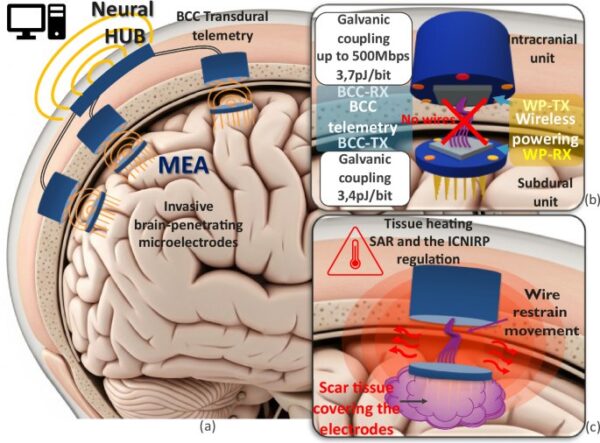
Researchers at imec, Eindhoven University of Technology and Erasmus MC propose a two-stage wireless architecture for intracortical BCIs: a transdural galvanic-coupled body channel link carries data from a free-floating microelectrode array to an intracranial unit, and a transcutaneous link then relays it outside the body. In phantom tests and ex vivo experiments on a human cadaveric head, the transdural link reached 500 Mbps at 20% duty cycling with bit error rates below 10⁻⁵. A built-in send-on-delta encoder (SODA) compresses data by up to 11.4x to cut thermal load, and brain-on-a-chip models showed no unintended neural activity. The study appeared in Communications Engineering on September 1, 2026.