
中 / EN

Optogenetics

3 entries
September 2026

Peking University Collaboration Reconstructs Movie Frames From Optogenetically Stimulated Mouse Cortex

A collaboration involving Peking University converted dynamic natural movie frames into spatiotemporal patterns of optogenetic stimulation in awake mice, then reconstructed movie frames from responses in the primary visual cortex. Comparing natural viewing with artificial stimulation, they found that stimulation evoked broadly comparable cortical dynamics and aligned representations. A deep learning model reconstructed frames from cortical signals under both conditions. The animal study offers a proof of concept for evaluating how visual cortical prostheses might translate images into stimulation patterns. It does not establish that stimulation produced the corresponding visual experience in mice or restored vision in humans.
August 2026

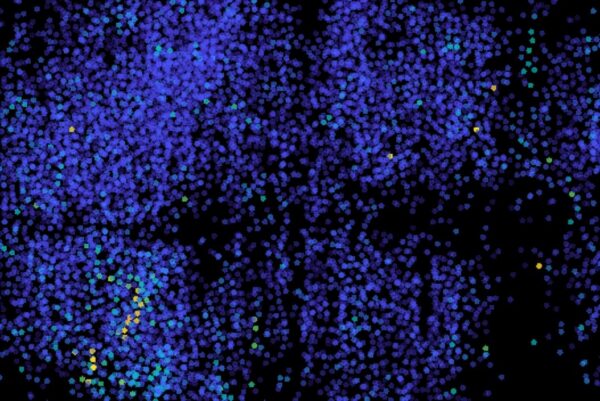
MIT Microscope Captures Whole-Brain Voltage in Zebrafish 200 Times a Second

MIT engineers have adapted a light-sheet microscope to image the electrical activity of neurons across a zebrafish's entire brain, scanning the whole brain 200 times a second — once every five milliseconds. Calcium imaging, the usual proxy for neural activity, resolves activity only on the order of seconds and cannot capture single spikes, while genetically encoded voltage indicators report membrane potential directly but had previously been limited to small, localized populations. Faster camera acquisition and remote refocusing pushed volumetric imaging to rates that resolve individual neuronal impulses, revealing brain-wide activity patterns evoked by ultraviolet light; the study appears in Nature Methods.
July 2026
© 2026 BCIwiki.com Digest Topics Tips Subscribe Revisions About