

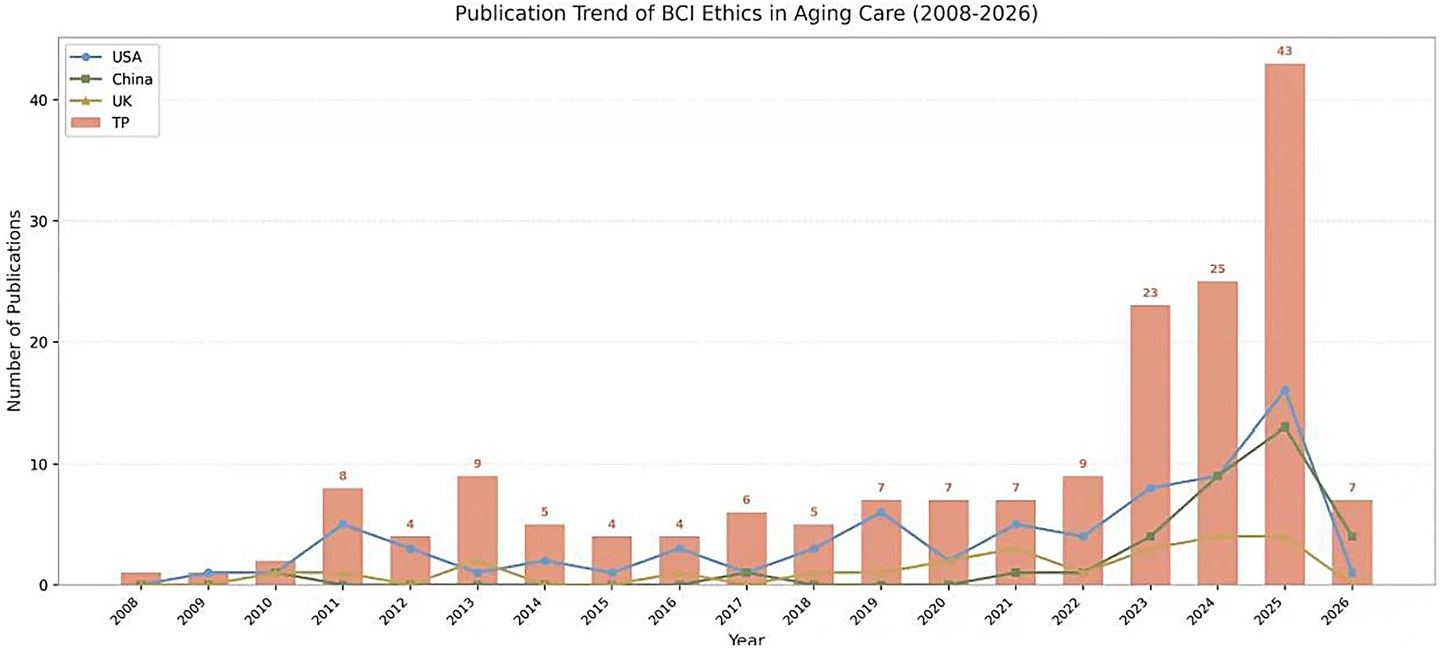
BCIwiki (bciwiki.com) — A systematic review of brain-computer interfaces (BCIs) in elderly care identified 177 studies from 12,423 records and proposed a three-level analytical framework for examining ethical and communication challenges. The review, by Kun Fu, Peize Li, Xinxi Peng, Shuangcheng Li, Yifan Zhao, and Xi Chen, was published in Frontiers in Digital Health on August 28, 2026.
Six core ethical themes emerged: privacy and data security, informed consent and autonomy, personhood and identity, technical risks and safety, equity and accessibility, and risk-benefit trade-offs. The authors argue that BCI ethical risks are not peripheral but structurally embedded in the technology's interaction logic—decoding uncertainty can translate into care misjudgment, neural data inferability extends privacy risks beyond information leakage to psychological exposure and power asymmetry, and technology-mediated communication creates structural tensions in trust and responsibility.
The proposed framework spans human-computer interaction, interpersonal communication, and public opinion dissemination, examining how ethical risks manifest as communication breakdowns across the closed-loop BCI process of neural signal acquisition, intention decoding, and external feedback. A three-dimensional mapping integrates ethical issues, communication challenges, and application scenarios (rehabilitation assistance, communication assistance, monitoring and prevention, and emotional support) to reveal scenario-specific ethical configurations.
The review concludes that responsible BCI deployment in elderly care requires not merely algorithmic improvement but the systematic engineering of ethical principles into care processes, including uncertainty disclosure at the interface level, data minimization and layered informed consent at the institutional level, and interdisciplinary collaboration with long-term support systems.