

BCIwiki (bciwiki.com) — Retrieving a meaningful concept from a spoken definition lowers low-beta power in scalp EEG, with a peak near 15 Hz, and the effect pointed the same way in all 13 participants tested, researchers at the University of Essex reported in Frontiers in Human Neuroscience on September 29, 2026 (PMID 42807381, DOI 10.3389/fnhum.2026.1913105). The work came from the university's Brain-Computer Interfaces and Neural Engineering Laboratory and its Department of Psychology.
Conventional brain-computer interfaces (BCIs) rely on sequential selection, which limits communication speed and depends on preserved sensory or motor pathways, the authors wrote. Semantic BCIs aim to decode concepts directly from neural activity. That first requires characterising how a high-semantic state (meaningful concept retrieval) differs from a low-semantic state (pseudo-word recognition) in scalp EEG.
The team built GRASP (Game of Retrieval and Semantic Processing), a response-locked auditory paradigm. Participants heard spoken sentence definitions and identified concrete concepts from 3 categories: body parts, foods and musical instruments. Phonologically matched pseudo-word trials kept a sentence-like sound while removing most lexical-semantic content. Participants pressed the spacebar once reasonably confident, and the analysis focused on the interval before that response.
The researchers recorded 64-channel EEG from 13 neurologically healthy British English speakers and applied Morlet time-frequency decomposition over 2-35 Hz. They computed concept-minus-pseudo-word contrast maps for each participant and category. These maps went into a permutation analysis based on Threshold-Free Cluster Enhancement (TFCE) across channel, frequency and time.
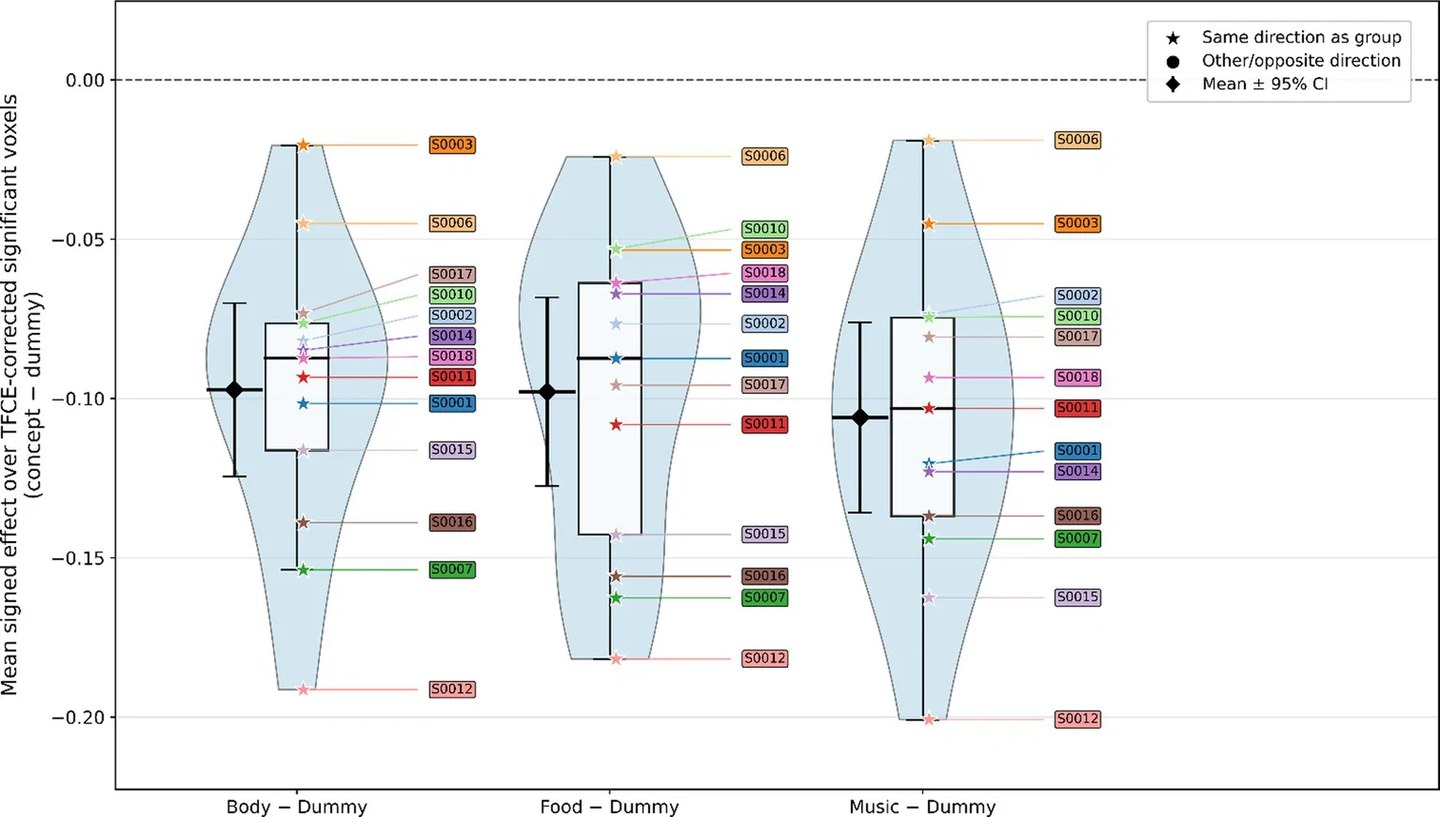
All 3 categories produced significant corrected effects in the low-beta range, peaking near 15 Hz, with lower power on meaningful trials. Every one of the 13 participants showed the same direction in all 3 contrasts. Body-part and instrument effects were strongest over centro-parietal and posterior regions, while food effects spread across frontal, central and posterior sites.
The authors said the boundary between high- and low-semantic states may offer a more cross-participant-stable EEG target than discriminating one concept from another. The study involved healthy volunteers only and did not test real-time decoding or patients.