
中 / EN

University of Essex

6 entries
October 2026

University of Essex EEG Tests Reach 73.4% in Pairwise Semantic Classification

University of Essex researchers recorded EEG from 14 participants retrieving concepts from verbal clues. Mean accuracies in three pairwise comparisons of food, musical instruments and body parts were 73.4%, 70.7% and 68.2%. The model learned representations from other participants before calibration with each test participant’s own labelled data.
September 2026

University of Essex Finds Consistent Low-Beta EEG Dip as Listeners Grasp Word Meaning

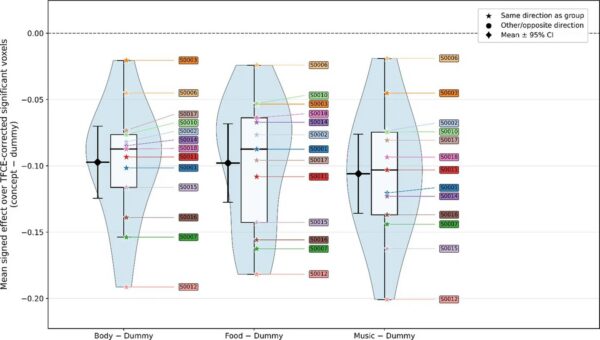
A team at the University of Essex in the UK found that scalp EEG shows a consistent drop in low-beta power when people work out a concept from a spoken definition. In an auditory guessing game, subjects heard a spoken definition and named the concept, such as a body part, food or musical instrument; phonologically similar pseudo-word sentences with almost no meaning served as the control. Across 64-channel EEG from 13 healthy subjects, all 3 categories showed reduced low-beta power, peaking near 15 Hz, during retrieval before the response, in the same direction for all 13. The researchers suggest that separating meaningful from meaningless states may be a better cross-person target than identifying specific concepts, informing future BCIs that decode meaning directly.

Lanzhou Jiaotong University Graph Model Beats EEGNet at Decoding VR Motor Imagery

Researchers at Lanzhou Jiaotong University proposed a hierarchical graph learning framework to decode motor imagery EEG recorded while people watch a movement in virtual reality and imagine performing it. The method splits scalp EEG into rhythmic components, selects key features, represents each trial's brain-region connectivity as a graph and classifies it with a hierarchical graph convolutional network. On the team's self-collected VR motor imagery dataset, it outperformed common baselines including EEGNet in three-class decoding. The team also found that observing plus imagining in VR strengthened connectivity among sensorimotor regions, engaging a wider brain network. The abstract does not give specific accuracy figures or the number of participants.

Speech Imagery BCIs May Be Overrated as Only 36% of Participants Reach Significance

Speech imagery (SI) brain-computer interface results may be hard to reproduce, a University of Essex team reports. When the researchers re-ran published decoding pipelines, classification accuracy averaged 11.25 percentage points below the original reports, with gaps ranging from 2% to 39%; in a replication analysis, only 36% of SI participants cleared the threshold for statistical significance, against 91% in motor imagery (MI) datasets. Published in the Journal of Neural Engineering on September 4, 2026, the study is the first to assess both the reproducibility and the replicability of SI decoding. Every SI study evaluated was missing methodological details, and the authors conclude that SI's feasibility as a practical BCI paradigm may have been overestimated, a warning for clinical applications and follow-up research that rely on it.
August 2026
April 2026

Enhancing the Capability and Accuracy of Motor Imagery Classification: A Deep Neural Network-Powered Multifaceted Strategy Model

Researchers propose DPMS-Net, a deep network that uses dynamic convolution to mine discriminative cues across temporal, spatial and frequency dimensions, combines channel and temporal attention, and adds a spectral-domain analysis component to surface subtle oscillatory features hidden in the EEG spectrum. On the BCI Competition IV 2a and 2b datasets it reached subject-dependent accuracies of 83.93% and 88.38%, and 67.67% on a self-collected stroke-patient dataset. The authors say its efficient decoding and robustness suit neurorehabilitation BCI systems.
© 2026 BCIwiki.com Digest Topics Tips Subscribe Revisions About