

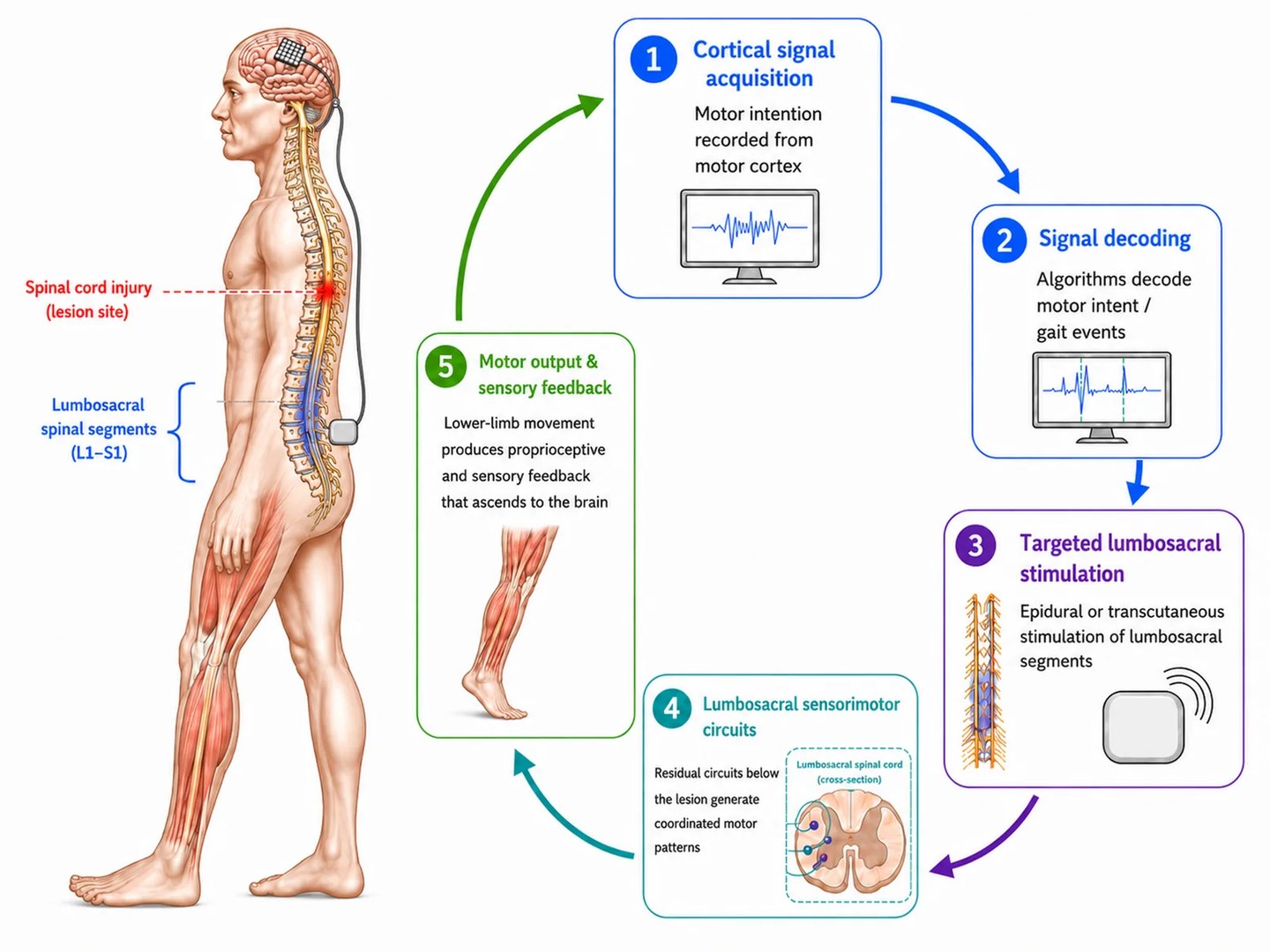
BCIwiki (bciwiki.com) – Whether brain-spine interfaces can become a routine treatment for spinal cord injury still rests on preliminary evidence, according to a review of the field published in Neurosurgical Review on August 22, 2026.Spinal cord injury strips motor and sensory function below the level of the lesion and affects millions of people worldwide. A brain-spine interface aims to route around the break: cortical motor-intention signals are read out and delivered to spinal sensorimotor circuits below the injury, restoring functional communication between the two ends. The approach rests on the observation that residual spinal pathways and circuits may remain partially responsive to neuromodulation even after injury.Early preclinical work and highly selected clinical studies have produced encouraging motor outcomes, the review says, but the evidence is preliminary and routine clinical use runs into a set of unanswered questions: safety, durability, criteria for patient selection, accessibility, and long-term functional benefit. Beyond brain-spine interfaces the review surveys other routes, from surgical intervention to regenerative therapy, and finds that neurostimulation and biomaterial-based strategies show potential in experimental and early translational settings while their clinical efficacy and generalisability remain incompletely established. It also notes that the nervous system’s own capacity to reorganise connections after injury leaves room for spontaneous recovery in some cases.Integrating brain-spine interfaces into clinical practice still faces substantial hurdles, the authors write, among them technical challenges, ethical considerations, and the need for specialised training for healthcare providers. Their conclusion is that brain-spine interfaces and other emerging treatments may improve quality of life for people with spinal cord injury, but establishing their safety, efficacy and generalisability will take further clinical investigation. The paper is a review and reports no new primary data.