/ EN
September 2026

BCI-Adaptive Learning Platform Lifts Retention in 90-Learner Study

Researchers divided 90 learners into two groups: one used a BCI platform that read attention, cognitive load and mental fatigue in real time and adjusted content and pacing accordingly; the other followed a conventional online course. The BCI group showed stronger sustained engagement and better knowledge retention. The mixed-methods design combined quantitative data (pre- and post-test scores, task completion rates and neural activity indicators) with surveys and semi-structured interviews on perceived engagement, usability and the overall learning experience. The participants came from English House Language Center, the European University of Armenia and Mesrop Mashtots University. The authors also flag unresolved privacy, ethical and accessibility questions around collecting and using neural data in education.
AI Should Read Intent in BCI Exoskeletons While Controllers Enforce Limits, Review Says

A brain-computer interface can read neural activity tied to movement, while a powered exoskeleton supplies the force needed to carry it out. But EEG is noisy, muscle signals shift with fatigue and recovery, and the right level of assistance depends heavily on the user and the task, so AI's main value lies in handling several changing signals at once rather than relying on a single fixed input. The review surveys how EEG, EMG and mechanical sensing are combined for exoskeleton control and contrasts two applications with very different goals: stroke rehabilitation and healthy users. The author argues that higher classification accuracy alone is not enough, since latency, calibration, fatigue, uncertainty and physical safety also determine whether a system is truly usable.

Anisotropic Hydrogel Electrode Records P300 and SSVEP Signals

Electrodes for non-invasive brain-computer interfaces have long traded off conductivity, conformity to the skin and durability. A conductive hydrogel made by in situ directional freezing copolymerization forms vertically aligned ion channels and an interconnected nanoporous network, giving it higher conductivity than conventional hydrogel electrodes. In preliminary P300 and steady-state visual evoked potential (SSVEP) experiments, it recorded signals comparable in quality to conventional wet- and dry-electrode benchmarks, while also offering a tissue-matched compressive modulus, high stretchability, skin adhesion and rapid self-healing. The paper presents these experiments as a feasibility demonstration and reports no data on long-term wear stability, scaled-up fabrication or human clinical trials.

Umbrella Review Ties Post-Stroke BCI Gains to Motor Attempt and 20-60 Minute Sessions

Motor attempt, meaning a patient's effort to move a paralyzed limb, was the intent-inducing modality most consistently tied to significant therapeutic effects in an umbrella review of 17 meta-analyses of brain-computer interface systems for stroke motor recovery, published in Symmetry on September 4, 2026 with a literature search cutoff of June 30, 2026. Electrical stimulation was a consistently effective feedback type, while robot-assisted and visual feedback gave inconsistent results, and higher weekly session frequency and moderate session durations of about 20 to 60 minutes were linked to consistent recovery. Combining motor attempt with electrical stimulation may yield greater benefits, the authors suggest.

Hybrid BCI Replaces Exoskeleton Crutch Controls at 95.06% SSVEP Accuracy

A hybrid brain-computer interface replaced crutch control for 10 participants walking with a custom lower-limb exoskeleton, classifying steady-state visual evoked potentials with 95.06% accuracy and reaching F1 scores of 99.80% and 99.22% for its wink- and clench-triggered asynchronous switches, researchers reported in IEEE TNSRE. Measured against crutch control, the system scored 78.25 versus 53.50 on the System Usability Scale and 3.15 versus 7.85 on NASA-TLX physical demand.

One EEG Diffusion Model Decodes Motor Imagery, Hemiplegic Side and Recovery

Researchers have proposed a unified EEG-based framework that simultaneously performs motor imagery classification, hemiplegic side detection and functional recovery prediction, aimed at motor rehabilitation after stroke. Stroke remains one of the leading causes of long-term motor disability worldwide, the authors note, and motor imagery brain-computer interfaces are seen as a way to accelerate recovery. Current MI-BCI methods, however, generalize poorly across patients, lack an effective functional assessment step, and are limited by scarce patient data and a shortage of suitable augmentation approaches. The framework introduces a diffusion model tailored to the spatio-temporal characteristics of EEG, built on a decoupled neural architecture with rotary spatial encoding and autoregressive temporal fusion. To offset data scarcity, the team designed two augmentation strategies adapted to stroke EEG. Experiments across multiple MI-BCI tasks show superior performance and generalizability, the authors say, supporting the method's potential for personalized stroke rehabilitation.
August 2026

Review Outlines Three BCI Paradigms for Post-Stroke Hand Rehabilitation

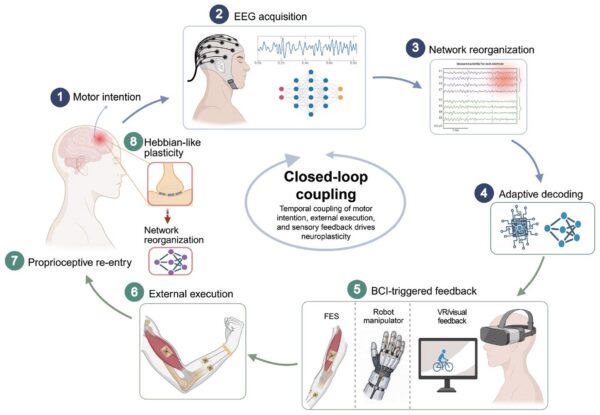
A review in Topics in Stroke Rehabilitation maps the neurophysiological basis of non-invasive EEG-based brain-computer interfaces for post-stroke hand recovery and sorts the field into three paradigms: motor imagery with physical feedback, motor imagery with virtual or multisensory feedback, and steady-state visual evoked potential (SSVEP)-driven training. These systems decode sensorimotor-cortex rhythms during imagined hand movement in real time to drive exoskeletons, functional electrical stimulation or virtual reality, closing a Hebbian feedback loop meant to strengthen or remodel damaged pathways in patients whom conventional rehabilitation, which depends on active movement, often cannot reach. Studies confirm the approaches can improve upper-limb function, the review says, but clinical adoption still faces low signal-to-noise ratios, wide individual variability and 'BCI blindness.'

Brain-Spine Interfaces Remain Supported by Limited Clinical Evidence

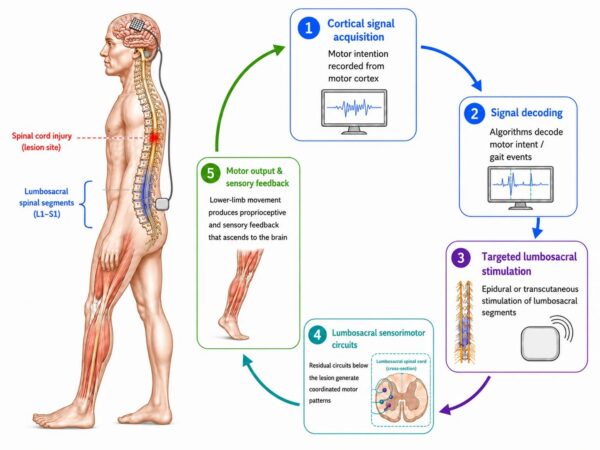
A review in *Neurosurgical Review* finds encouraging motor outcomes from early preclinical work and highly selected clinical studies of brain-spine interfaces, but concludes that the evidence remains preliminary. Safety, durability, patient selection, access, long-term functional benefit, technical complexity, ethics and specialist training all remain barriers to routine care.

Cochrane Review Finds Small, Low-Certainty Gains for BCI Stroke Rehabilitation

A Cochrane review of 43 randomized trials involving 1,628 participants found that BCI training may produce a small improvement in post-stroke upper-limb motor function compared with conventional rehabilitation, while effects on lower-limb function and activities of daily living were limited or uncertain. No clear advantage emerged over sham BCI, and certainty was low to very low because of bias risk, small samples, heterogeneity and possible publication bias.

Review Maps How Closed-Loop BCIs May Support Post-Stroke Recovery

A review in *Frontiers in Neuroscience* describes closed-loop BCIs as systems that detect motor imagery, motor attempts or sensorimotor rhythms and trigger contingent electrical stimulation, robotic assistance, virtual reality, multisensory feedback or neuromodulation. The authors argue that restoring the timing between intent, assisted movement and sensory feedback may promote activity-dependent plasticity, while stressing that outcomes vary with patient selection, signal quality, dose, feedback modality and trial design.

BCI emerges as hotspot in post-stroke motor rehab

Published in Neural Regeneration Research on August 18, 2026, the study conducted a bibliometric analysis of 3173 articles from the Web of Science Core Collection on post-stroke limb motor dysfunction and functional recovery from 2016 to 2025, by authors from Beijing Rehabilitation Hospital, Capital Medical University. The field is in a period of rapid expansion, with technology-assisted rehabilitation as the dominant trend and robot-assisted training and virtual reality as the two major technological keywords. Burst literature analysis revealed three hotspot phases, with the recent phase (2020 to present) covering neuromodulation (brain-computer interface and non-invasive brain stimulation), global disease burden and public health policy. Highly cited studies focus on comparative efficacy, robot-assisted training, brain-computer interfaces, vagus nerve stimulation and prediction of rehabilitation outcomes.

Sixth-Finger BCI Neurofeedback Aids Stroke

Researchers report that a BCI-controlled sixth-finger neurofeedback intervention improved motor function in stroke: after 8 sessions (2 weeks) of motor-imagery BCI training, 14 patients gained an average of 7.9 points on FMA-UE and 7.1 on the Barthel Index, with 9 of 14 reaching the 6.6-point minimally clinically important difference. EEG tracking across the full intervention showed a two-phase ERD trend that strengthened in week one and narrowed to the contralateral sensorimotor area in week two, and resting-state functional connectivity rose afterward, correlating with motor gains. The authors say the work offers longitudinal evidence on neuroplasticity in stroke rehabilitation.

Wearable BCI Hits 79.38% Online Decoding Accuracy

The study was published in ITM Web of Conferences on August 14, 2026, addressing the demand for portable, real-time brain-computer interface systems in stroke rehabilitation by completing the physical integration and online experimental validation of a wearable system. The system uses a specialized EEG headset with miniaturized acquisition circuits secured via pogo pins, featuring 10 core recording channels positioned over the sensorimotor cortex. During the evaluation phase, the research team recruited 6 healthy subjects and 2 stroke-affected hemiplegic patients for closed-loop experiments based on motor imagery and motor attempts. Common Spatial Pattern was used for spatial feature extraction and Linear Discriminant Analysis for intention classification, with personalized sub-band optimization applied to further improve recognition. The authors report an average offline recognition rate of 84.91% and a classification accuracy of 79.38% in the more challenging online real-time testing. Analysis of spatiotemporal spectra and R² value distributions validated activation patterns in the sensorimotor areas during motor intention triggering, which the authors present as support for advancing the technology from laboratory settings toward community rehabilitation.
July 2026

Preprint: Triad Interviews With Stroke Survivors Expose Three XAI Elicitation Biases

Researchers report a preprint, posted to arXiv on July 28, 2026 and not yet peer reviewed, on the methodological problem of eliciting explainable AI (XAI) requirements from stroke survivors. Existing protocols run dyadic interviews and overlook facilitation dynamics; this formative study moved to a survivor-caregiver triad, with three stroke survivors (two with moderate-to-severe aphasia) and three caregivers, and facilitators used four scaffolding techniques: analogical bridging, projective personas, binary forcing and extended response time. A reflexive analysis identified three systematic facilitation biases — normative bias, hypothesis confirmation bias and the presence effect — which the authors present as protocol risk guidelines for practitioners.
June 2026

LEGEND Decodes Tri-Modal Signals for SCI

A study published in Computers in biology and medicine introduces LEGEND, a neural-decoding architecture that jointly models cortical EEG, spinal ESG, and peripheral-muscle EMG for a neural bypass in spinal cord injury rehabilitation. The model encodes the three signal modalities in Lorentz hyperbolic space, connects 51 channel nodes through a signed tri-layer phase-locking-value graph, and refines the representation with graph attention. Under strict leave-one-subject-out evaluation on the Steele dataset, LEGEND achieved 56.51%±12.27% accuracy, 23.4 percentage points above EEGNet. The researchers argue that hyperbolic representations can capture complex relationships across the motor hierarchy, providing a computational foundation for rehabilitation decoding that links brain, spinal, and muscle activity.
April 2026

Feasibility of a Hybrid SSVEP-Motor Imagery BCI with Robotic Feedback for Stroke Upper Limb Rehabilitation

Researchers assessed the feasibility of a hybrid brain-computer interface that integrates motor imagery (MI) and steady-state visual evoked potentials (SSVEP) with robotic glove feedback for upper limb motor rehabilitation in 32 stroke patients, split into a conventional-treatment control group and an experimental group receiving 10- or 20-day BCI interventions. The experimental group showed considerable improvement in Fugl-Meyer scores over the control group, and the BCI achieved EEG classification accuracy up to 98.08% with stable operation; after longer training, accuracy rose, the laterality coefficient moved toward normal, and task-related brain connectivity strengthened. The authors say the hybrid system may overcome the limits of conventional therapy and single-modality BCIs.
© 2026 BCIwiki.com Digest Topics Tips Subscribe Revisions About