

BCIwiki (bciwiki.com) — Electrocorticography (ECoG) grids used for hand-movement decoding can be reduced by 75-94% in surface area without a meaningful decline in classification performance, provided electrodes are placed over informative areas, researchers at University Medical Center Utrecht Brain Center and collaborators reported in Neuroinformatics on August 7, 2026.
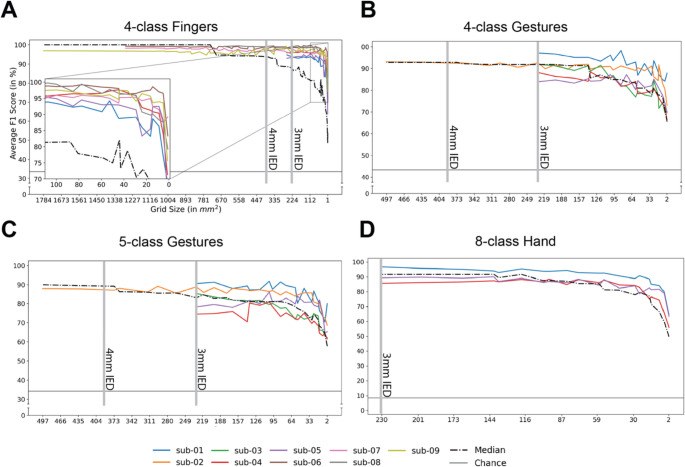
The team exhaustively evaluated all possible rectangular subgrids within implanted 32-, 64-, and 128-channel ECoG grids in nine individuals with epilepsy, covering 4, 5, and 8 hand-movement classes. Classification performance remained stable for progressively smaller subgrids until a critical threshold of approximately 60 mm², below which performance declined substantially. Subgrids above the threshold achieved equally high F1 scores (range 81.64-99.71%) as full grids with an area greater than 230 mm² (range 82.85-96.75%). The authors conclude that ECoG-based BCIs can accurately decode up to seven different hand movements from well-located grids with a small number of electrodes, paving the way for smaller and safer BCI implants.