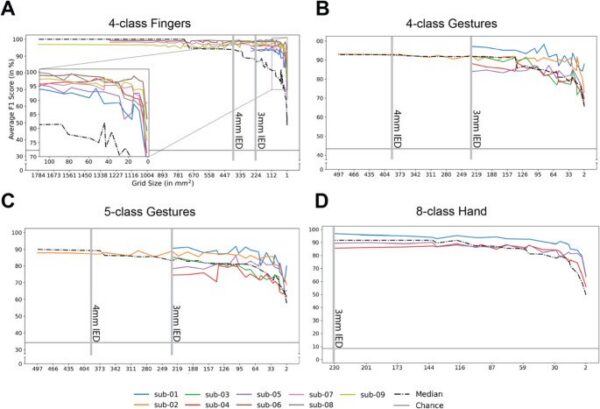
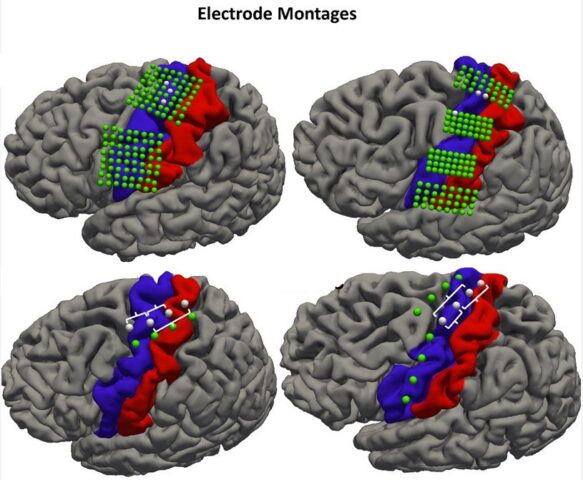
Researchers at University Medical Center Utrecht's Brain Center in the Netherlands and collaborators exhaustively tested every rectangular subgrid inside 32-, 64- and 128-channel ECoG arrays recorded from nine people with epilepsy. Grid area could be cut by 75% to 94% without meaningful loss of hand-movement classification accuracy, as long as the remaining electrodes sat over informative cortex; below a critical area of about 60 mm², performance fell sharply. The study appeared in the journal Neuroinformatics on August 7, 2026.
A preprint from the Utrecht-BCI Lab at the UMC Utrecht Brain Center in the Netherlands, the invasive-BCI group led by Nick Ramsey, asks why some people with ALS control an implanted brain-computer interface (BCI) better than others. It found that preservation of grey matter in the motor cortex is associated with higher-quality brain signals, suggesting an MRI-based measure could help identify who is a suitable candidate for implantation. The preprint was posted to medRxiv on June 23, 2026 (DOI 10.64898/2026.06.23.26355654).