
/ EN
2026-05-07 00:00 China Papers Foundations & Methods Translated from EN

Integrated Ultrasonic Platform for Bioelectronic Control Through Biological Barriers Based on Metasurface

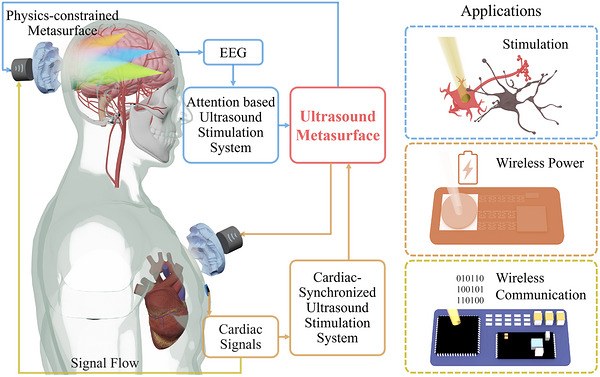
Summary The study presents an integrated ultrasonic platform that delivers high-resolution, multi-point ultrasound energy through highly aberrating barriers such as the skull and ribs, with about ±6.5% intensity uniformity across foci, using a physics-constrained metasurface design framework, and demonstrates two adaptive stimulation paradigms — attention-gated and cardiac-synchronized stimulation. A dual-channel acoustic link sustains continuous transcranial wireless power and data streaming through a single ultrasonic metasurface, remaining robust even under a 400-fold power difference. The authors frame the platform as groundwork for next-generation ultrasound-based brain-computer interfaces (uBMI) and closed-loop bioelectronic therapies.
Why it matters Solving deep-tissue focusing and wireless power/data delivery in a single metasurface clears two obstacles — aberration and power — that have kept ultrasound-based BCIs short of closed-loop use.

超表面超声平台穿透颅骨肋骨,供电传数据刺激一体完成
Image: Advanced science (Weinheim, Baden-Wurttemberg, Germany), CC BY 4.0

This study, published in Advanced Science (Weinheim, Baden-Württemberg, Germany), presents an integrated ultrasonic platform using a physics-constrained metasurface design framework for high-resolution multifocal ultrasound energy delivery through highly aberrating biological barriers such as the skull and ribs, achieving about 6.5% intensity uniformity across multiple foci.

The platform demonstrates attention-based and cardiac-synchronized adaptive stimulation paradigms and introduces a dual-channel acoustic link enabling continuous wireless power and data streaming through the skull, robust even with a 400-fold power differential, contributing to next-generation ultrasonic brain-machine interfaces (uBMIs) and closed-loop bioelectronic therapies. PMID 42095521, DOI 10.1002/advs.75563

Compiled by BCIwiki from public sources

Sources · 1

Fudan University timeline

2026-09 One EEG Diffusion Model Decodes Motor Imagery, Hemiplegic Side and Recovery 2026-07 Ghost-LENet Tops 80% on Motor Imagery EEG Using a Few Thousand Parameters 2026-05 sEEG Study Finds Motor Imagery Activity Shifts by Task Stage and Frequency Band All entries →
Read original ↗
Suggest a correction Revisions · none / EN
© 2026 BCIwiki.com Digest Topics Tips Subscribe Revisions About