
/ EN

Ultrasound Neuromodulation

4 entries

Focused ultrasound neuromodulation penetrates the skull non-invasively to activate or inhibit specific brain regions, opening a new path for precise non-invasive intervention. This topic covers stimulation parameter optimization, implantable ultrasound devices, and preclinical validation.

July 2026

Preprint: Functional Ultrasound Imaging Through a Human Cranial Window Maps Motor Effector Encoding

A preprint shows that functional ultrasound imaging (fUSI), read through an acoustically transparent cranial-window implant, reliably resolved multi-body-part and single-digit movement encoding in one participant's primary sensorimotor cortex, with maps consistent with classical somatotopy and single-trial decoding supported across sessions; analysis of key decoding voxels suggested different Brodmann areas encode single-digit movement differently. The researchers argue fUSI can map motor representations at submillimeter resolution, filling a key gap in humans between invasive electrophysiology and non-invasive blood-flow imaging; the work has not been peer reviewed.
Chinese Rehabilitation Association Sets July Workshop on Closed-Loop EEG-TMS

The Chinese Association of Rehabilitation Medicine will hold a workshop on EEG-driven closed-loop TMS in Guangzhou, southern China, on July 17, 2026, staged under its Naoke China (脑客中国) series and run by its committee on brain function monitoring and modulation in rehabilitation. The technique reads EEG in real time and triggers a TMS pulse when a target brain state appears, a 'brain-state-dependent stimulation' approach that pairs the spatial precision of TMS with the temporal resolution of EEG, and the program is built around moving BCI work out of the laboratory into neurorehabilitation and the precision diagnosis of brain disorders. Shenzhen Yingchi Technology, a subsidiary of Hanix United, is among the supporting organizations, and registration closes on July 17.
May 2026

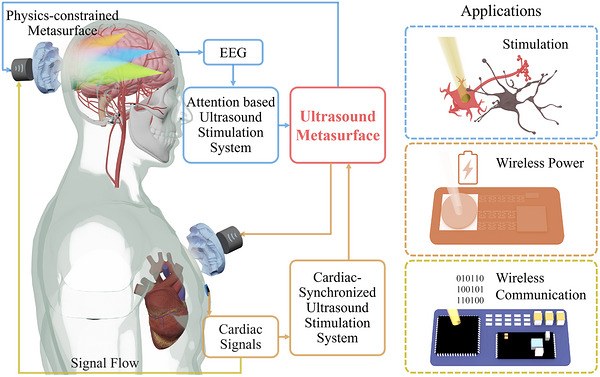
Integrated Ultrasonic Platform for Bioelectronic Control Through Biological Barriers Based on Metasurface

The study presents an integrated ultrasonic platform that delivers high-resolution, multi-point ultrasound energy through highly aberrating barriers such as the skull and ribs, with about ±6.5% intensity uniformity across foci, using a physics-constrained metasurface design framework, and demonstrates two adaptive stimulation paradigms — attention-gated and cardiac-synchronized stimulation. A dual-channel acoustic link sustains continuous transcranial wireless power and data streaming through a single ultrasonic metasurface, remaining robust even under a 400-fold power difference. The authors frame the platform as groundwork for next-generation ultrasound-based brain-computer interfaces (uBMI) and closed-loop bioelectronic therapies.
April 2026

Bengbu Medical University Hospital Registers Multicenter Trial of MRI-Guided Temporal Interference Stimulation for Refractory Migraine

A randomized, sham-controlled trial will pair a non-invasive brain-computer interface with MRI-guided multichannel temporal interference stimulation in patients whose migraines resist medication. It plans to enroll 78 people aged 18 to 65, split evenly between real and sham stimulation, with headache frequency as the primary endpoint. The registration lists only design and bibliographic fields, so device details and actual enrollment remain unknown and efficacy has yet to be read out.
© 2026 BCIwiki.com Digest Topics Tips Subscribe Revisions About