

BCIwiki (bciwiki.com) — Memory prosthetics, closed-loop brain-computer interfaces that decode hippocampal activity and deliver adaptive stimulation, are transitioning from animal proof-of-concept to first-in-human trials. The review was published in iScience on August 30, 2026 by researchers at Hangzhou Dianzi University, the Zhejiang Institute of Artificial Intelligence, and the Third Affiliated Hospital of Wenzhou Medical University.
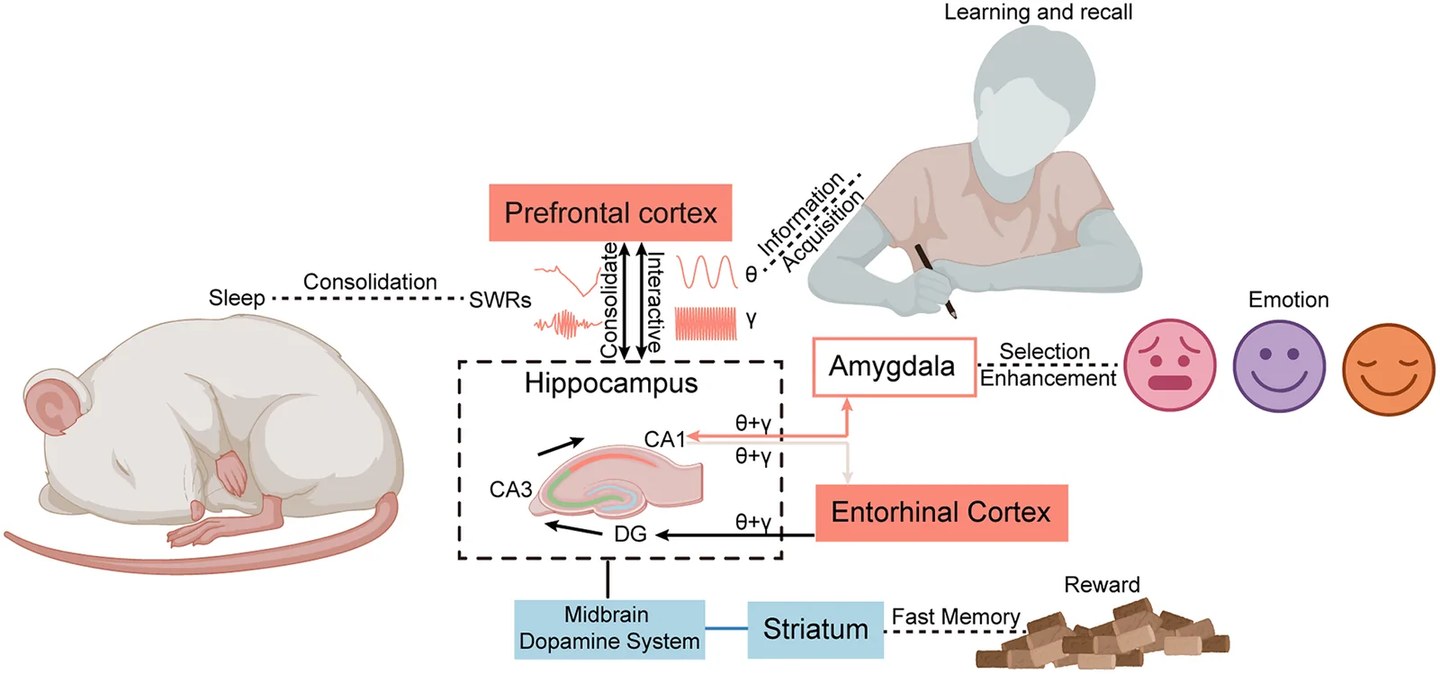
Realizing chronically implantable systems, the authors argue, requires co-design of three materials-mediated subsystems whose structure-property-processing relationships have been treated in isolation: biocompatible electrode interfaces, on-chip neuromorphic computation, and closed-loop control hardware. The review maps neuroscientific findings including theta-phase tracking, theta-gamma coupling and sharp-wave ripple detection onto engineering specifications for latency, sampling and charge injection, and onto materials requirements for impedance, switching endurance and chronic stability.
The authors develop a structure-property-processing taxonomy of two dominant materials families: chronic electrode coatings (Pt-Ir, IrOx, PEDOT:PSS, carbon-based materials and MXene) and oxide memristive synapses (Al2O3/TiO2-x, SrTiO3, HfO2). They distinguish established findings from emerging directions and flag where small-cohort clinical results have been over-generalized.