

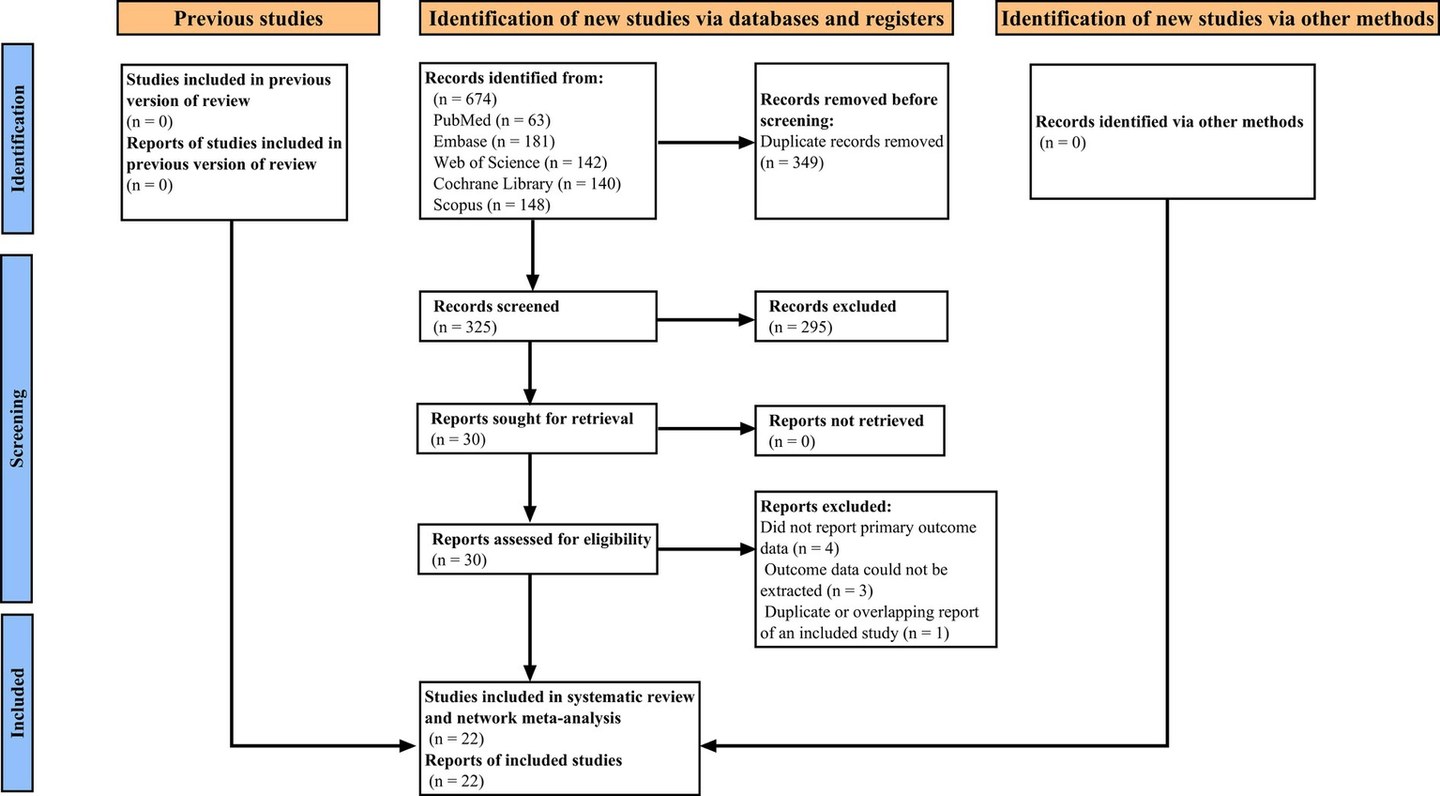
BCIwiki (bciwiki.com) — According to Frontiers in Neuroscience, the journal published a systematic review and network meta-analysis on October 16, 2026, comparing brain-computer interface (BCI) training with different feedback modalities for post-stroke upper-limb motor recovery. The review included 22 randomized controlled trials involving 956 patients across subacute, chronic, and mixed post-stroke stages. Some approaches improved scores relative to usual rehabilitation, but certainty for the main comparisons was low or very low.
The researchers searched PubMed, Embase, Web of Science, Cochrane Library, and Scopus from inception through April 2026. BCI interventions were classified by feedback modality and feedback contingency as multimodal feedback (BCI-MM), robotic or exoskeleton-assisted feedback (BCI-Robot), functional electrical stimulation feedback (BCI-FES), and visual feedback (BCI-visual). Comparator interventions were classified separately, with usual rehabilitation (UR) as the reference. The primary outcome was the Fugl-Meyer Assessment for Upper Extremity (FMA-UE), a measure of upper-limb motor function.
In the random-effects network meta-analysis, BCI-Robot showed greater FMA-UE improvement than UR, with a weighted mean difference (WMD) of 6.28 and a 95% confidence interval of 2.70–9.86. BCI-MM also showed a statistically significant benefit, with a WMD of 4.03 and a 95% confidence interval of 1.00–7.06. Non-BCI robotic training improved scores as well, with a WMD of 4.26 and a 95% confidence interval of 0.42–8.10. The authors therefore caution that the BCI-Robot effect cannot be attributed to BCI alone.
BCI-FES did not differ significantly from UR. BCI-visual had the highest surface under the cumulative ranking curve (SUCRA) value, at 77.6%, but its comparison with UR was non-significant and had very low-certainty evidence. SUCRA is a treatment-ranking metric, not the proportion of patients who improved. No BCI feedback modality was statistically superior to another.
For secondary outcomes, BCI-Robot showed greater improvement than UR on the Action Research Arm Test (ARAT), whereas Wolf Motor Function Test (WMFT) findings were non-significant. The FMA-UE network contained 11 connected nodes, with no global or local inconsistency detected. Risk of bias was assessed using the Cochrane Risk of Bias 2 tool, and evidence certainty was assessed using CINeMA. The authors call for high-quality direct-comparison trials.