

Shanghai “Neuro Space” Marks First Anniversary: 52 Firms On Board, World’s First Invasive BCI Device Approved. Launched in June 2025, the Shanghai Brain-Computer Interface Future Industry Cluster, branded “Neuro Space” (脑智天地), is China’s first dedicated BCI industrial zone. Its 25,000 m² pilot area has now entered full routine operation.
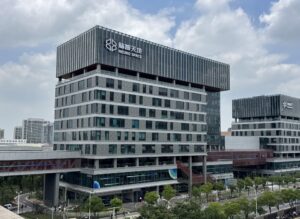
Exterior view of the Shanghai BCI Future Industry Cluster
Cluster Scale
As of late July 2026, the cluster hosts 52 registered BCI companies and 22 startup incubators, spanning flexible electrodes, BCI chips, ultrasound-based interfaces, and vision restoration. Supporting facilities include the Sinan Super Incubator, the iBrain EEG data platform, Fudan University’s BCI Sci-Tech Transfer Center, and Huashan Hospital’s Clinical Translation Center.
Commercialization Progress
The world’s first approved invasive BCI medical device, developed in Shanghai, received regulatory clearance in 2026, with its first clinical prescription issued in July. Five additional Class III medical devices are currently in clinical trials or under regulatory review.
On the capital front, Shanghai accounts for nearly 60% of China’s BCI financing events, totaling approximately RMB 2.117 billion. In standards and testing, the Shanghai Medical Device Inspection Institute handles over 90% of the nation’s type testing for implantable BCIs and has led the drafting of China’s first industry standard for BCI medical devices.
New Products and Technology Highlights
At an open-day showcase on August 6, several resident companies presented their latest achievements:
Non-invasive brain-controlled consumer terminal. An EEG-based interactive demonstration system in which users wear a ring-shaped brainwave receiver; once attention-level readings exceed a set threshold, the system activates devices such as a popcorn maker or an electric fan. The company reports that it has begun filing patents in low-noise amplification, motion artifact removal, and medical-scenario adaptation.
Integrated transcranial magnetic stimulation navigation system. Designed for depression treatment, this first-of-its-kind system integrates functional MRI, a structured-light 3D camera, electromagnetic field simulation, collaborative robotic arm control, and TMS technology, enabling an end-to-end workflow from brain-network target computation to treatment delivery.
LingXi Cloud brain-disorder data platform. The platform hosts approximately 2.1 million cases of petabyte-scale clinical and research data, covering EEG, imaging, clinical scales, medication records, follow-up data, and neuromodulation modalities. It is positioned as the foundational data infrastructure for precision diagnosis and treatment of brain disorders and real-world evidence research.