

BCIwiki (bciwiki.com) — According to device manufacturer MBrainTrain, researchers from ETH Zurich and partner clinics studied walking in 10 people with Parkinson's disease and 10 healthy controls. All patients had an implanted Medtronic Percept PC neurostimulator and were tested on medication and with deep brain stimulation (DBS) switched on at their usual clinical settings. The study examined differences remaining under combined treatment, rather than comparing treatment-on and treatment-off conditions. The original study was posted as a preprint on Research Square on September 17, 2026, and has not been peer reviewed (DOI: 10.21203/rs.3.rs-10919819/v1).
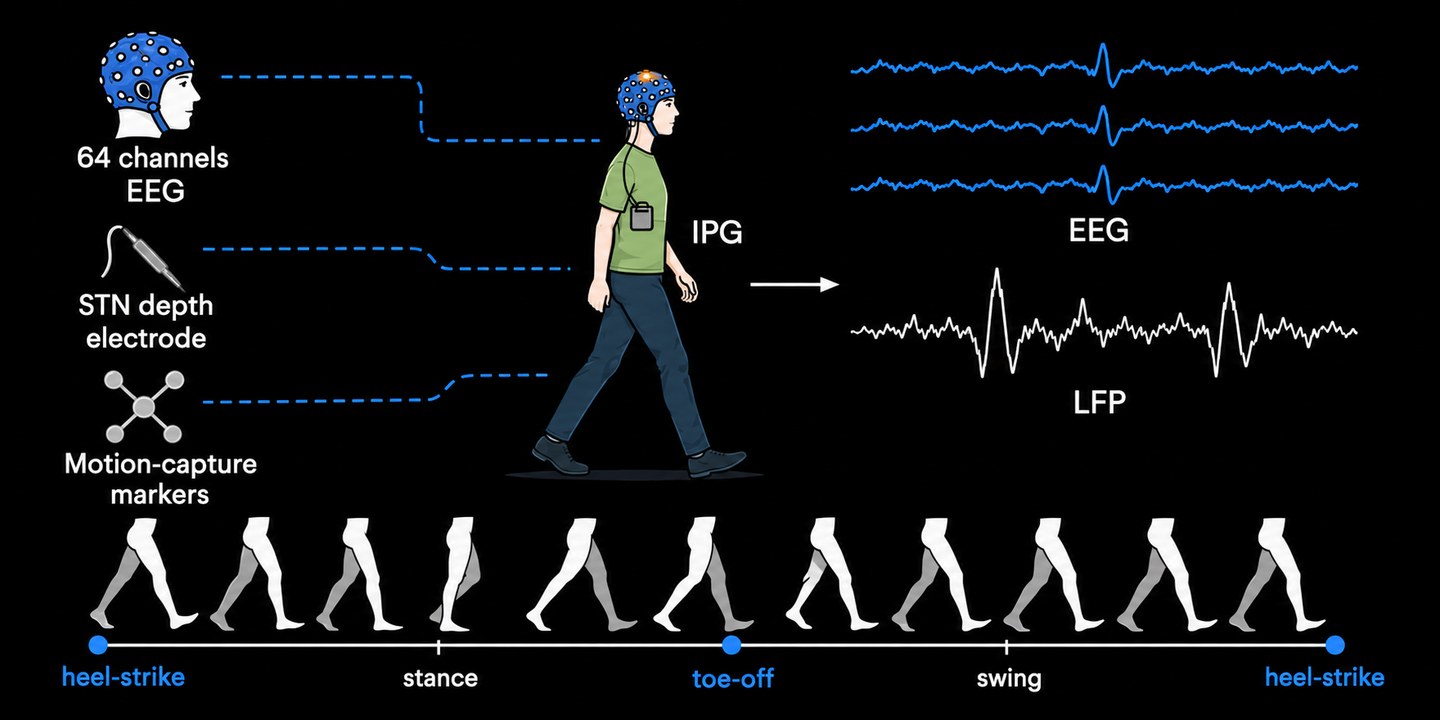
MBrainTrain reports that its Smarting PRO X 64-channel mobile electroencephalography (EEG) system recorded cortical activity while patients' implanted devices simultaneously recorded subthalamic nucleus (STN) local field potentials from the hemisphere opposite the more affected side of the body. A 16-camera Vicon system tracked whole-body movement using 62 markers. Participants first sat with their eyes open for 2 minutes, then walked a figure-eight path around two cones. Only straight segments were analyzed because turns added variability and could not be tracked reliably.
The researchers examined both averaged spectra and activity aligned to individual steps. Of 24 between-group comparisons of averaged spectra, only two survived correction: patients had higher prefrontal alpha power during walking and a lower motor high-beta peak frequency at rest. Both groups showed reduced alpha and beta power during walking, but the reduction mainly involved high-beta in patients and low-beta in controls. The authors interpret higher prefrontal alpha power as potentially indicating lower engagement during steady walking; this is an interpretation, not a direct measurement of functional engagement.
Step-by-step analysis divided each gait cycle into four phases: initial double support, left leg swing, final double support, and right leg swing. Although none of the analyzed STN spectral features differed between rest and walking, STN low-beta, high-beta, and gamma activity varied across the gait cycle. Cortical modulation patterns differed between groups in every frequency band, with the strongest differences in high-beta and gamma. Gamma differences occurred in all four phases and high-beta differences in three of four. When normalization used the average gait cycle instead of rest, cohort-by-gait-phase effects remained, but prefrontal-versus-motor differences did not.
MBrainTrain's account discusses these timing-related signals as candidate directions for gait-specific biomarkers, noting that a closed-loop system using them would need to sense and respond within a single step. It also emphasizes that the researchers do not yet identify the signals as biomarkers of impaired Parkinson's gait. Their relationships with clinically measurable outcomes, including walking speed, stride length, and step-to-step variability, still need testing. The findings do not validate a new treatment based on these signals.