

BCIwiki (bciwiki.com) — A review published in Frontiers in Neuroscience on October 13, 2026, examines functional ultrasound brain-computer interfaces based on neurovascular coupling. Author Chengshan Zhang discusses technical principles, clinical applications, future directions, and challenges. The review analyzes their clinical value in stroke assessment, epilepsy monitoring, and early identification of neurodegenerative diseases; it does not report a new clinical efficacy trial.
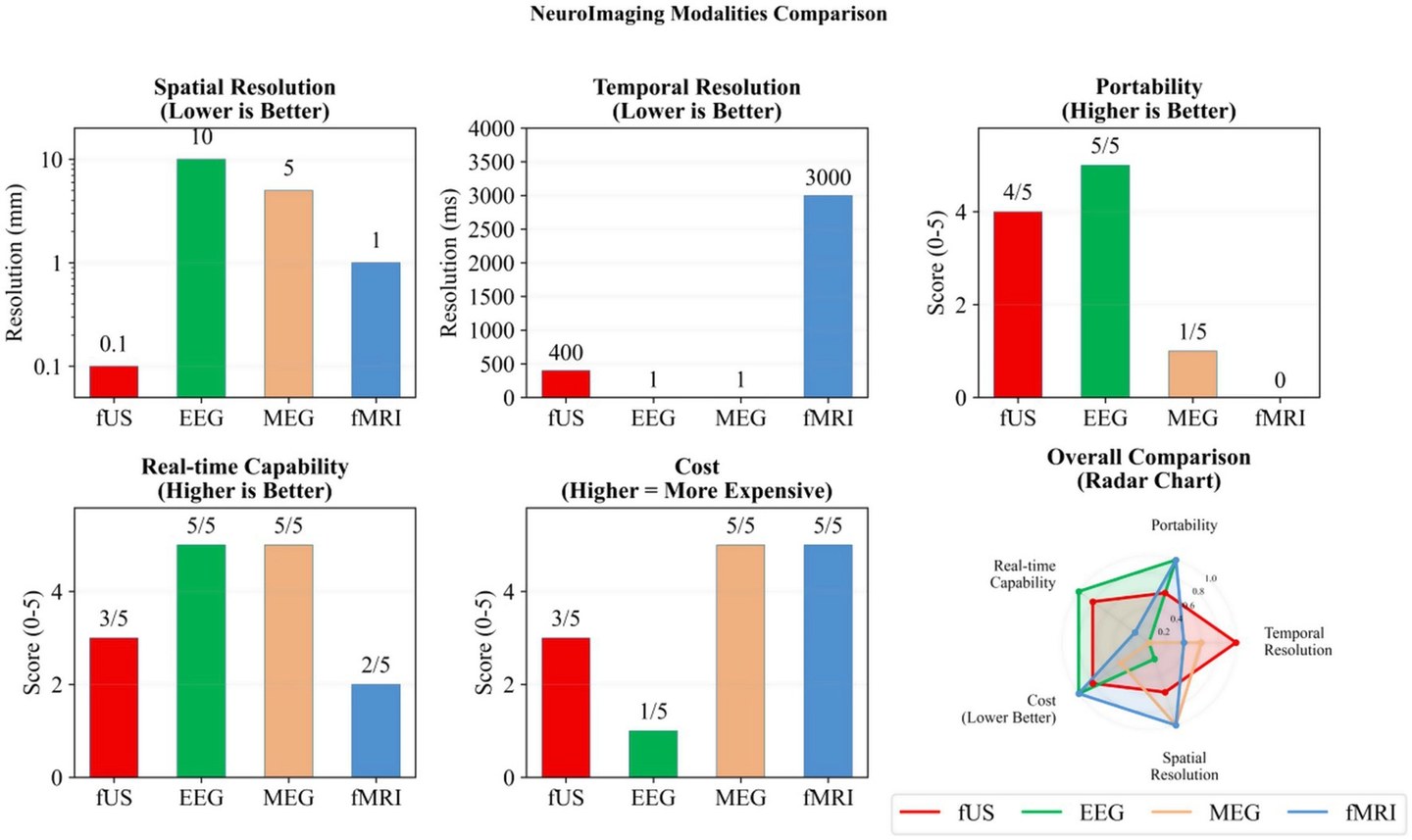
Brain-computer interfaces (BCIs) bypass peripheral nerves and muscles to establish direct information pathways between the brain and external devices. Functional ultrasound (fUS) uses neurovascular coupling, the relationship between neural activity and blood flow, to detect cerebral blood volume changes. Its spatial resolution is approximately 100 μm, and its imaging frame interval is 200–500 ms. However, the hemodynamic response limits effective temporal resolution to 1–2 s. The imaging frame interval should therefore not be treated as the temporal precision with which the system tracks neural activity.
According to the author, transcranial focused ultrasound neuromodulation, sonogenetics, and intravascular ultrasound are driving the transition from signal acquisition alone toward bidirectional closed-loop systems combining acquisition and modulation. These systems remain at the proof-of-concept stage. The review identifies key bottlenecks: a 1–2 s hemodynamic response delay relative to neural electrical activity, unclear biosafety of chronic ultrasound exposure, and insufficient decoding reliability under pathological conditions. The author recommends multicenter clinical trials and more robust decoding algorithms.