
中 / EN

Deep Brain Stimulation

4 entries
October 2026

Treated Parkinson's Patients Show Differences in Brain Activity Timing During Walking

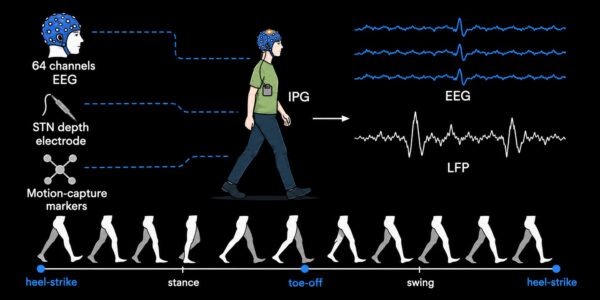
A study of 10 people with Parkinson's disease and 10 healthy controls found differences in how brain activity varied across walking phases while patients were on medication and receiving deep brain stimulation at their usual clinical settings. Researchers simultaneously recorded EEG, subthalamic nucleus signals, and whole-body movement, analyzing only straight walking segments. Group differences were limited in averaged spectra, but step-by-step analysis revealed prominent high-beta and gamma timing differences and gait-cycle modulation in the subthalamic nucleus. These signals are not yet established biomarkers of impaired gait; their relationships with walking speed, stride length, and step-to-step variability still need testing. This study is a preprint and has not been peer reviewed.
September 2026

Parkinson's Patients Learn to Control Deep Brain Stimulation Through a BCI Game

Researchers at the University of California, San Francisco (UCSF), a public research university known for its neuroscience work, had two Parkinson's disease patients train at home with a brain-computer interface (BCI) airplane-simulator game, learning to down-regulate cortical beta activity and thereby control the intensity of their own deep brain stimulation (DBS). The work, posted as a preprint on medRxiv on August 17, 2026, points to BCI applications in neuromodulation and to more personalized treatment for Parkinson's and other conditions; its conclusions have not yet been peer reviewed.
August 2026

Chinese Hospitals Test Closed-Loop BCI Neuromodulation for Resistant Depression

A multicenter trial has begun in China to test closed-loop brain-computer interface neuromodulation for treatment-resistant depression, run jointly by the Shanghai Mental Health Center and two Beijing hospitals, Anding Hospital and Xuanwu Hospital. The study will compare closed-loop deep brain stimulation and transcutaneous auricular vagus nerve stimulation against sham stimulation, enrolling patients who have responded inadequately to standard antidepressant treatment. It uses a patient-preference design with randomized assignment within each intervention group.
Review Identifies Three Shared Bottlenecks Across DBS and BCIs

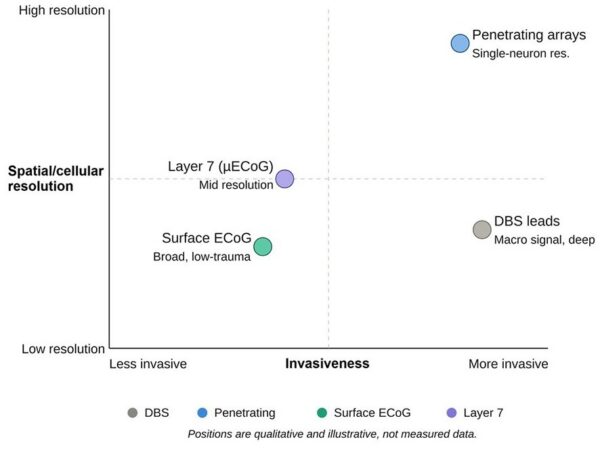
A mini-review places deep-brain stimulation, brain-computer interfaces and speech neuroprostheses within a shared closed-loop architecture of sensing, decoding, stimulation or output, power, telemetry and chronic validation. It identifies long-term stability, neural coding and equitable access as recurring constraints across all three fields and argues that governance must advance alongside engineering.
© 2026 BCIwiki.com Digest Topics Tips Subscribe Revisions About