

September 2026
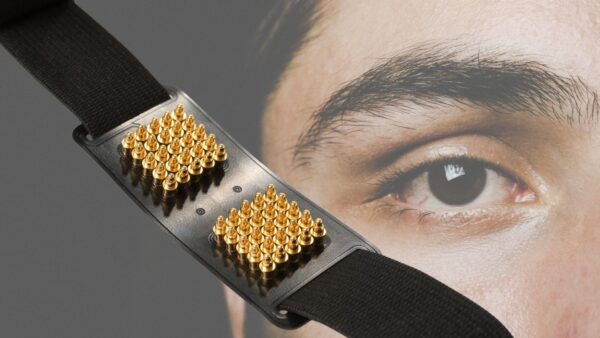
Low-Cost 8-Channel EEG and VR Headset Reach Up to 90% Accuracy in Single-Subject Test
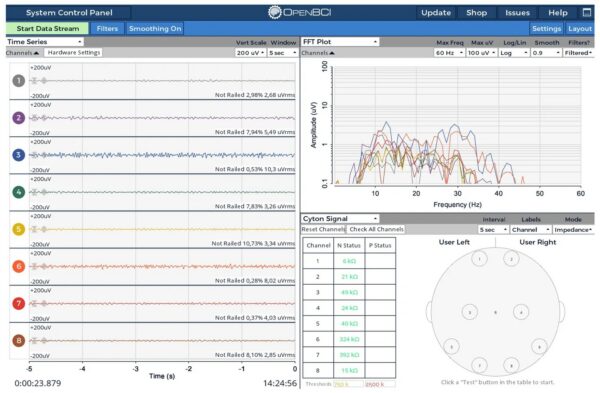
Adding fNIRS to EEG Fails to Improve Brain-Controlled Stimulation in 16-Person Trial
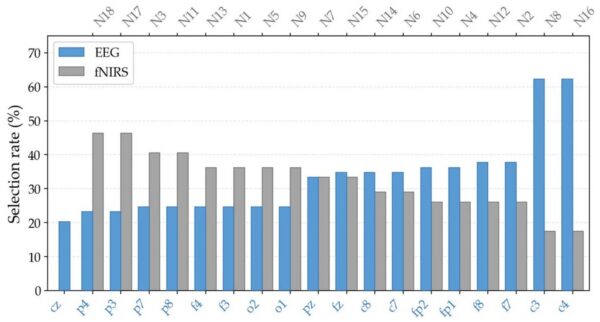
fMRI-Guided Training Lifts EEG Individual-Finger Decoding Accuracy to 74.53%
Because the fingers' representations sit close together in the motor cortex, telling individual finger movements apart from scalp EEG has long been difficult. Researchers first learned a set of spectral projections from simultaneously recorded EEG and functional MRI (fMRI), then used the class geometry derived from fMRI to correct EEG predictions. In tests on 12 healthy participants, group average accuracy for two-class movement execution rose from 66.93% to 74.53%, and for three-class execution from 44.83% to 56.58%; for two-class motor imagery it rose from 80.78% to 85.63%. At inference the system uses EEG alone, with no paired fMRI data required.
Random Forest Tells Real From Imagined Movements, Even on Consumer-Grade EEG
Compact Hybrid Deep Learning Model Reaches 83.89% on Four-Class Motor Imagery EEG
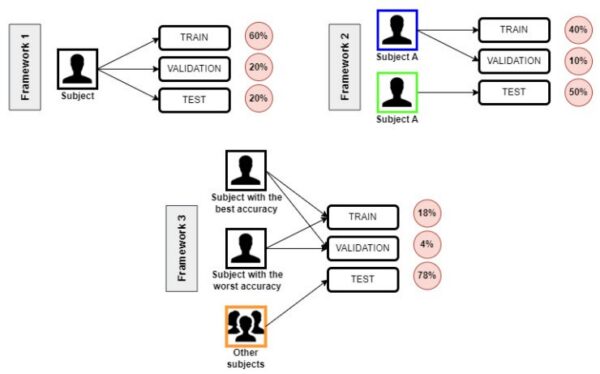
Researchers have proposed a compact hybrid deep learning model for classifying four-class motor imagery EEG signals. Combining spatial convolutional filtering, bidirectional temporal modeling and an attention mechanism, the end-to-end model reached a mean accuracy of 83.89% on the public BCI Competition IV Dataset 2a, outperforming conventional baselines. The authors say bidirectional temporal modeling and attention weighting make motor imagery classification more robust, which could help BCIs assist patients with motor disabilities, and that the model offers an efficient option for decoding in resource-constrained settings.
U2Multi-UDA Merges Alignment, Fusion and Fine-Tuning to Lift Motor Imagery Accuracy
Researchers have proposed U2Multi-UDA, a unified multilevel multisource unsupervised domain adaptation framework for motor imagery brain-computer interfaces that raised mean accuracy by 2.69, 1.89 and 3.83 percentage points over the best-performing baselines on two public datasets and one self-constructed dataset, with consistent gains in Kappa. It tackles two persistent obstacles, wide variation between subjects and a shortage of labeled target-domain data, which existing methods address at only one level of adaptation, whether domain alignment, feature interaction or model fine-tuning. The single pipeline aligns source and target distributions with optimal transport while mutual information estimates how relevant each source domain is to the target, fuses spatio-temporal EEG features through multisource cross-attention guided by those weights and reinforced with pseudolabels, and closes with segmented weight-decomposed low-rank adaptation for parameter-efficient fine-tuning that curbs overfitting.
August 2026
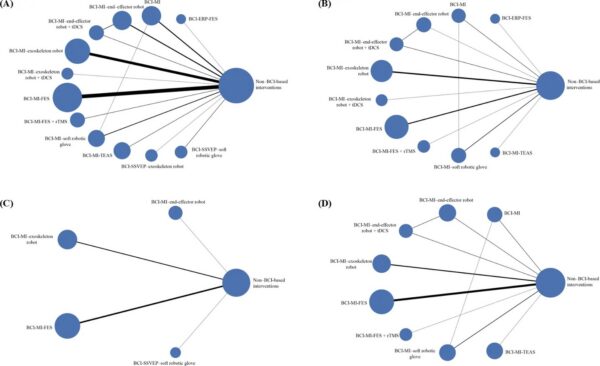
72-Trial Meta-Analysis Ranks Noninvasive BCI Options for Post-Stroke Arm Recovery
Motor Cortex Excitability Rises Then Falls in the Hour after Finger-Tapping Fatigue
Researchers at Sapienza University of Rome had 20 healthy young adults complete 10 consecutive blocks of finger tapping, then used transcranial magnetic stimulation (TMS) to track motor cortex excitability over the following 60 minutes. Excitability rose after the fatiguing task and drifted back to baseline, and participants whose tapping slowed most showed the largest increases. The findings were published in Clinical Neurophysiology on August 25, 2026, and the authors say they offer a framework for studying altered compensatory responses in neurological disorders.
Gaze-Plus-Motor-Imagery BCI Reaches 100% Accuracy With 16-Channel EEG
Motor imagery BCIs have long faced two problems: wide variation between users and only a small number of distinguishable commands. In this study, users first select a target by looking at it, then confirm the choice with imagined movement, merging the two steps into one. In tests with 15 healthy participants using 16-channel EEG, the hybrid paradigm outperformed motor imagery alone in every channel configuration, reaching up to 100% accuracy. The researchers also found that fixating on the target made EEG responses more stable, which supports using fewer electrodes and lowering the hardware barrier.
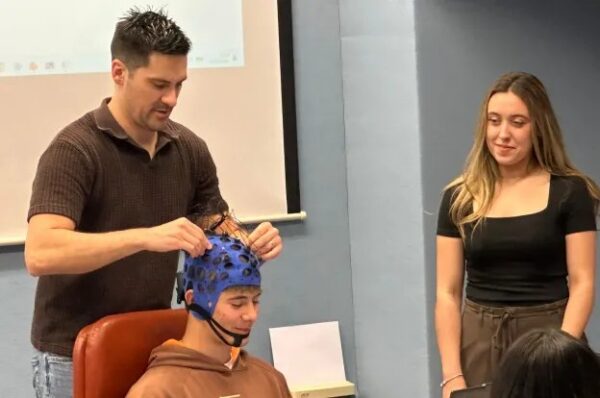
P300 BCI Reads Silently Chosen Digits in a Granada Classroom
Medial wall ECoG signals aid finger motor decoding
Published in Journal of Neural Engineering on August 7, 2026, the study analyzed human electrocorticography data from four subjects to investigate medial wall contributions to finger movement decoding. Significantly above-chance finger movement detection was observed across multiple medial wall subregions, with local motor potentials and oscillatory power in the 8-12 Hz and 12-34 Hz bands contributing most strongly. Feature dynamics shared key properties with primary motor cortex, including pre-movement desynchronization, while also exhibiting region-specific positive or negative LMP modulations. Medial wall channels in two subjects enabled significant differentiation between individual fingers, and one subject showed decoding of both contralateral and ipsilateral finger movements, though this is a single case and preliminary.
2-Block EEG Gait Decoder Reaches 70.5 ms Latency
This preprint reports a 2-block lightweight architecture for real-time EEG gait decoding that the authors say enables closed-loop lower-limb exoskeleton control. In closed-loop deployment, the study reports a 55.3% gait initiation success rate with Rex assistance and 52.7% volitionally, with a mean end-to-end processing time of 70.5 ms (±41.5). The authors add that the manuscript was accepted for publication at the 2026 IEEE International Workshop on Machine Learning for Signal Processing (MLSP 2026).
July 2026
Preprint: Neural SS-DMP Decoder Holds Accuracy Longer as Recordings Drift
Brown University researchers have posted a preprint proposing Neural SS-DMP, a movement decoder that does not output hand coordinates directly: it first infers a compact set of parameters describing the motion the user intends, then hands them to a generator governed by physical dynamics that draws the full trajectory, so decoded output stays within motion a body can actually produce. The generator is tuned per person, blending general movement dynamics with the individual's own patterns estimated from training data, and the authors say that across two kinds of neural recording the model came out ahead of strong existing methods on both accuracy and trajectory smoothness while holding performance longer on recordings made after training ended. The study is a preprint, has not been peer reviewed, and its results come entirely from offline data rather than live control.
ATCNet-CIAM Hits 87.96% on BCI IV-2b in Multi-Session Motor Imagery Decoding
ATCNet-CIAM, a decoder pairing temporal convolution and channel attention with a CIAM module, reached 86.32% accuracy on BCI IV-2a and 87.96% on BCI IV-2b under the standard protocol, its authors report, along with 89.46% and 83.64% on the within-session two-class and three-class WBCIC-MI tasks. Motor imagery EEG is the workhorse signal for non-invasive brain-computer interfaces, but decoding it robustly across sessions and subjects remains the central obstacle. The manuscript was posted to arXiv on July 26, 2026 and has not been peer reviewed; it has been accepted for the International Conference on Intelligence Systems and Robotics for Sustainable Development (ISRSD) 2026.
Sigmoidal Decoding of Locomotion Speed in Mouse M1
The study shows mouse primary motor cortex encodes locomotion speed through a sigmoidal state-transition mechanism carried by two functionally distinct spiking populations, a framework that also extends to local field potential (LFP) band power. Using chronic 32-channel laminar arrays in 8 mice, the team recorded 5,889 single units across 384 channels and clustered them into speed-positively related (70.8%) and speed-inversely related (29.2%) groups sharing a speed threshold of about 2.3 m/min. The minority speed-inversely related population decoded speed more accurately via inverse-sigmoid transformation, generalizing across animals. The authors say the findings point toward stable, calibration-light brain-machine interface design.
Carnegie Mellon's Sensory-Guided Training Speeds Motor Imagery BCI Learning
Carnegie Mellon University researchers report a sensory-guided joint learning framework that pairs human motor learning with adaptive machine learning to train motor imagery BCI users. Across 31 BCI-naive participants, average online discrete accuracy was 86.0% in one dimension and 77.5% in two, with continuous control accuracy at 77.5% and 66.9% respectively; tactile guidance reduced how much users had to explore and accelerated neural adaptation, while sample reweighting kept decoder updates aligned with the learner's own trajectory. The authors frame the approach as a shift from passive calibration to active human-machine joint learning; the study appears in Nature Communications.
June 2026
Bispectral EEG Separates Grasping Stages
A study published in Computers in biology and medicine applies cross-frequency bispectral analysis to nonlinear EEG activity during the planning and execution of natural reach-to-grasp movements. The researchers extracted magnitude- and phase-based features from complex bicoherence matrices and assessed them through classification, permutation-based feature selection, and within-subject statistics. Execution showed stronger nonlinear coupling than planning, led mainly by beta- and gamma-driven interactions. Decoding precision versus power grasps performed similarly across the two stages, suggesting that grasp-type representations emerge during planning and persist into execution. Compared with conventional analytical baselines, bispectral features provided consistent advantages for grasp-type discrimination and multiclass classification. The findings offer a new set of motor-decoding features for future brain-computer interface and neuroprosthetic research.