
/ EN

medRxiv

4 entries
September 2026

Parkinson's Patients Learn to Control Deep Brain Stimulation Through a BCI Game

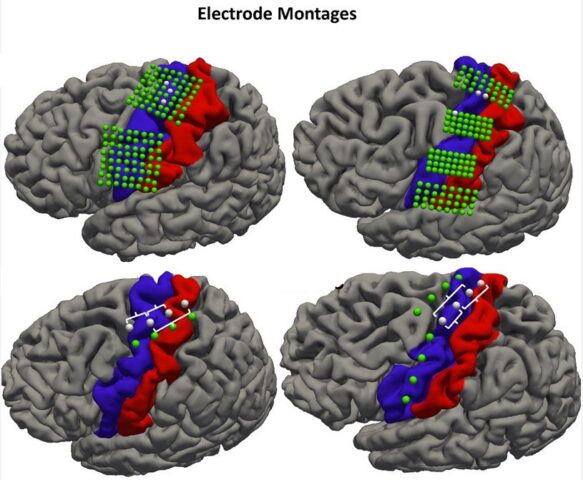
Researchers at the University of California, San Francisco (UCSF), a public research university known for its neuroscience work, had two Parkinson's disease patients train at home with a brain-computer interface (BCI) airplane-simulator game, learning to down-regulate cortical beta activity and thereby control the intensity of their own deep brain stimulation (DBS). The work, posted as a preprint on medRxiv on August 17, 2026, points to BCI applications in neuromodulation and to more personalized treatment for Parkinson's and other conditions; its conclusions have not yet been peer reviewed.
August 2026

OCD Severity and Momentary Distress Show Distinct Neural Signatures

Baylor College of Medicine researchers analyzed more than 200 hours of intracranial recordings from eight patients with treatment-resistant obsessive-compulsive disorder, five of whom also had bilateral orbitofrontal ECoG electrodes. Neural signals alone did not decode symptom severity or momentary distress above chance; adding facial and speech features raised performance to R=0.73 for severity and R=0.34 for distress. The medRxiv preprint has not been peer reviewed.
July 2026

Deep Learning Localizes Epileptogenic Zones

The researchers developed a deep learning architecture that analyzes multichannel interictal intracranial EEG to localize epileptogenic zones without requiring seizure-period recordings or manual annotation. The model combines a Morlet-wavelet temporal Transformer with a spatial attention encoder. It was evaluated with 50.5 hours of recordings from 161 patients and 17,012 channels at 7 independent centers. Leave-one-center-out validation produced a pooled AUROC of 0.778 with a 95% confidence interval of 0.748 to 0.808, and discrimination remained above chance at every held-out center. The results indicate performance comparable to established electrophysiological baselines across centers and implantation modalities, but prospective clinical validation is still needed. This medRxiv preprint has not been peer reviewed.

Preprint: MRI Grey Matter Loss May Predict Who Can Control an ECoG BCI in ALS

A preprint from the Utrecht-BCI Lab at the UMC Utrecht Brain Center in the Netherlands, the invasive-BCI group led by Nick Ramsey, asks why some people with ALS control an implanted brain-computer interface (BCI) better than others. It found that preservation of grey matter in the motor cortex is associated with higher-quality brain signals, suggesting an MRI-based measure could help identify who is a suitable candidate for implantation. The preprint was posted to medRxiv on June 23, 2026 (DOI 10.64898/2026.06.23.26355654).
© 2026 BCIwiki.com Digest Topics Tips Subscribe Revisions About