
/ EN

University College London

4 entries
August 2026

Stanford's Palanker Wins Defense Health Agency Award for PRIMA Retinal Implant

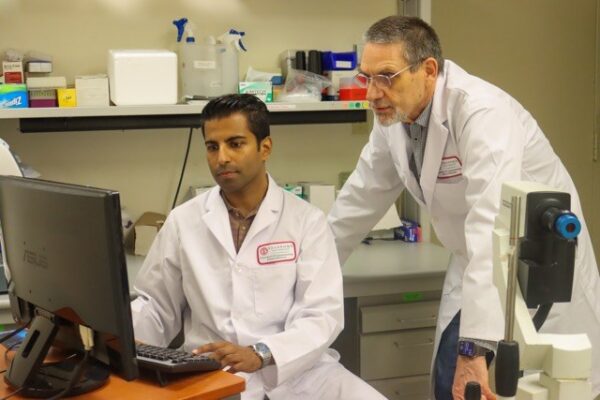
Daniel Palanker, a Stanford professor and affiliate of the university's Wu Tsai Neurosciences Institute, has won the U.S. Defense Health Agency's Outstanding Research Accomplishment award for the PRIMA retinal implant, designed to restore central vision after photoreceptor loss. A 2-mm chip sits beneath the retina and is driven by infrared light from augmented-reality glasses, converting that light into current that stimulates the next layer of neurons. A 2025 paper in the New England Journal of Medicine reported that the device let legally blind patients with advanced dry age-related macular degeneration read letters and words, and the award recognizes its potential for military personnel with laser-damaged retinas.

P300 BCI Reads Silently Chosen Digits in a Granada Classroom
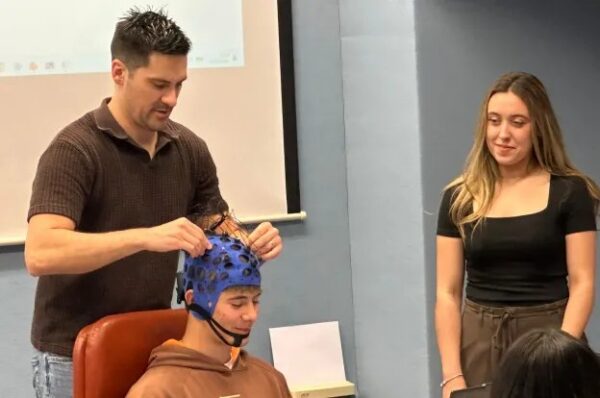
A team from the University of Granada in Spain took a P300 brain-computer interface into a secondary school classroom, using a Bitbrain Versatile EEG system to identify a digit a volunteer had silently chosen, in front of nearly a hundred students. The demonstration grew out of a thesis by industrial electronic engineering student Marta Rodríguez Comino, supervised by Dr. Joaquín T. Valderrama and Dr. Iván López Espejo. The water-based portable EEG system decoded the attention signals using principal component analysis and a support vector machine.
July 2026

Deep Learning Localizes Epileptogenic Zones

The researchers developed a deep learning architecture that analyzes multichannel interictal intracranial EEG to localize epileptogenic zones without requiring seizure-period recordings or manual annotation. The model combines a Morlet-wavelet temporal Transformer with a spatial attention encoder. It was evaluated with 50.5 hours of recordings from 161 patients and 17,012 channels at 7 independent centers. Leave-one-center-out validation produced a pooled AUROC of 0.778 with a 95% confidence interval of 0.748 to 0.808, and discrimination remained above chance at every held-out center. The results indicate performance comparable to established electrophysiological baselines across centers and implantation modalities, but prospective clinical validation is still needed. This medRxiv preprint has not been peer reviewed.

UCL Workshop Syncs EEG, Eye Tracking, ECG and GSR in a Flight Simulator

Researchers demonstrated synchronized EEG, ECG, GSR and eye tracking during a flight-simulation experiment at a workshop held with Professor Tom Carlson at University College London. A g.Nautilus 28-channel wireless EEG headset, ECG and GSR sensors and Tobii Pro Glasses 3 captured the signals in real time, tracking mental workload, engagement and heart rate variability (HRV) across two complete flight cycles of take-off, free flight and landing. The rig can be set up in 30 minutes and leaves participants free to move throughout.
© 2026 BCIwiki.com Digest Topics Tips Subscribe Revisions About