
/ EN

BCIwiki — Brain-computer interface news, research and industry database

Latest

August 2026

Medial wall ECoG signals aid finger motor decoding

Published in Journal of Neural Engineering on August 7, 2026, the study analyzed human electrocorticography data from four subjects to investigate medial wall contributions to finger movement decoding. Significantly above-chance finger movement detection was observed across multiple medial wall subregions, with local motor potentials and oscillatory power in the 8-12 Hz and 12-34 Hz bands contributing most strongly. Feature dynamics shared key properties with primary motor cortex, including pre-movement desynchronization, while also exhibiting region-specific positive or negative LMP modulations. Medial wall channels in two subjects enabled significant differentiation between individual fingers, and one subject showed decoding of both contralateral and ipsilateral finger movements, though this is a single case and preliminary.
Why it matters Explores the medial wall as a viable signal source for finger movement decoding, expanding candidate brain regions for invasive motor BCIs beyond lateral sensorimotor cortex.
WABO EEG Art Demo Yields 100+ Works at ChinaJoy

WABO (瓦博科技) says it ran a four-day neural art experience at the Snapdragon Pavilion during ChinaJoy 2026, held from July 31, 2026 to August 3, 2026 in Shanghai, producing more than 100 AI artworks with participants. Visitors wore a non-invasive EEG headband and viewed feedback derived from their signal state, with task-specific features feeding the artwork-generation process; the company says no private thoughts were read. The setup paired WABO's acquisition hardware with a Snapdragon X Elite laptop, keeping signal processing, model inference and image generation on the endpoint, which the company describes as a practical test of a neural-intent workflow outside a controlled development setting.
Why it matters A four-day public run at a consumer expo stress-tests wearability, signal quality and latency outside the lab; keeping the whole pipeline on a Snapdragon X Elite endpoint also shows how Chinese non-invasive BCI firms are packaging neural interaction for consumer settings.

P300 BCI Reads Silently Chosen Digits in a Granada Classroom

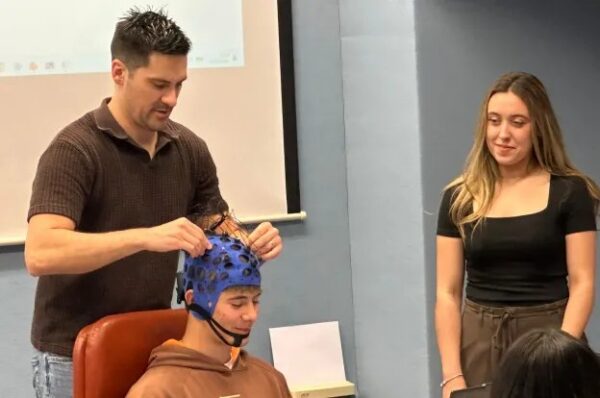
A team from the University of Granada in Spain took a P300 brain-computer interface into a secondary school classroom, using a Bitbrain Versatile EEG system to identify a digit a volunteer had silently chosen, in front of nearly a hundred students. The demonstration grew out of a thesis by industrial electronic engineering student Marta Rodríguez Comino, supervised by Dr. Joaquín T. Valderrama and Dr. Iván López Espejo. The water-based portable EEG system decoded the attention signals using principal component analysis and a support vector machine.
Why it matters The science is not new; the deployment envelope is, in that a water-based headset run by a student in a school hall still resolved a single silently chosen digit, which is a fair read on how far low-setup EEG has moved outside shielded labs.

Utrecht Team Finds ECoG Grids Can Shrink up to 94% without Losing Decoding Accuracy

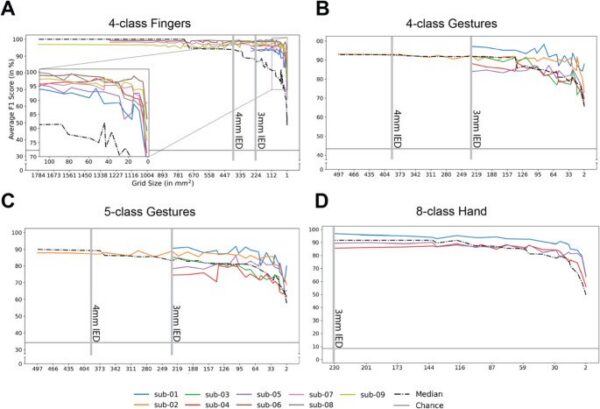
Researchers at University Medical Center Utrecht's Brain Center in the Netherlands and collaborators exhaustively tested every rectangular subgrid inside 32-, 64- and 128-channel ECoG arrays recorded from nine people with epilepsy. Grid area could be cut by 75% to 94% without meaningful loss of hand-movement classification accuracy, as long as the remaining electrodes sat over informative cortex; below a critical area of about 60 mm², performance fell sharply. The study appeared in the journal Neuroinformatics on August 7, 2026.
Why it matters Implant footprint drives both surgical risk and device cost, and this puts a floor under it: about 60 mm², derived rather than guessed. The catch is the proviso, since the saving holds only if the electrodes sit over informative cortex, which is precisely what a pre-implant workup cannot always establish in advance.

ReCIL: Rehearsal-Based Class Incremental Learning for Cross-Subject Motor Imagery Classification

Researchers propose ReCIL, a rehearsal-based class incremental learning method for cross-subject motor imagery classification that lets a model learn new MI classes sequentially without retraining from scratch. Using Euclidean alignment to reduce cross-subject EEG distribution shift and global-local replay to preserve earlier-task knowledge, ReCIL achieved a good balance between plasticity and stability across three public MI datasets. The authors report it as the first study of cross-subject class incremental learning for MI classification.
Why it matters The method targets a practical bottleneck: existing MI decoders must re-collect data or be retrained whenever a new class is added, so incremental learning points to brain-computer interfaces whose command vocabularies can grow without that recurring cost.

Haidian Hosts Nearly 60% of China's Key BCI Firms

Beijing's Haidian district is accelerating its push to become a hub for brain-computer interface development, with nearly 60% of China's key BCI companies based in the district, CCTV.com reported on August 6, 2026. According to the report, the Zhongguancun (Haidian) BCI Industry Cluster was formally unveiled at the 2026 Zhongguancun Forum annual meeting and now hosts more than 20 BCI projects, and an AI-plus-BCI standards testing and validation laboratory has been completed. The report did not disclose a list of the cluster's projects, the methodology behind the company figure, or further construction plans.
Why it matters The near-60% concentration figure from state media offers a baseline for mapping the geography of China's BCI industry, and the cluster plus its testing laboratory signal regional infrastructure moving from policy statements to physical facilities.

Air Force Medical University Releases Multi-Day fNIRS Stroop Dataset from 55 Adults

Researchers at Air Force Medical University have published a functional near-infrared spectroscopy (fNIRS) dataset in Scientific Data: frontal hemoglobin responses from 55 young adults, each recorded across three color-word Stroop sessions spread over about two weeks, with more than 30 trials per condition. The authors offer it for work on conflict inhibition, for building decoders for neurofeedback training, and for training large-scale cross-subject fNIRS models.
Why it matters Repeat-session data is the scarce ingredient in fNIRS, because without it there is no way to tell whether a decoder has learned a cognitive state or one day's optode placement, and three sessions per subject across 55 people is enough to start testing that.

BiGSTF-Net: Inter-Modal Mutual Guidance and Intra-Modal Spatio-Temporal Fusion for EEG-fNIRS Cognitive Classification

The study proposes BiGSTF-Net, a multimodal architecture that exploits the complementary properties of EEG and functional near-infrared spectroscopy (fNIRS) for cognitive-state decoding: heterogeneous spatio-temporal extractors capture each modality's representations, a modal residual interaction unit provides bidirectional cross-modal guidance, and a spatio-temporal gating unit fuses intra-modal features. Under cross-session evaluation on multiple BCI datasets, BiGSTF-Net consistently outperformed representative multimodal fusion baselines; ablations validated each component and visualizations matched the known neurophysiological features of the two signals.
Why it matters Its bidirectional cross-modal guidance goes beyond concatenating EEG and fNIRS, showing how to fuse temporal and hemodynamic signals in a way that survives cross-session shifts.

Preprint: NeuroPB Scales Neural Decoding with Pretrained Behavioral Representations

A preprint introduces NeuroPB, a framework that scales neural decoding by transferring pretrained behavioral representations: a motion encoder is first pretrained on large-scale motor behavior data, then limited paired neural-behavior recordings align neural activity to the behavioral representation space, and a neural encoder with a lightweight motor decoder reconstructs continuous movement. The researchers report that behavioral pretraining lifted center-out trajectory decoding R² by 11% and random-target task performance by 8%, that pretraining on robotic trajectories matched macaque-trajectory performance, and that only 10% calibration was needed to match training from scratch. The study is a preprint and has not been peer-reviewed.
Why it matters The telling result is that surrogate behavior data — robotic trajectories — can stand in for scarce paired neural recordings, opening a route to high-performance BCIs in data-limited settings.

Preprint: OSPDIM Online Source-Free Adaptation for Class-Imbalanced EEG

A preprint introduces OSPDIM, a source-free online unsupervised domain adaptation framework for class-imbalanced label shift in online EEG brain-computer interfaces. The study argues that Riemannian alignment methods such as the Riemannian centering transform handle covariate shift but implicitly assume balanced class priors, so shifting label distributions in real online use geometrically misalign the target data; OSPDIM adds a manifold-constrained bias parameter in the Riemannian tangent-space mapping, optimized by information maximization, and estimates and corrects the geometric bias online rather than relying on global batch statistics. 2D SPD matrix simulations showed OSPDIM correcting misalignment that standard centering fails on, and across multiple motor imagery datasets it significantly outperformed standard Riemannian baselines, especially online. The study is a preprint and has not been peer-reviewed.
Why it matters A source-free, online correction for the class-imbalance label shift that standard Riemannian alignment mishandles, targeting the drift that degrades plug-and-play EEG BCIs in real, non-stationary use.

© 2026 BCIwiki.com Digest Topics Tips Subscribe Revisions About