
/ EN

BCIwiki — Brain-computer interface news, research and industry database

Top picks

1 Peking University Third Hospital Joins Chinese Invasive BCI Trial for Spinal Cord Injury China 2 Paradromics Implant Lets First Participant Speak Her Own Words in Real Time United States 3 EEG-to-Text Results Overstated as Random Noise Fools Some Decoders South Korea

Latest

September 2026

Low-Channel EEG Network Decodes Emotions at 87% Accuracy by Modeling Frontotemporal Asymmetry

Portable EEG headsets capture far fewer channels than lab-grade systems, limiting emotion decoding accuracy. Researchers at Xiamen University of Technology developed the Spatiotemporal Spectral Asymmetric Fusion Network (STSANet), which explicitly models nonlinear hemispheric lateralization between homologous frontotemporal electrodes. On the SEED benchmark and a self-collected dataset, STSANet achieved 86.80% and 87.43% accuracy, respectively. The team also confirmed consistent spectral energy distributions between the portable Xmuse and the professional-grade Enobio, suggesting the approach could work on consumer-grade hardware.
Why it matters This study tackles a practical bottleneck: decoding emotion from portable EEG headsets with few channels. By modeling frontotemporal asymmetry rather than relying on high-density coverage, STSANet reaches 87% accuracy on two datasets. The cross-device consistency check between consumer and professional hardware is a useful step toward real-world deployment, though validation remains limited to two datasets.
Two Occipital EEG Channels Decode Blinks and Saccades at 72.37% Accuracy

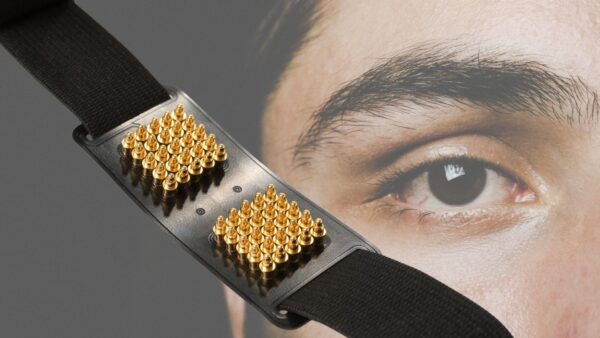
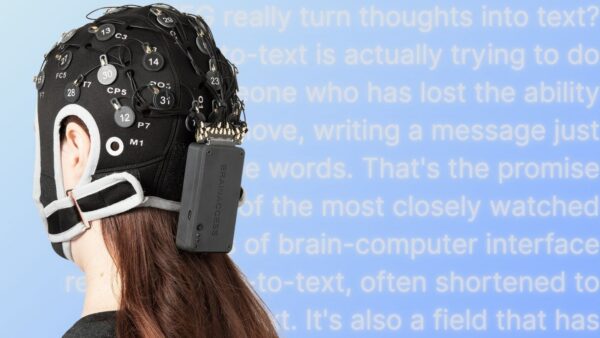
A research team in Poland used just two occipital electrodes (O1 and O2) on an EEG headband to distinguish four classes of eye events (blinks, left saccades, right saccades and a neutral state) with 72.37% test accuracy. Instead of training a single stronger model, they split four one-dimensional convolutional neural networks into binary experts and used stacked generalization, letting a meta-classifier resolve conflicts between them. Notably, the experts that performed worst on their own produced the best results when combined. The work was published by Neurotechnology, an EEG hardware maker whose BrainAccess brand makes consumer EEG headbands; HALO is its four-channel portable headband, and the accompanying software is free. Eye tracking usually requires dedicated equipment, and this study shows that two occipital channels on a consumer EEG headband can also pick up blinks and saccades. But the data come from only 4 healthy participants and 1,284 samples, so the approach is still a long way from replacing an eye tracker.
Why it matters Eye tracking normally requires dedicated hardware; this study suggests that two occipital channels on a consumer EEG headband can register blinks and saccades. The 72.37% four-class accuracy is well above the roughly 50% ceiling reached by any single end-to-end model, but with only 4 healthy participants and 1,284 samples, the method is still far from replacing an eye tracker.

BCI-Adaptive Learning Platform Lifts Retention in 90-Learner Study

Researchers divided 90 learners into two groups: one used a BCI platform that read attention, cognitive load and mental fatigue in real time and adjusted content and pacing accordingly; the other followed a conventional online course. The BCI group showed stronger sustained engagement and better knowledge retention. The mixed-methods design combined quantitative data (pre- and post-test scores, task completion rates and neural activity indicators) with surveys and semi-structured interviews on perceived engagement, usability and the overall learning experience. The participants came from English House Language Center, the European University of Armenia and Mesrop Mashtots University. The authors also flag unresolved privacy, ethical and accessibility questions around collecting and using neural data in education.
Why it matters Bringing BCIs into the classroom means reading attention, cognitive load and mental fatigue, then adjusting pacing in real time. The experimental group retained more, but the sample was just 90 learners from three Armenian institutions, and the paper itself acknowledges that privacy and accessibility questions around using neural data in education remain unresolved.

Singapore Trial Tests EEG-Headband Games for Rehab in Children With Brain Injury

KK Women's and Children's Hospital in Singapore has registered a clinical trial of brain-computer interface neurofeedback training (BCI-NFT) for children and adolescents aged 7 to 21 with acquired brain injury from causes including traumatic brain injury, stroke, encephalitis, brain tumors and epilepsy. The intervention group will complete 12 sessions of about 60 minutes each over 10 weeks, wearing a wireless EEG headband while interacting with neurofeedback computer games; the control group receives standard care first and then crosses over to training. A cohort of peers with no history of brain injury will provide normative EEG data. The trial plans to enroll 70 participants, with primary endpoint results expected in February 2028.
Why it matters The trial brings EEG neurofeedback training to cognitive rehabilitation in children after acquired brain injury from a range of causes, including traumatic brain injury, stroke, encephalitis, brain tumors and epilepsy, using a waitlist-controlled crossover design. It tests two things at once: whether EEG measures can objectively quantify cognitive impairment, and whether structured training beats standard care alone on attention, memory and executive function. With 70 planned participants and primary results due in February 2028, it is still an early-stage validation.

Synchron Stent Electrode Beats Scalp EEG per Channel in One ALS Patient

A participant with severe upper-limb paralysis caused by amyotrophic lateral sclerosis (ALS) wore an endovascular stent-electrode array and a scalp EEG cap at the same time, in the same session, while attempting ankle flexion and extension. Both recordings changed markedly during attempted movement, but the stent array showed stronger per-channel motor modulation and was unaffected by skull attenuation. Scalp EEG was more susceptible to eye blinks and jaw-muscle activity, while the stent array picked up prominent cardiac signals. Neither method reliably distinguished left from right ankle movement, leaving spatial localization an open problem.
Why it matters This is the first direct comparison of endovascular stent-electrode and scalp EEG signal quality in the same human participant. It answers a practical question for patients and clinicians: how much is gained by placing electrodes inside a blood vessel next to the cortex rather than on the scalp? The answer is stronger per-channel modulation and better resistance to blink artifacts, at the cost of cardiac interference, while left-right spatial resolution remains unsolved.

iMINDBench Sets a Shared Cross-Institution Test for Intracranial EEG Decoding

Intracranial EEG (iEEG), recorded by electrodes implanted inside the brain, is widely regarded as an ideal signal for decoding intent, but differing datasets and preprocessing pipelines make it hard to tell whether models are actually improving. A research team built iMINDBench, a benchmark that brings together naturalistic movie-watching data from three institutions, 15 decoding tasks, standardized preprocessing and fixed evaluation splits. Pretrained systems generally beat baselines within their own preprocessing pipeline, but classic spectral baselines remained competitive on other institutions' data. Scaling up supervised data from other subjects or institutions to 25 times the volume yielded only limited, task-dependent gains over training on data from the same session.
Why it matters Whether data from one institution carries over to another is a question intracranial EEG decoding cannot sidestep on the way to general-purpose models. By turning preprocessing differences into separate comparison tracks, the benchmark draws a line between a better model and better-cleaned data. That 25 times more external data brings only limited gains suggests data volume is not the current bottleneck; stable cross-subject, cross-institution decoding is.

SPAR-EEG Single-Channel Denoiser Lifts P300 Speller Accuracy by 7.8 Points

Wearable neurotechnology and BCI applications, from assistive interfaces to clinical monitoring, favor single-channel EEG because it needs few electrodes and is light to wear. But muscle, eye and motion artifacts are hard to remove from a single channel, especially without auxiliary channels, artifact labels or hand-picked clean baseline segments. SPAR-EEG needs none of these: it applies three artifact-specific attenuation passes to each EEG segment, one based on variational mode decomposition for high-frequency muscle bursts and two based on singular spectrum analysis for blink-like ocular transients and slow motion drift. It achieved the best artifact-region SNR improvement at all 26 SNR levels tested and raised final accuracy by 7.8 percentage points in a P300 speller task using only the FP1 and FP2 leads.
Why it matters Single-channel EEG is key to taking wearable BCIs into daily use, but artifact removal has depended on extra electrodes or manual labeling. By tackling muscle, blink and motion-drift artifacts with separate targeted passes, SPAR-EEG improved results both on public benchmarks and in real-world movement recordings, suggesting that low-burden, motion-prone use cases may no longer need multi-channel hardware.

CoME Framework Scores How Mobile an EEG Study Really Is

A participant walking on a treadmill and one walking freely outdoors with a recorder on their back can both be described as doing mobile EEG, yet their freedom of movement differs enormously. The CoME framework, proposed in 2017, scores a study on four dimensions (device mobility, participant mobility, system specification and channel count) in a format such as (2D, 4P, 17S, 32C). Device and participant mobility have to be scored separately: a head-mounted system used for resting-state recording earns a high device score but still rates 0P for participant mobility. The framework is not a product ranking, and a higher score does not mean a better system.
Why it matters Mobile EEG has become a catch-all term: a headset streaming data to a nearby computer is not the same as a fully head-mounted system logging offline to internal memory. By splitting mobility into separate device and participant scores, CoME exposes a tension in current hardware: the highest-spec systems are often not the most portable, and the portable ones tend to have lower specifications. The 5D tier that represented the future in 2017 is now achievable with existing products, yet none of the 30 studies the paper's authors examined at the time reached it.

EEG-to-Text Results Overstated as Random Noise Fools Some Decoders

Translating scalp EEG directly into free-form text has long been seen as one of the most ambitious goals for non-invasive brain-computer interfaces. But when researchers fed random noise instead of real EEG into several published decoders, some models still produced fluent sentences and scored about as well as they did on real brain data, suggesting the language model was doing most of the work. The field has since made noise-baseline tests and decoding without teacher forcing standard validation practice, and has used magnetoencephalography (MEG) as a comparison to quantify how far EEG trails cleaner signals.
Why it matters The study reworks the EEG-to-text scoreboard: noise-baseline tests show that some decoders' fluent output came mostly from the language model rather than the brain signal. Earlier decoding accuracy figures therefore deserve a discount, which is why noise baselines are becoming standard for new models. A head-to-head MEG comparison puts a number on EEG's gap, though MEG's room-sized scanner means it will not replace portable, low-cost EEG any time soon.

AI Should Read Intent in BCI Exoskeletons While Controllers Enforce Limits, Review Says

A brain-computer interface can read neural activity tied to movement, while a powered exoskeleton supplies the force needed to carry it out. But EEG is noisy, muscle signals shift with fatigue and recovery, and the right level of assistance depends heavily on the user and the task, so AI's main value lies in handling several changing signals at once rather than relying on a single fixed input. The review surveys how EEG, EMG and mechanical sensing are combined for exoskeleton control and contrasts two applications with very different goals: stroke rehabilitation and healthy users. The author argues that higher classification accuracy alone is not enough, since latency, calibration, fatigue, uncertainty and physical safety also determine whether a system is truly usable.
Why it matters The review splits exoskeleton control into two layers: AI interprets the user's intent and chooses a high-level assistance strategy, while conventional controllers still enforce mechanical limits on torque, joint angle and speed. It also points out that the goals diverge, with stroke rehabilitation requiring assistance to taper as voluntary control improves, and healthy users mainly wanting to reduce physical effort. The review offers no new trial data and reports no clinical outcomes for any system; its discussion centers on latency, calibration, fatigue and safety, the issues that decide whether such systems can actually be used.

© 2026 BCIwiki.com Digest Topics Tips Subscribe Revisions About