/ EN

BCIwiki — Brain-computer interface news, research and industry database

Latest

August 2026

Zhejiang Cuts BCI Device Review to 40 Days

The General Office of China's Zhejiang Provincial People's Government issued Several Measures for Promoting Industry-University-Research Coordination in Brain-Computer Interfaces, document number Zhe Zheng Ban Fa [2026] No. 33, dated July 16, 2026 and released on August 12, comprising 18 measures in five areas. Class II BCI devices of clear clinical value may enter a special review procedure with the timeline cut to within 40 working days, while medical consumables are listed through a green channel within 10 working days. Funding comes in four tiers: up to 10 million yuan for a provincial major science and technology project, up to 8 million yuan for research hospitals deeply involved in preclinical work and product launch, up to 3 million yuan for applied basic research, and 1 million, 500,000 and 100,000 yuan for leading international, national and local standards. Beds used solely for clinical research are exempt from efficiency and DRG performance assessment.
Why it matters Forty working days is the shortest Class II device review pledge from any province, less than half the 90 days Shandong promised nine days earlier, marking review speed as a new axis of inter-provincial competition. The 8 million yuan tier goes to research hospitals rather than companies and pairs with an exemption of research beds from performance assessment, addressing why hospitals are reluctant to give up capacity.
SpikeGadgets Hardware Closes the Loop on Rat Hippocampus in Milliseconds

SpikeGadgets says its hardware, using low-latency Ethernet and the TrodesNetwork API, lets researchers detect a neural activity pattern and trigger a perturbation within milliseconds. Two UCSF studies show it in use: one continuously decoded hippocampal population activity in rats to run a neurofeedback system, training the animals to volitionally generate specific memory representations for reward; the other triggered theta-phase-specific optogenetic stimulation in real time and showed that theta rhythm and replay are mechanistically separable.
Why it matters Closed-loop is the word every neuromodulation pitch uses; these two experiments show what it costs to actually do it — a millisecond-scale detect-and-stimulate path — though the account comes from the vendor's own blog, so the latency claims want third-party timing.

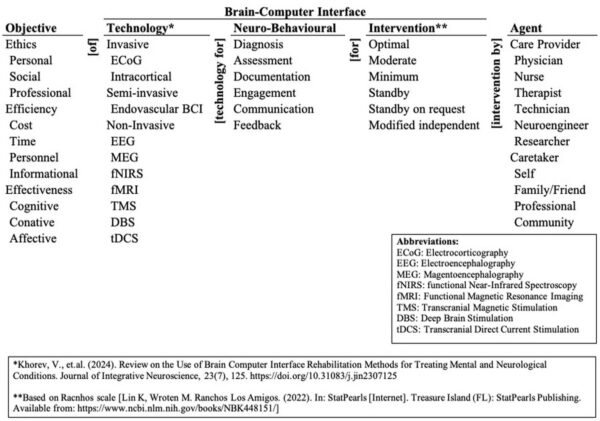
BCI Ethics Ontology for Mental Healthcare

Researchers propose an ontology framework for balancing ethics, effectiveness, and efficiency of BCI use in mental healthcare.
Why it matters As BCIs become more prevalent in mental healthcare, a systematic tool for ethical analysis is lacking. This ontology provides a structured roadmap for ethical decision-making in BCI-assisted neuro-behavioural interventions, with relevance to clinical practice and policy.

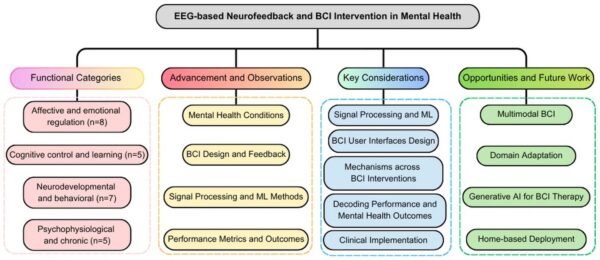
Review: Closed-Loop EEG BCI for Mental Health

A PRISMA-guided review evaluates closed-loop EEG-based BCI and neurofeedback interventions for mental health, screening 1,101 records and including 25 studies.
Why it matters Closed-loop EEG-based BCIs hold growing promise for mental health intervention, yet most studies remain small pilots. This review systematically examines 25 post-2021 studies across paradigm design, signal processing, and ML methods, offering a comprehensive reference for the field's technical roadmap and future directions.

DWT and Chirplet Transform Boost MI-EEG Classification to 94.8%

Researchers propose combining discrete wavelet transform and chirplet transform for motor imagery EEG classification, achieving 94.8% accuracy on CBCIC with 1.03-second response time.
Why it matters Accurate MI classification is key to BCI system reliability. This method combining DWT and chirplet transform emphasises the importance of time-related data, achieving high accuracy and fast response time on two public datasets.

Unifying Consent for Implantable BCIs

Researchers address the challenge of unifying consent standards for implantable brain-computer interfaces.
Why it matters As implantable BCI clinical trials and commercialisation advance, unifying consent standards is an urgent ethical and regulatory need. This paper directly addresses this challenge, offering guidance for clinical standardisation in the BCI field.

BrainGate2: Preparatory Motor Cortex Activity Encodes Movement Direction

Intracortical recordings from 3 BrainGate2 participants show preparatory motor cortex activity encodes movement direction, curvature, and distance, enabling preparatory-activity-based online cursor control.
Why it matters Preparatory activity could improve BCI performance by anticipating user intentions, but what features it encodes in humans was poorly understood. This study systematically reveals rich movement features encoded by preparatory activity and demonstrates an online cursor control paradigm, opening new directions for high-performance BCIs.

Review: BCI in Neurorehab and Nursing for Paraplegia

A review systematically examines stratified BCI rehabilitation strategies and comprehensive nursing models for paraplegic patients, showing BCIs can activate neuroplasticity and relieve spasticity.
Why it matters Traditional paraplegia rehabilitation relies on passive training with limited central neural remodelling effects. This review examines BCI applications from both neurorehabilitation and nursing perspectives, proposing stratified strategies and a comprehensive nursing model for clinical practice.

Review: SSVEP-BCI Application Bottlenecks and Solutions

A review analyses technical, hardware, and user-level bottlenecks facing SSVEP-BCI systems in real-world deployment, summarising solutions including EMG fusion denoising, novel sponge electrodes, and hybrid paradigms.
Why it matters SSVEP is a mainstream BCI paradigm due to its high information transfer rate and low training requirements, yet real-world deployment faces multiple bottlenecks. This review systematically analyses core difficulties at technical, hardware, and user levels and summarises existing solutions, providing a roadmap for practical SSVEP-BCI deployment.

Review Maps Deep Learning for Motor Imagery BCIs

A review published in Sensors surveys RNN, VAE, GAN, and Transformer architectures used for motor imagery BCI classification, along with their key challenges.
Why it matters by systematically comparing sequence-oriented, attention-based, and generative deep learning architectures for motor imagery classification, the review offers researchers a consolidated map of current bottlenecks — inter-subject variation, low SNR, and real-time constraints — that any new decoding method still has to address.

© 2026 BCIwiki.com Digest Topics Tips Subscribe Revisions About