

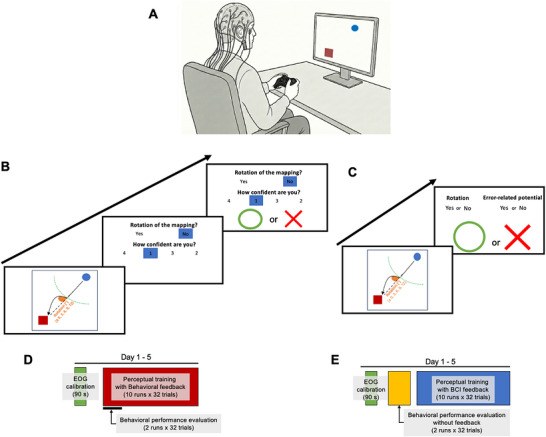
BCIwiki (bciwiki.com) — Feeding people real-time readouts of their brain's error-related potentials (ErrPs) during perceptual training improved their ability to perceive subtle visuo-motor errors faster than behavioral training alone, researchers at The University of Texas at Austin and the National Institute of Neurological Disorders and Stroke reported in Advanced Science on July 15, 2026 (PMID 42452959; DOI 10.1002/advs.76153).
Accurate perception of small visuo-motor errors underpins perceptual and sensorimotor learning and supports timely corrections in precision tasks, the authors wrote. Conventional training, which typically gives feedback on response accuracy, does little to improve sensitivity to such errors. Rather than modulating sensory regions, as earlier approaches did, the team targeted a cognitive marker: the error positivity (Pe), a component of the ErrP that originates in the anterior cingulate cortex, a key decision-making region, and is thought to reflect conscious awareness of errors. They hypothesized that the Pe is a modifiable neural correlate of error perception.
In a five-day longitudinal study, participants received real-time feedback on whether an ErrP was present in their EEG. Compared with behavioral training alone, the feedback accelerated perceptual learning for 3° errors. For 6° errors it improved perceptual performance without speeding the learning rate. The behavioral gains were accompanied by an increase in Pe amplitude.
The authors said the findings offer new neurophysiological insight into how errors are perceived and support ErrP-based brain-computer interface (BCI) interventions as a way to foster perceptual learning where detecting subtle errors is critical. The abstract does not report the number of participants or how long the gains lasted.