

BCIwiki (bciwiki.com) — Frontiers in Rehabilitation Sciences published a case report on 2026-10-25 describing improvements across several functional domains after an 8-month multidisciplinary rehabilitation program for a patient with a large-area stroke. The authors were affiliated with Beijing Bo'ai Hospital, China Rehabilitation Research Center, and Capital Medical University in China. The report presents exploratory observations rather than definitive evidence of the combined protocol's efficacy.
The patient was a 38-year-old man with right hemiplegia and global aphasia following a large left hemispheric infarction. His response to conventional rehabilitation had been limited. The team used a closed-loop "assess-decide-intervene-re-assess" management framework, periodically combining clinical scales, diffusion tensor imaging (DTI), functional magnetic resonance imaging (fMRI), EEG, and 3D gait analysis to adjust treatment.
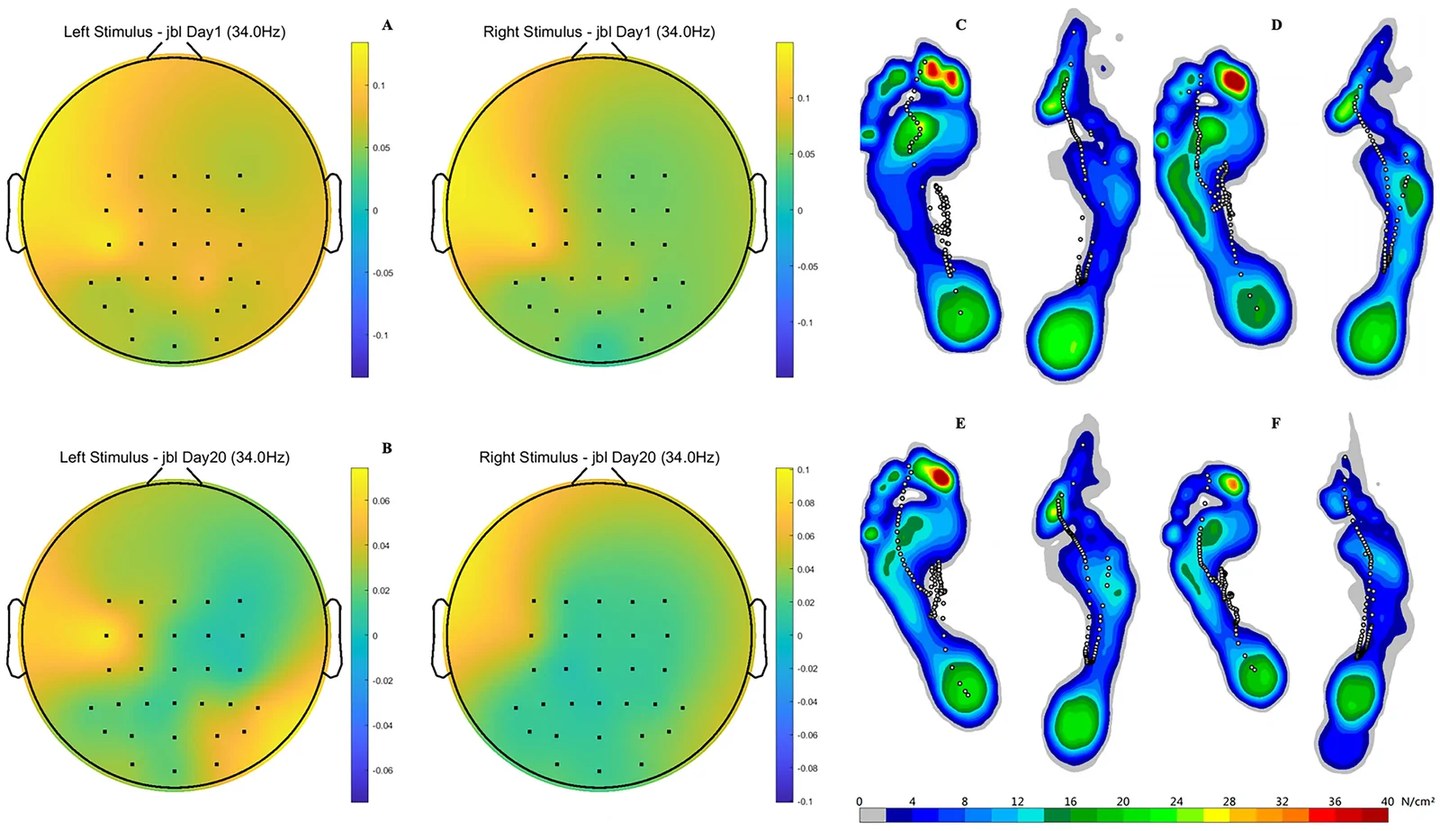
Alongside conventional therapy, staged interventions included repetitive transcranial magnetic stimulation for aphasia and intermittent theta-burst stimulation for motor disorder. Brain-computer interface (BCI)-robotic training and task-oriented virtual reality targeted upper limb function. Gait analysis informed biomechanical correction using custom insoles.
The LOTCA cognitive assessment score increased by 16 points, CRRCAE language assessment subscales improved by 60–90%, the FMA motor score increased from 20 to 56, FMA-B reached 12, and the MBI daily living score rose from 40 to 91. Imaging showed increased fractional anisotropy (FA) in the corpus callosum and right corticospinal tract, with elevated amplitude of low-frequency fluctuations (ALFF) and regional homogeneity (ReHo) in right frontal-temporal areas. Event-related desynchronization (ERD) decreased during BCI training, and gait parameters improved.
The authors interpreted the concurrent neural changes as suggesting possible trans-hemispheric network reorganization, not as proof of a recovery mechanism. The single-case design also cannot separate the contributions of conventional rehabilitation and the individual neuromodulation techniques. The authors describe the findings as hypothesis-generating observations that provide a preliminary rationale for further investigation of individualized neurorehabilitation.