

BCIwiki (bciwiki.com) — A dynamic multi-branch EEG decoding network reached 96.41% average accuracy on a public motor imagery benchmark and showed preliminary offline cross-subject decoding in people with spinal cord injury, researchers at Shandong University of Traditional Chinese Medicine, its affiliated hospital and Qilu University of Technology (Shandong Academy of Sciences) reported in Frontiers in Neuroscience on September 25, 2026 (PMID 42787353, DOI 10.3389/fnins.2026.1918072).
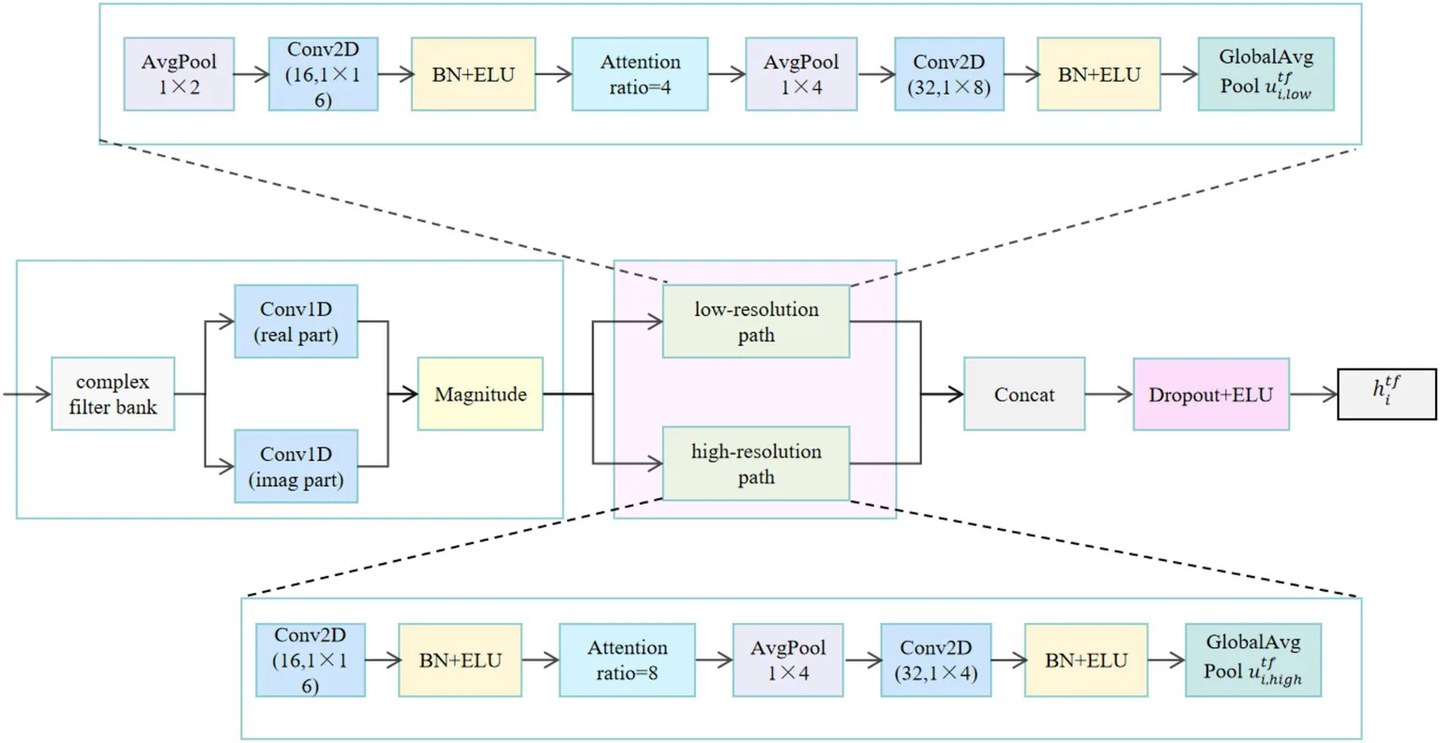
Decoding motor imagery from electroencephalography (EEG) is hard because the signals are noisy, drift over time and vary widely between people. The network, called DMB-EDN, jointly models temporal dynamics, learnable time-frequency patterns and rhythm-specific spectral information. It pairs a learnable Gabor-based time-frequency representation with physiology-guided rhythm modeling, and uses trial-conditioned dynamic fusion to weigh the contribution of each of its 3 branches separately for every EEG trial.
The team tested the method on 3 datasets. Under subject-specific evaluation on BCI Competition IV 2a, it achieved 96.41% average accuracy and a kappa of 0.952. On the High Gamma Dataset, where performance is near saturation, it matched the strongest baseline. On a self-collected spinal cord injury dataset, under leave-one-subject-out evaluation, meaning it was tested on people excluded from training, it reached 85.00% accuracy and a kappa of 0.700, which the authors describe as preliminary evidence of improved offline cross-subject decoding.
Ablation experiments showed that all 3 branches and the trial-conditioned fusion contributed to performance, and analysis of fusion weights found systematic shifts linked to movement class and brain oscillations. The authors said validation in larger multicenter cohorts and in prospective online brain-computer interface (BCI) systems is still needed.