

BCIwiki (bciwiki.com) — Researchers affiliated with The First People’s Hospital of Zunyi, Xuanwu Hospital of Capital Medical University and Tianjin Huanhu Hospital, China, developed a consensus on reconstruction for post-stroke spastic hemiplegia, published in Ibrain on October 28, 2026. A multidisciplinary panel links functional goals and the main limiting impairment to noninvasive BCI, diagnostic motor nerve block, peripheral nerve surgery and reconstruction.
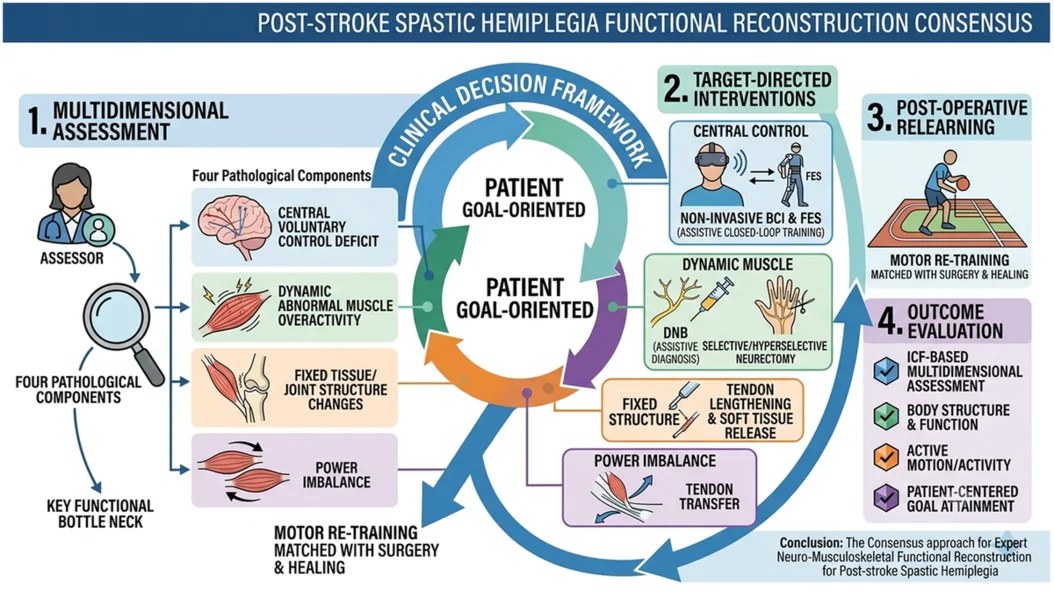
The consensus emphasizes assessment of four major components: central voluntary motor impairment, dynamic abnormal muscle overactivity, fixed structural limitations, and muscle force imbalance. Treatment should follow the patient's functional goals and the primary factor restricting performance, rather than a uniform pathway based solely on the diagnosis of spastic hemiplegia.
When voluntary motor control is impaired, task-oriented motor training remains fundamental. BCI-based closed-loop training is positioned as a potential adjunct for selected patients. Selective or hyperselective peripheral nerve surgery may be considered for focal, functionally significant muscle overactivity caused by abnormal neural drive, with diagnostic motor nerve block assisting patient selection.
Fixed structural restrictions may require tendon or soft-tissue procedures, while muscle force imbalance may benefit from tendon transfer or other dynamic reconstruction. When several impairments coexist, combined reconstruction followed by targeted motor retraining and comprehensive reassessment may be appropriate. The consensus notes that variable evidence quality means no universal treatment sequence or combination strategy is currently supported. These recommendations are not efficacy results from a new clinical trial.