
/ EN

Hemiplegia

5 entries
September 2026

Vietnamese BCI Speller Types up to 4.95 Characters a Minute in Two-Person Pilot

Two participants typed Vietnamese at 4.95 and 3.45 characters per minute using motor imagery EEG in a pilot test of BCI-vSpeller, a speller built around a custom virtual keyboard of more than 160 selectable keys covering characters, tone marks and special symbols. Researchers from VNU University of Engineering and Technology in Hanoi, reported the findings in Technology and Disability. BCI spellers let users enter text by controlling an interface with mental signals, an approach aimed at people with severe speech and mobility impairments.
BCI Training Improves Post-Stroke Arm Function Across 35 Trials, 1,188 Patients

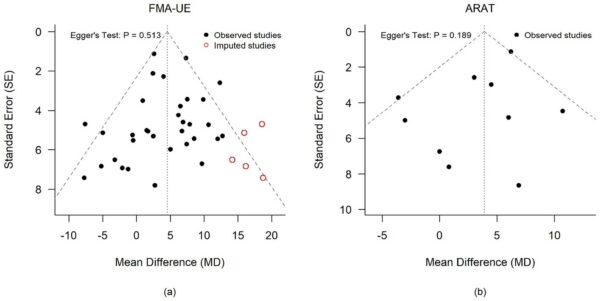
Brain-computer interface training significantly improves upper-limb motor function after stroke, according to a systematic review and meta-analysis of 35 randomized controlled trials involving 1,188 participants, published in Frontiers in Neurology on September 3, 2026. Pooled data showed mean improvements of 4.55 points on the Fugl-Meyer Assessment-Upper Extremity (FMA-UE), 3.90 points on the Action Research Arm Test (ARAT) and 8.53 points on the Wolf Motor Function Test (WMFT), but the effect depended heavily on the comparator: a mean difference of 6.70 against usual care versus only 1.97 against sham-contingent controls. Twenty-two trials reported multi-level neuroplastic changes, though the evidence was insufficient to explain the mechanisms of recovery.
May 2026

ChiCTR Registers Trial of Motor Imagery BCI for Lower-Limb Stroke Rehab

The Chinese Clinical Trial Registry (ChiCTR) has logged a study of how brain-computer interface training built on a motor imagery paradigm affects lower-limb motor function in stroke patients. Registered on May 28, 2026 as ChiCTR2600125562, the trial is recruiting; design, sample size and sponsor are absent from the record carried by the WHO International Clinical Trials Registry Platform (ICTRP) and must be read from the original ChiCTR entry.

Shanghai Trial to Test BCI-Driven Lower Limb Exoskeleton in 60 Stroke Patients

The randomized controlled trial plans to enroll 60 patients with lower limb motor impairment after stroke, with the intervention group receiving BCI-assisted exoskeleton rehabilitation training and the control group conventional walking training. Primary outcomes include lower limb surface electromyography, lower limb motor function, the Modified Barthel Index, a balance scale and functional ambulation, testing whether a BCI-driven exoskeleton adds functional benefit over conventional gait training. Punan Hospital, Pudong New Area, Shanghai is the sponsor, with first enrolment set for May 30, 2026. The trial is registered with the Chinese Clinical Trial Registry (ChiCTR) under number ChiCTR2600125531, with a registration date of May 28, 2026, and recruitment has not yet started.

Trial Pairs iTBS With Motor Imagery BCI Training for Post-Stroke Arm Impairment

Guangdong Provincial Hospital of Traditional Chinese Medicine has registered a parallel-design interventional trial, ChiCTR2600124411, that plans to enroll 81 patients with unilateral upper-limb impairment after stroke in three groups of 27. Two groups receive intermittent theta-burst stimulation (iTBS) over the dorsolateral prefrontal cortex or the primary motor cortex, and one receives sham stimulation; all three undergo motor imagery BCI training. Primary outcomes are BCI decoding accuracy, the Fugl-Meyer Assessment and brain network topology. The trial was registered on May 12, 2026 and is not yet recruiting.
© 2026 BCIwiki.com Digest Topics Tips Subscribe Revisions About