
中 / EN

ALS

9 entries
October 2026

Registered Study Will Compare BCI Communication With Eye Tracking in ALS

A registered study that is not yet recruiting will compare a wearable brain-computer interface communication device with the eye-tracking devices already used by people with ALS. It plans to enroll 30 adults who use Tobii Dynavox or Smartbox eye-tracking devices. Each participant will try three options at home over 12 weeks: their own eye-tracking device and Cognixion ONE with either a head-worn augmented-reality display or a screen-based display. The main measure is the time participants voluntarily choose to use each option. Additional measures include communication speed, accuracy, and caregiver burden. No results are available. Cognixion ONE is investigational and is not FDA-approved or cleared for any medical use.
Language Models Speed P300 Spellers by Up to 75%, Approaching Theoretical Limit

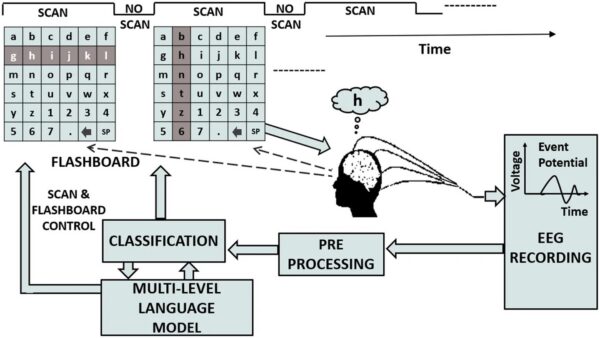
Researchers have shown that language models can raise typing speed on P300 spellers, the EEG-based BCIs that let people with severe paralysis such as ALS type by focusing on flashing characters, by up to about 45% with within-subject training and about 75% with cross-subject training compared with conventional methods. The spellers are slow and need individual calibration. Using EEG data from 78 subjects in simulation, the team compared several language models for word prediction. The best-performing models differed in architecture yet all came within 5% of the theoretical upper bound, suggesting that larger language models will yield little further gain and that brain signal decoding is now the bottleneck. The conclusions come from offline simulation, not testing by patients.
September 2026

Preprint: Hosted Jev Model Matches 7B LLMs in Speech BCI Rescoring Without a GPU

Gabriele Cinà reported in an arXiv preprint posted on September 27, 2026, that Jev, a hosted model, can replace the multi-billion-parameter language model that speech neuroprostheses use to rescore candidate sentences, the only GPU-dependent step in the system. Jev returns a probability for each candidate in one call, which is combined with the decoder's own score. On 978 held-out sentences from a participant with ALS, the published decoder alone had an 8.1% word error rate, versus 7.5% with Jev and 7.8% with both OPT-6.7b and Qwen2.5-7B; after re-tuning decoder weights, the figures were 6.9%, 7.2% and 7.4% respectively. Jev needs no GPU, costs $0.07 per thousand sentences, and has 262 ms end-to-end latency over the internet, versus 27 ms for a 7B model on a local GPU. The work is a preprint and has not been peer reviewed.

Study Compares AI Command Execution With External Gating in BCIs

Researchers tested five language models as AI agents using 1,065 episodes from 47 people with amyotrophic lateral sclerosis. At matched execution coverage, providing reconstructed decoder confidence never reduced unfaithful execution below a deterministic gate; two models performed significantly worse. Apparent safety improvements mainly reflected less frequent action. A subsequent test gave ten models the same command vocabulary as a deterministic resolver. No direct agent arm improved on the resolver's risk-coverage frontier. However, a hybrid architecture that let models propose semantic corrections while an external gate controlled admission extended coverage in five of ten models without observed unfaithful executions.

Study Finds Tuned Fixed-Weight LM Fusion Matches Adaptive Methods in P300 Spellers

Researchers reanalyzed 3,373 spelling selections from 47 patients with ALS and found that adjusting how much a P300 brain-computer interface speller trusts its language model on each selection did not beat a tuned fixed weight. P300 spellers choose letters by detecting the P300 response in EEG and often use a language model to predict the next character. Across 22 language models of up to 46.7B parameters, none showed adaptive fusion outperforming the fixed weight under fair comparison. The fixed-fusion output probability also flagged erroneous selections better than purpose-built controllers, with 2.8- to 3.8-fold error enrichment. The study is a preprint and has not been peer reviewed.
August 2026

LLM Correction of BCI Typing Can Silently Change Meaning, 20-Model Benchmark Finds

Large language models used to correct error-prone text from P300 brain-computer interface spellers can produce fluent sentences that no longer mean what the user intended, a failure the researchers call intent drift. Across 20 open-weight models tested on simulated P300 output, drift rose from 2.2% at a 0% character error rate to 60.3% at 40%, with an odds ratio of 2.30 per 10-percentage-point increase. Model confidence separated correct from incorrect outputs with an AUROC of 0.83 but was poorly calibrated: 28.4% of high-confidence outputs were unfaithful. Clinically important messages such as medication doses drifted slightly more than matched controls (odds ratio 1.10). None of six correction strategies eliminated drift; conservative strategies reduced it, but even the best still produced wrong output 18 times per 100 corrections. The study is a preprint and has not been peer reviewed.

Language Models Changed 4.4% of P300 Speller Choices in Data From 47 ALS Patients

P300 spellers are a common brain-computer interface communication tool for people with ALS, and researchers have begun adding large language models as language priors to raise spelling accuracy. But accuracy alone cannot show whether an output came from the patient's brain signals or the model's prediction. A retrospective study re-decoded 3,373 P300 speller selections from 47 people with ALS, fusing reconstructed neural posteriors with 25 language priors ranging from 5-gram models to a 46.7-billion-parameter model. The prior accounted for a participant-weighted mean of 8.6% of posterior displacement, a neural contribution fraction of 0.914. In 4.4% of selections, the fused system produced the intended character where neural evidence alone would not have. Results were similar across 21 neural language models. The work is a preprint and has not been peer reviewed.
July 2026

Preprint: MRI Grey Matter Loss May Predict Who Can Control an ECoG BCI in ALS

A preprint from the Utrecht-BCI Lab at the UMC Utrecht Brain Center in the Netherlands, the invasive-BCI group led by Nick Ramsey, asks why some people with ALS control an implanted brain-computer interface (BCI) better than others. It found that preservation of grey matter in the motor cortex is associated with higher-quality brain signals, suggesting an MRI-based measure could help identify who is a suitable candidate for implantation. The preprint was posted to medRxiv on June 23, 2026 (DOI 10.64898/2026.06.23.26355654).
March 2026

Brain implant restores two-handed typing at 22 words per minute

Two people with tetraplegia typed on a virtual two-handed QWERTY keyboard simply by attempting finger movements, which electrodes implanted in the brain decoded into keystrokes. Typing speed was set by the users and reached 110 characters per minute, or 22 words per minute, with a word error rate of 1.6%, which the authors say resembles able-bodied typing accuracy. Accurate decoding required as few as 30 calibration sentences, and a 5-gram language model improved sentence output. One participant has amyotrophic lateral sclerosis (ALS) and the other a spinal cord injury.
© 2026 BCIwiki.com Digest Topics Tips Subscribe Revisions About