
中 / EN
2026-10-01 00:00 United States Papers Communication & Language Source language EN

Language Models Speed P300 Spellers by Up to 75%, Approaching Theoretical Limit

Summary Researchers have shown that language models can raise typing speed on P300 spellers, the EEG-based BCIs that let people with severe paralysis such as ALS type by focusing on flashing characters, by up to about 45% with within-subject training and about 75% with cross-subject training compared with conventional methods. The spellers are slow and need individual calibration. Using EEG data from 78 subjects in simulation, the team compared several language models for word prediction. The best-performing models differed in architecture yet all came within 5% of the theoretical upper bound, suggesting that larger language models will yield little further gain and that brain signal decoding is now the bottleneck. The conclusions come from offline simulation, not testing by patients.
Why it matters Earlier work used GPT-2 to accelerate the P300 speller; this study indicates the speedup is not tied to any one model and that the language-prediction side is close to its ceiling, so developers should redirect effort toward decoding brain signals. Cross-subject training could also lighten the calibration burden on patients, though none of this has yet been tested in real-time typing.

大语言模型助力P300拼写器打字提速最高75%,性能已逼近理论上限
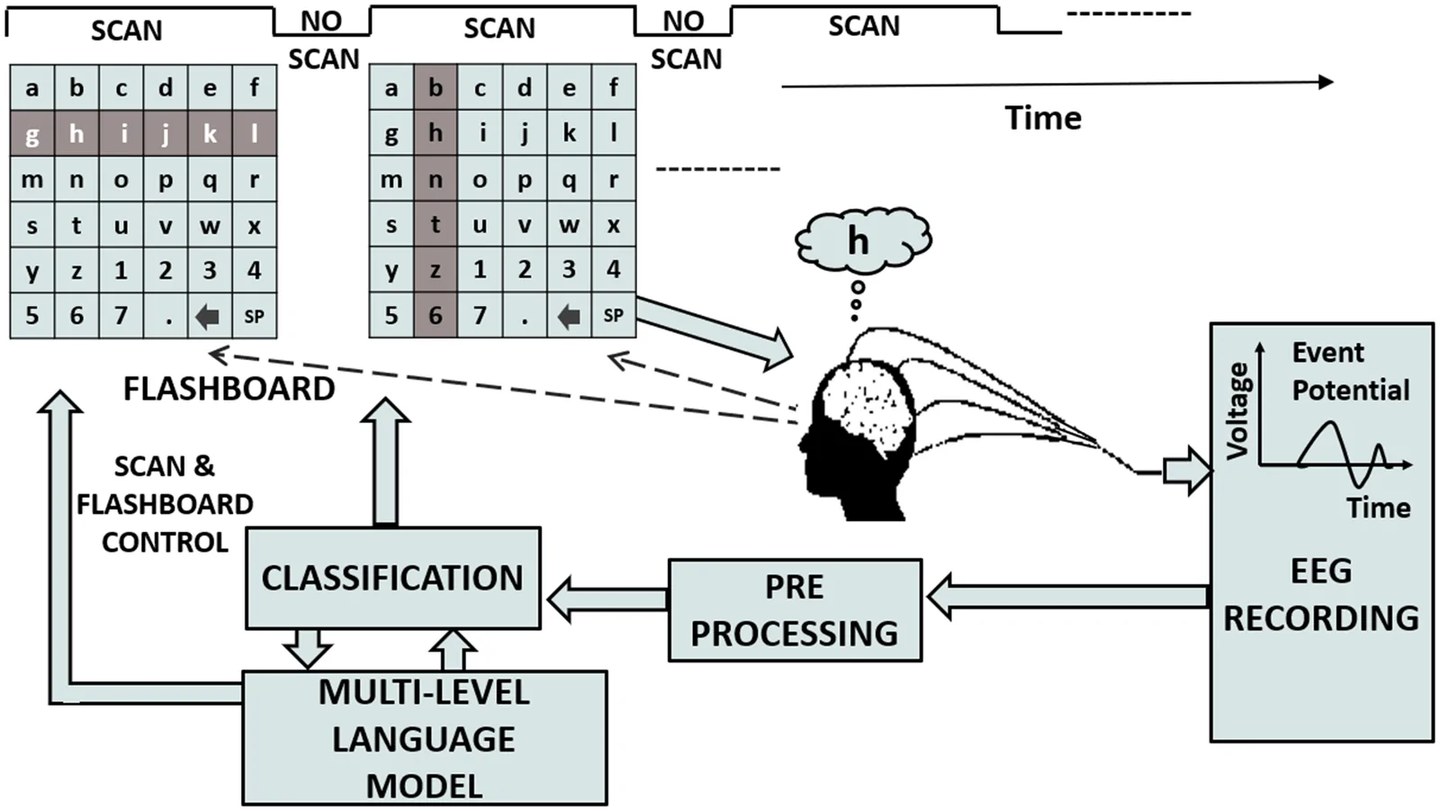
Image: PloS one, CC BY 4.0

BCIwiki (bciwiki.com) — Language models can raise P300 speller typing speed by up to ~45% with within-subject training and ~75% with across-subject training over conventional approaches, according to simulations on EEG data from 78 subjects reported in PLOS ONE on October 1, 2026 (PMID 42821610; DOI 10.1371/journal.pone.0349281).

The P300 speller brain-computer interface (BCI) helps people with amyotrophic lateral sclerosis (ALS) and similar conditions communicate by translating EEG responses into text, but slow typing and the need for subject-specific calibration limit its use. Earlier work showed that large language models such as GPT-2 can improve performance by predicting words; whether the gains were model-specific, and where the ceiling lies, had not been established.

The researchers built a multi-model theoretical analysis framework, evaluated a wide range of language models within a unified decoding framework, and introduced an idealized language model to set an upper bound on achievable performance. They also added cross-subject classifier training to reduce calibration demands and test generalization.

Several high-performing models, despite architectural differences, came within 5% of the theoretical bound, which the authors say indicates diminishing returns from further model scaling. The gains held for both within-subject and across-subject classifiers. The authors conclude that the main bottleneck is shifting from language modeling to neural signal decoding. The work is based on offline simulations and was not tested in live use by patients.

Authors are affiliated with the University of Illinois Urbana-Champaign, the University of Washington and the University of California, Los Angeles, among others.

Compiled by BCIwiki from public sources

Sources · 1

University of Washington timeline

2026-09 Adaptive BCI Decoders Concentrate Task Information in Fewer Monkey Motor Neurons 2026-08 Stanford's Palanker Wins Defense Health Agency Award for PRIMA Retinal Implant 2026-07 Soft Porous Brain Implants Reduce Glial Scarring and Guide Regeneration 2026-07 Bayesian pooling: 13x energy, no practical gain All entries →
Read original ↗
Suggest a correction Revisions · none 中 / EN
© 2026 BCIwiki.com Digest Topics Tips Subscribe Revisions About