
/ EN
2026-09-03 00:00 ChinaSingapore Papers Foundations & Methods Translated from EN

BCI Training Improves Post-Stroke Arm Function Across 35 Trials, 1,188 Patients

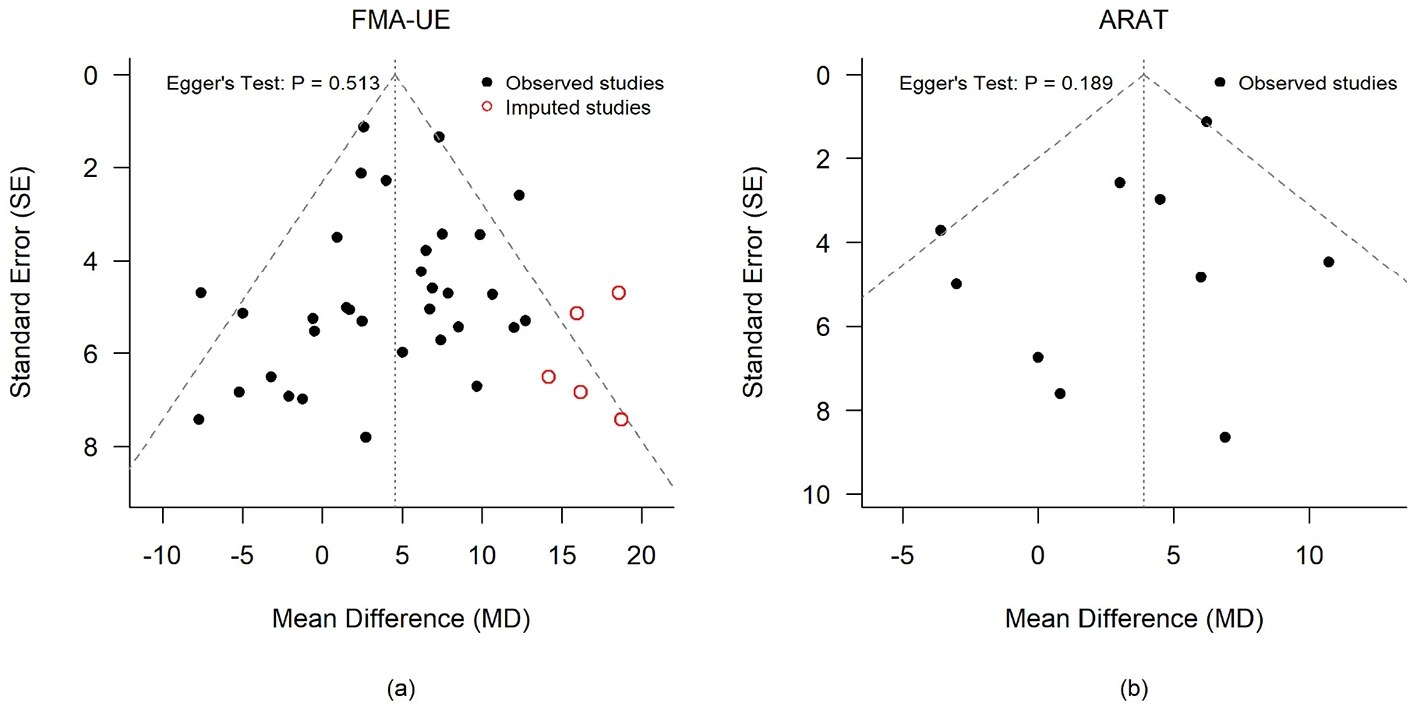
Summary Brain-computer interface training significantly improves upper-limb motor function after stroke, according to a systematic review and meta-analysis of 35 randomized controlled trials involving 1,188 participants, published in Frontiers in Neurology on September 3, 2026. Pooled data showed mean improvements of 4.55 points on the Fugl-Meyer Assessment-Upper Extremity (FMA-UE), 3.90 points on the Action Research Arm Test (ARAT) and 8.53 points on the Wolf Motor Function Test (WMFT), but the effect depended heavily on the comparator: a mean difference of 6.70 against usual care versus only 1.97 against sham-contingent controls. Twenty-two trials reported multi-level neuroplastic changes, though the evidence was insufficient to explain the mechanisms of recovery.
Why it matters The number worth carrying away is not the pooled effect but the spread between comparators: a 6.70-point mean difference against usual care falls to 1.97 against a sham-contingent control, which suggests much of the headline benefit is not specific to the BCI itself. That ratio, not the FMA-UE gain, is what a payer or a trialist should be arguing over, and 22 trials reporting neuroplastic change without explaining a mechanism does not settle it.

脑机接口训练改善卒中后上肢功能,35项试验汇总显示运动评分提升
Image: Frontiers in Neurology, CC BY 4.0

BCIwiki (bciwiki.com) — Brain-computer interface (BCI) training significantly improves upper-limb motor function after stroke, according to a systematic review and meta-analysis of 35 randomized controlled trials involving 1,188 participants. The review, by researchers from Zhejiang University, Beijing Sport University, Nanjing Medical University and other institutions, was published in Frontiers in Neurology on September 3, 2026. Pooled data showed mean improvements of 4.55 points on the Fugl-Meyer Assessment-Upper Extremity (FMA-UE; 95% CI: 2.84 to 6.25), 3.90 points on the Action Research Arm Test (ARAT; 95% CI: 1.31 to 6.50), and 8.53 points on the Wolf Motor Function Test (WMFT; 95% CI: 3.01 to 14.04).

The team searched PubMed, Embase, Web of Science and other databases for randomized controlled trials published up to May 2026. Effects varied by comparator type: the mean difference in FMA-UE was 6.70 points against usual care but only 1.97 points against sham-contingent controls, a significant between-group difference. Stroke stage, signal strategy and feedback modality did not significantly modify the effect. On neuroplasticity, 22 trials reported multi-level changes spanning corticospinal excitability, sensorimotor rhythm modulation and network reorganization, but the evidence was too heterogeneous and sparse to support a mechanistic account of recovery. The review was registered in PROSPERO under identifier CRD420251053630.

Compiled by BCIwiki from public sources

Sources · 1
doi.org 2026-09-03

From these organizations

2026-08 Zhejiang University Review: SSVEP-BCI Application Bottlenecks and Solutions 2026-07 Zhejiang University Preprint: UnSPC Cyclic Adaptation-Generalization Framework for Long-Term BMIs 2026-07 Zhejiang University Preprint: SSCDL Enhances Neural Decoding Generalization in Brain-Machine Interfaces 2026-07 Nanyang Technological University NIRx and Artinis Form fNIRS Partnership Backed by Gilde Healthcare
Read original ↗
Suggest a correction Revisions · none / EN
© 2026 BCIwiki.com Digest Topics Tips Subscribe Revisions About