
/ EN
2026-08-17 00:00 GermanyFranceUnited States Papers Sensation & Feedback Translated from EN

Stanford's Palanker Wins Defense Health Agency Award for PRIMA Retinal Implant

Summary Daniel Palanker, a Stanford professor and affiliate of the university's Wu Tsai Neurosciences Institute, has won the U.S. Defense Health Agency's Outstanding Research Accomplishment award for the PRIMA retinal implant, designed to restore central vision after photoreceptor loss. A 2-mm chip sits beneath the retina and is driven by infrared light from augmented-reality glasses, converting that light into current that stimulates the next layer of neurons. A 2025 paper in the New England Journal of Medicine reported that the device let legally blind patients with advanced dry age-related macular degeneration read letters and words, and the award recognizes its potential for military personnel with laser-damaged retinas.
Why it matters Nominated by the Air Force Office of Scientific Research, this is the first retinal neuroprosthesis recognized by a U.S. defense health body — evidence that vision prostheses now have a military constituency alongside the macular degeneration market. The team's preclinical pixels, one-fifth the size of those in the clinical implant, are the variable to watch, since resolution is what bounds how much a patient can actually read.

斯坦福教授因视网膜植入体获美国国防健康局奖项
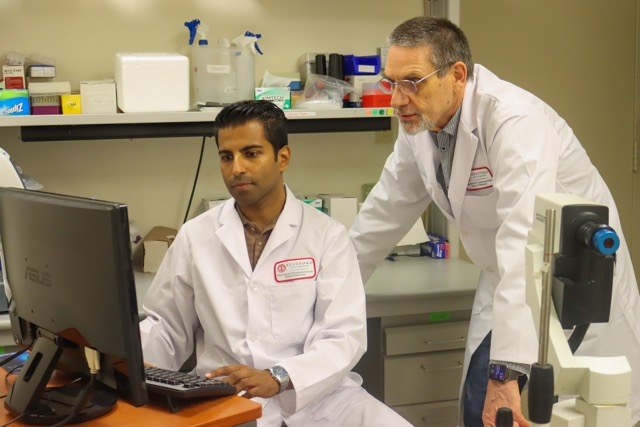
Image: Wu Tsai Neurosciences Institute

BCIwiki (bciwiki.com) — Stanford University ophthalmology professor Daniel Palanker received the Outstanding Research Accomplishment (Individual/Academia) award from the U.S. Defense Health Agency for developing the PRIMA retinal implant. The award was presented at the Military Health Research Symposium in Kissimmee, Florida, on August 3, 2026, following a nomination by the Air Force Office of Scientific Research. Palanker is an affiliate of Stanford University's Wu Tsai Neurosciences Institute, which advances cutting-edge neuroscience research.

The PRIMA system is designed to restore central vision after photoreceptors are lost due to disease or injury. It uses a 2-by-2-millimeter chip implanted beneath the retina, illuminated by infrared light delivered via augmented reality glasses. The chip converts light into electrical current, stimulating the next layer of neurons, which then send signals to the brain. A landmark paper published in the New England Journal of Medicine on October 25, 2025, showed the device restored functional central vision in people with advanced dry age-related macular degeneration, allowing those considered legally blind to read letters and words. The award also recognizes PRIMA's potential to help restore sight following retinal injuries.

After more than two decades of developing PRIMA, Palanker and his collaborators continue to advance the technology, recently demonstrating preclinical results with pixels one-fifth the size of those in current clinical implants, an innovation that could enable substantially higher visual resolution.

Compiled by BCIwiki from public sources

Sources · 2
med.stanford.edu 2026-08-17

From these organizations

2026-09 University of Pittsburgh Synchron Stent Electrode Beats Scalp EEG per Channel in One ALS Patient 2026-09 University of Pittsburgh Carnegie Mellon Team Strips ECG Noise From Stentrode, Keeps Motor Signals 2026-09 Inserm NETBCI Dataset Pairs MEG and EEG from 19 Users across Four BCI Training Sessions 2026-08 Stanford University Review Proposes 'Brain-Inspired BCIs' for Low-Power, Closed-Loop Neurotech
Read original ↗
Suggest a correction Revisions · none / EN
© 2026 BCIwiki.com Digest Topics Tips Subscribe Revisions About