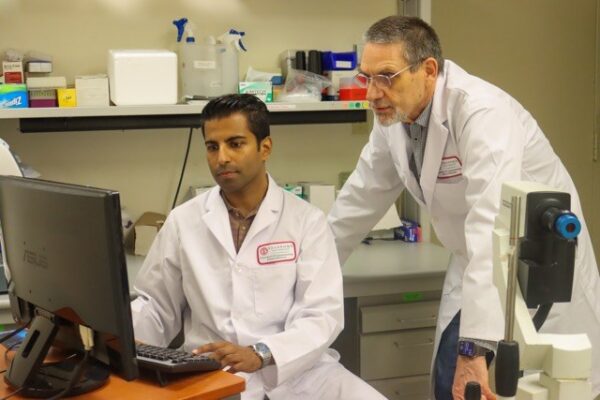
Daniel Palanker, a Stanford professor and affiliate of the university's Wu Tsai Neurosciences Institute, has won the U.S. Defense Health Agency's Outstanding Research Accomplishment award for the PRIMA retinal implant, designed to restore central vision after photoreceptor loss. A 2-mm chip sits beneath the retina and is driven by infrared light from augmented-reality glasses, converting that light into current that stimulates the next layer of neurons. A 2025 paper in the New England Journal of Medicine reported that the device let legally blind patients with advanced dry age-related macular degeneration read letters and words, and the award recognizes its potential for military personnel with laser-damaged retinas.
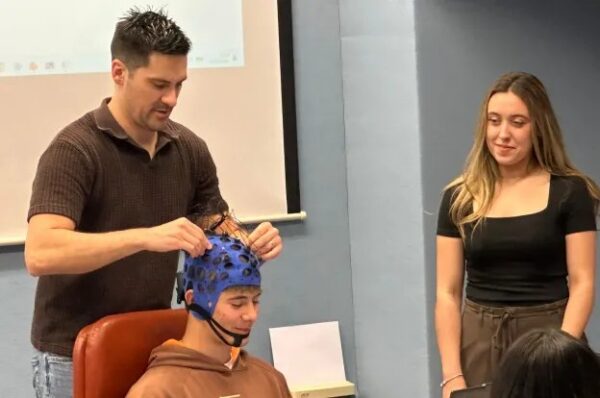
A team from the University of Granada in Spain took a P300 brain-computer interface into a secondary school classroom, using a Bitbrain Versatile EEG system to identify a digit a volunteer had silently chosen, in front of nearly a hundred students. The demonstration grew out of a thesis by industrial electronic engineering student Marta Rodríguez Comino, supervised by Dr. Joaquín T. Valderrama and Dr. Iván López Espejo. The water-based portable EEG system decoded the attention signals using principal component analysis and a support vector machine.