

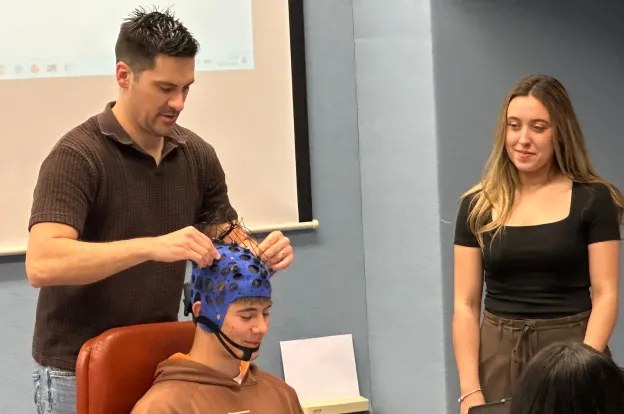
BCIwiki (bciwiki.com) — A team at the University of Granada brought P300 brain-computer interface technology into a secondary school classroom this spring, using a Bitbrain Versatile EEG system to demonstrate guessing a silently chosen digit from brain activity in front of nearly a hundred students. According to a post published on Bitbrain's website on August 7, 2026, the experiment grew out of a thesis by Marta Rodríguez Comino, a final-year student in Industrial Electronic Engineering, supervised by Dr. Joaquín T. Valderrama and Dr. Iván López Espejo.
In the experiment, digits from 0 to 9 appeared sequentially on a screen, and the volunteer was asked to silently count how many times their chosen digit appeared. When the target digit appeared, the brain produced a positive deflection around 300 milliseconds later, the P300 signal, with an amplitude significantly larger than responses to other digits. The team used principal component analysis to reduce the signals to their most informative parts and a support vector machine to learn the boundary between the attended digit and the rest, thereby decoding the digit the volunteer was attending to.
The demonstration was made possible in a classroom setting by the Versatile EEG system's water-based electrodes, which allow setup in just a few minutes and maintain stable signal quality, suitable for live demonstrations. The system synchronized brain signals and on-screen stimuli precisely via a Lab Streaming Layer protocol, with data processed in MATLAB. Bitbrain noted that the event showed how the same EEG equipment used for careful research can also run a live classroom demo in front of a hundred students, giving teenagers hands-on exposure to brain-computer interface technology.