
/ EN

University of Pittsburgh

5 entries
September 2026

Synchron Stent Electrode Beats Scalp EEG per Channel in One ALS Patient

A participant with severe upper-limb paralysis caused by amyotrophic lateral sclerosis (ALS) wore an endovascular stent-electrode array and a scalp EEG cap at the same time, in the same session, while attempting ankle flexion and extension. Both recordings changed markedly during attempted movement, but the stent array showed stronger per-channel motor modulation and was unaffected by skull attenuation. Scalp EEG was more susceptible to eye blinks and jaw-muscle activity, while the stent array picked up prominent cardiac signals. Neither method reliably distinguished left from right ankle movement, leaving spatial localization an open problem.
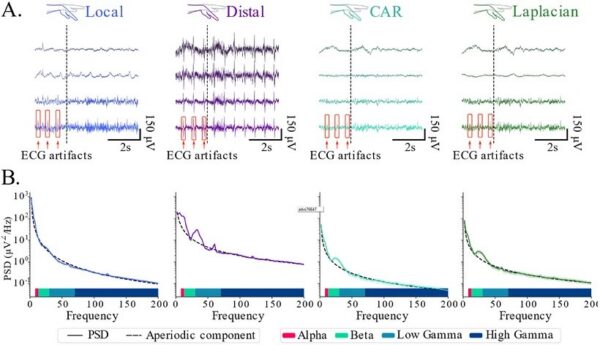

Carnegie Mellon Team Strips ECG Noise From Stentrode, Keeps Motor Signals

Stentrode, an endovascular brain-computer interface, often picks up electrocardiogram (ECG) artifacts. Researchers at Carnegie Mellon University and colleagues found that conventional re-referencing schemes reduce ECG artifacts but also diminish beta-band activity linked to movement. They applied band-limited independent component analysis (BL-ICA) as a spatial filter to remove ECG artifacts while preserving motor features. The study appeared in Advanced Science.
August 2026

Stanford's Palanker Wins Defense Health Agency Award for PRIMA Retinal Implant

Daniel Palanker, a Stanford professor and affiliate of the university's Wu Tsai Neurosciences Institute, has won the U.S. Defense Health Agency's Outstanding Research Accomplishment award for the PRIMA retinal implant, designed to restore central vision after photoreceptor loss. A 2-mm chip sits beneath the retina and is driven by infrared light from augmented-reality glasses, converting that light into current that stimulates the next layer of neurons. A 2025 paper in the New England Journal of Medicine reported that the device let legally blind patients with advanced dry age-related macular degeneration read letters and words, and the award recognizes its potential for military personnel with laser-damaged retinas.

Crossmodal Congruency Test Tells Sensory Feedback Types Apart at the Knee but Not the Foot

A University of Pittsburgh team (Bose et al.) tested the crossmodal congruency effect (CCE) task in 15 able-bodied volunteers to see whether it can quantify how intuitive lower-limb sensory feedback feels. At the knee, the task distinguished more natural pneumatic stimulation from less natural electrical stimulation; at the foot, it could not tell the same stimuli apart. The study was posted to bioRxiv on August 10, 2026. Lower-limb amputees often have balance and gait problems because their prostheses give no somatosensory feedback; electrical-stimulation neuroprostheses can partly restore sensation, but there has been no way to quantify how intuitive that sensation is. The authors stress that external factors affecting the CCE must be identified before it can be used with amputees.
July 2026
© 2026 BCIwiki.com Digest Topics Tips Subscribe Revisions About