
/ EN
2026-09-04 00:00 AustraliaUnited States Papers Foundations & Methods Translated from EN

Carnegie Mellon Team Strips ECG Noise From Stentrode, Keeps Motor Signals

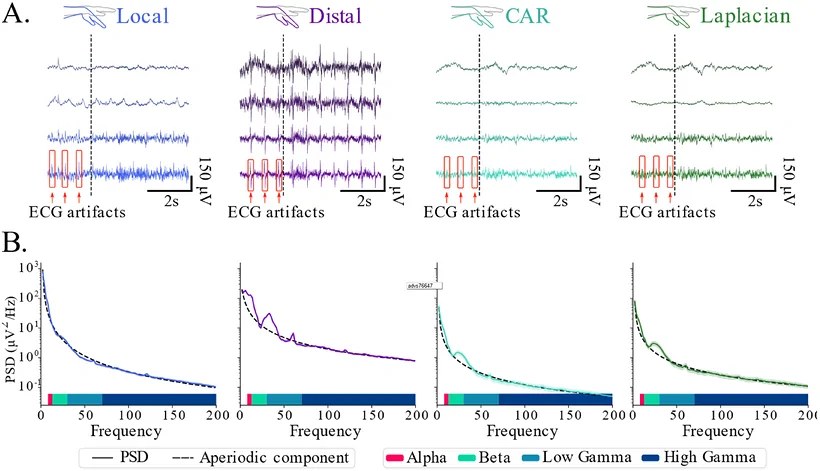
Summary Stentrode, an endovascular brain-computer interface, often picks up electrocardiogram (ECG) artifacts. Researchers at Carnegie Mellon University and colleagues found that conventional re-referencing schemes reduce ECG artifacts but also diminish beta-band activity linked to movement. They applied band-limited independent component analysis (BL-ICA) as a spatial filter to remove ECG artifacts while preserving motor features. The study appeared in Advanced Science.
Why it matters The first artifact-removal method written specifically for endovascular recordings, and a sign the field has moved on from proving that a stent-mounted array can record at all to protecting the narrow frequency band that actually carries movement intent.

去除心电伪迹保留运动特征,卡内基梅隆团队改进Stentrode信号处理
Image: Advanced science (Weinheim, Baden-Wurttemberg, Germany), CC BY 4.0

BCIwiki (bciwiki.com) — A study published in Advanced Science on September 4, 2026, shows that while conventional re-referencing schemes reduce electrocardiogram (ECG) artifacts in signals from the Stentrode endovascular brain-computer interface, they also diminish beta-band activity related to movement; band-limited independent component analysis (BL-ICA) removes ECG artifacts while preserving motor features.

Led by Feldman AK at the Neuroscience Institute, Carnegie Mellon University, the study involved collaborators from the University of Pittsburgh, the Royal Melbourne Hospital at the University of Melbourne, and Synchron, Inc. The researchers compared typical referencing schemes, including monopolar stent-mounted, common average, and Laplacian references, finding that they significantly reduced ECG artifacts but also significantly diminished resting-state beta activity.

They proposed BL-ICA as a spatial filter that weights noise on each electrode differently, effectively separating ECG artifacts from vascular electrocorticography (vECoG) recordings. After reconstructing signals without the ECG component, they evaluated reduced cross-channel correlation and increased relative entropy between rest and go distributions, and assessed beta burst features in both source and reconstructed signal spaces to confirm preservation of low-frequency motor features.

Compiled by BCIwiki from public sources

Sources · 1

From these organizations

2026-09 Carnegie Mellon University Synchron Stent Electrode Beats Scalp EEG per Channel in One ALS Patient 2026-09 Icahn School of Medicine at Mount Sinai 4,096-Channel μECoG Array Maps Brain Function During Surgery With 91.3% Channel Yield 2026-08 Carnegie Mellon University BCI Society Workshop Tackles Outcome Measures for Pivotal Trials 2026-08 University of Pittsburgh Stanford's Palanker Wins Defense Health Agency Award for PRIMA Retinal Implant
Read original ↗
Suggest a correction Revisions · none / EN
© 2026 BCIwiki.com Digest Topics Tips Subscribe Revisions About