
/ EN

BCIwiki — Brain-computer interface news, research and industry database

Latest

September 2026

Apple to Acquire Certain Sonera Assets and Hire Staff, EU Filing Shows

On May 8, 2026, Apple notified the European Commission under Article 14 of the Digital Markets Act that it would, through a subsidiary, acquire certain assets of Sonera and offer jobs to and hire certain Sonera employees. The deal value was not disclosed and neither party has announced it; May 8 is the filing date, and no closing date has been made public. The Commission describes Sonera as a company developing chip-scale magnetic sensors. Founded in 2018 in Berkeley, California, as a University of California, Berkeley spinout, Sonera builds acoustically driven ferromagnetic resonance magnetic sensors that operate at room temperature and has raised about $20 million.
Why it matters Apple's filing, made on May 8 under its gatekeeper notification duties in the EU, went unnoticed by the media for four months, and it describes buying some assets and hiring some staff, not acquiring the company, in the future tense, so the filing date is not a closing date; Sonera's own preprint says its sensors read articulatory muscle activity, not brain signals.
Shandong Hospital Registers Retrospective Cohort Study of Closed-Loop BCI Exoskeleton in Stroke Recovery

The study asks whether adding closed-loop BCI exoskeleton training to conventional rehabilitation improves lower-limb recovery in stroke patients. The retrospective cohort plans to enroll 58 patients in a closed-loop training group and 57 in a conventional rehabilitation group, with the primary endpoint being change in FMA-LE score from baseline to week 6. Secondary outcomes include motor imagery-related EEG features, the 10-Meter Walk Test and the Berg Balance Scale, indicating the researchers want to track both walking function and the brain signals themselves. The trial is self-funded by the research team and has not yet begun recruiting.
Why it matters This is an attempt to test closed-loop BCI exoskeleton training inside a real rehabilitation workflow, with 58 patients in the training arm and 57 in conventional rehabilitation — a sizeable cohort for this kind of study. The primary endpoint is limited to change in FMA-LE score at week 6, but the secondary outcomes pair motor imagery-related EEG features with lower-limb surface electromyography, so behavioral gains and neural signal changes are observed together. It is a retrospective design funded by the research team, and the registration lists neither device models nor actual enrollment figures, so conclusions must wait for the data.

Peking Union Medical College Team's 480-Target Hybrid BCI Hits 260 Bits per Minute

A team at the Institute of Biomedical Engineering, Chinese Academy of Medical Sciences and Peking Union Medical College, has built a hybrid brain-computer interface (BCI) that combines surface electromyography (sEMG) with steady-state visual evoked potentials (SSVEP), encoding 480 targets with 120 flicker frequencies and four hand gestures. In online experiments it achieved a mean classification accuracy of 84.55 ± 7.23% and a mean information transfer rate (ITR), a key measure of practical BCI performance, of 260.07 ± 30.41 bits/min. Its command set matches the largest target counts in existing systems, and the authors place its performance among the top, offering a technical reference for large-command-set BCIs. The work appeared in Cognitive Neurodynamics on September 7, 2026.
Why it matters Matching the largest command sets reported so far while keeping ITR high, the study shows that pairing muscle signals with visual evoked potentials is a workable way to scale BCI commands, though accuracy still has headroom and results come from controlled online sessions rather than real-world use.

Anhui Hospital to Build 400-Person Post-Stroke BCI Dataset

About 70% to 80% of stroke survivors cannot live independently because of physical disability, and regaining walking function is central to changing that. This observational, cross-sectional study plans to enroll 200 stroke patients and 200 healthy controls, collecting EEG, fNIRS, sEMG, fMRI and other central and peripheral physiological signals alongside clinical measures such as Facial Action Units, the Berg Balance Scale and Fugl-Meyer motor function. The goal is a reusable non-invasive BCI dataset for stroke rehabilitation research. First enrollment is set for October 1, 2026.
Why it matters This registration pushes BCI data collection beyond a single modality: EEG, fNIRS, sEMG and fMRI recorded together, paired with fine-grained measures such as Facial Action Units, across 200 stroke patients and 200 healthy controls. It tests no therapy; what it produces is a reusable dataset that teams working on post-stroke motor and affective decoding could use as a baseline. First enrollment is set for October 1, 2026, but the registry does not yet say how many participants will actually be recruited or whether the data will be shared.

Preprint: A 10 mW Comms Budget Can't Carry 1,000-Channel Brain Implants

To move from lab prototypes to long-term clinical systems, implantable brain-computer interfaces must place thousands to millions of electrodes several millimeters to centimeters deep in brain tissue without heating it by more than about 1 degree Celsius. This review benchmarks inductive, mid-field, RF, ultrasonic, magnetoelectric, optical, UWB and electro-quasistatic wireless links against three clinical axes (depth, size and data rate), noting that almost every clinically relevant implant is weakly coupled, with coupling coefficients of only 10^-3 to 10^-1. Within a communication budget of about 10 mW, narrowband high-Q links suit power transfer and low-speed data, but at 1-10 nJ/b they cannot deliver the more than 10 Mbps to tens of Gbps uplinks that interfaces with a thousand or more channels require. The study is a preprint and has not been peer reviewed.
Why it matters The review shifts the question from which wireless link is best to the finding that no existing option delivers the uplink rates thousand-channel-plus implants need under a roughly 10 mW budget and a 1 degree Celsius tissue-heating ceiling. By benchmarking inductive, ultrasonic, UWB and other routes on depth, size and data rate, and laying out a co-design roadmap spanning electromagnetics, packaging, security and regulation, it effectively sets an acceptance checklist for implant communications over the next few years.

Compact Hybrid Deep Learning Model Reaches 83.89% on Four-Class Motor Imagery EEG

Researchers have proposed a compact hybrid deep learning model for classifying four-class motor imagery EEG signals. Combining spatial convolutional filtering, bidirectional temporal modeling and an attention mechanism, the end-to-end model reached a mean accuracy of 83.89% on the public BCI Competition IV Dataset 2a, outperforming conventional baselines. The authors say bidirectional temporal modeling and attention weighting make motor imagery classification more robust, which could help BCIs assist patients with motor disabilities, and that the model offers an efficient option for decoding in resource-constrained settings.
Why it matters At 83.89% mean accuracy on four-class motor imagery, the model clearly beats CSP-LDA and SVM baselines while staying compact, making it a practical decoding option where computing resources are limited.

Vietnamese BCI Speller Types up to 4.95 Characters a Minute in Two-Person Pilot

Two participants typed Vietnamese at 4.95 and 3.45 characters per minute using motor imagery EEG in a pilot test of BCI-vSpeller, a speller built around a custom virtual keyboard of more than 160 selectable keys covering characters, tone marks and special symbols. Researchers from VNU University of Engineering and Technology in Hanoi, reported the findings in Technology and Disability. BCI spellers let users enter text by controlling an interface with mental signals, an approach aimed at people with severe speech and mobility impairments.
Why it matters BCI speller results are overwhelmingly reported for languages that fit a small alphabet, so a writing system needing more than 160 selectable targets is a useful stress test of how selection accuracy holds up as the target set grows. At roughly 5 characters a minute from two participants, the rate is nowhere near conversational, but the value here is the design problem, not the throughput.

Umbrella Review Ties Post-Stroke BCI Gains to Motor Attempt and 20-60 Minute Sessions

Motor attempt, meaning a patient's effort to move a paralyzed limb, was the intent-inducing modality most consistently tied to significant therapeutic effects in an umbrella review of 17 meta-analyses of brain-computer interface systems for stroke motor recovery, published in Symmetry on September 4, 2026 with a literature search cutoff of June 30, 2026. Electrical stimulation was a consistently effective feedback type, while robot-assisted and visual feedback gave inconsistent results, and higher weekly session frequency and moderate session durations of about 20 to 60 minutes were linked to consistent recovery. Combining motor attempt with electrical stimulation may yield greater benefits, the authors suggest.
Why it matters Most BCI stroke evidence argues about whether the therapy works. This review is about which knobs to turn, and it lands on the inexpensive ones: motor attempt as the reliable trigger and electrical stimulation as the reliable feedback, with robotics and visual feedback inconsistent. That points protocol design away from the equipment-heavy end and toward something a rehabilitation ward can actually staff, though the review sits several layers of synthesis above the raw trials, so heterogeneity in stroke type, patient age and intervention window is inherited rather than resolved.

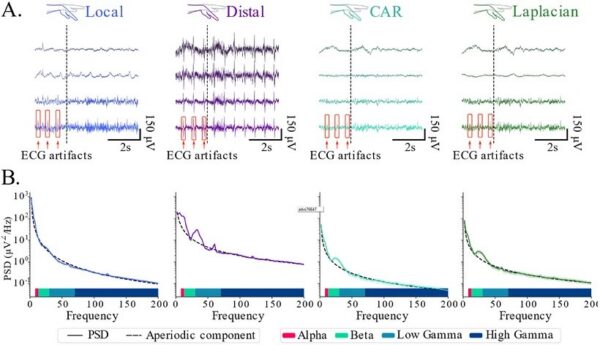
Carnegie Mellon Team Strips ECG Noise From Stentrode, Keeps Motor Signals

Stentrode, an endovascular brain-computer interface, often picks up electrocardiogram (ECG) artifacts. Researchers at Carnegie Mellon University and colleagues found that conventional re-referencing schemes reduce ECG artifacts but also diminish beta-band activity linked to movement. They applied band-limited independent component analysis (BL-ICA) as a spatial filter to remove ECG artifacts while preserving motor features. The study appeared in Advanced Science.
Why it matters The first artifact-removal method written specifically for endovascular recordings, and a sign the field has moved on from proving that a stent-mounted array can record at all to protecting the narrow frequency band that actually carries movement intent.

Speech Imagery BCIs May Be Overrated as Only 36% of Participants Reach Significance

Speech imagery (SI) brain-computer interface results may be hard to reproduce, a University of Essex team reports. When the researchers re-ran published decoding pipelines, classification accuracy averaged 11.25 percentage points below the original reports, with gaps ranging from 2% to 39%; in a replication analysis, only 36% of SI participants cleared the threshold for statistical significance, against 91% in motor imagery (MI) datasets. Published in the Journal of Neural Engineering on September 4, 2026, the study is the first to assess both the reproducibility and the replicability of SI decoding. Every SI study evaluated was missing methodological details, and the authors conclude that SI's feasibility as a practical BCI paradigm may have been overestimated, a warning for clinical applications and follow-up research that rely on it.
Why it matters The first systematic check on whether speech imagery decoding holds up: reproduced accuracies fell 2% to 39% short of the originals and only 36% of participants reached significance, versus 91% for motor imagery, suggesting the paradigm's promise may be overstated.

© 2026 BCIwiki.com Digest Topics Tips Subscribe Revisions About