/ EN

BCIwiki — Brain-computer interface news, research and industry database

Latest

September 2026

BCI Training Improves Post-Stroke Arm Function Across 35 Trials, 1,188 Patients

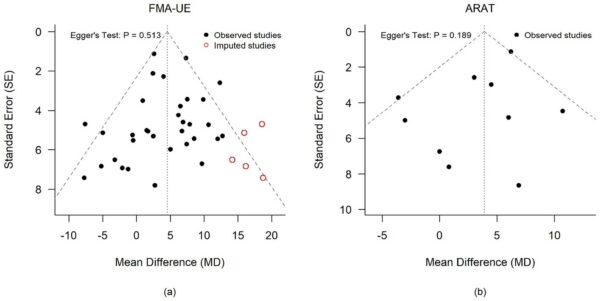
Brain-computer interface training significantly improves upper-limb motor function after stroke, according to a systematic review and meta-analysis of 35 randomized controlled trials involving 1,188 participants, published in Frontiers in Neurology on September 3, 2026. Pooled data showed mean improvements of 4.55 points on the Fugl-Meyer Assessment-Upper Extremity (FMA-UE), 3.90 points on the Action Research Arm Test (ARAT) and 8.53 points on the Wolf Motor Function Test (WMFT), but the effect depended heavily on the comparator: a mean difference of 6.70 against usual care versus only 1.97 against sham-contingent controls. Twenty-two trials reported multi-level neuroplastic changes, though the evidence was insufficient to explain the mechanisms of recovery.
Why it matters The number worth carrying away is not the pooled effect but the spread between comparators: a 6.70-point mean difference against usual care falls to 1.97 against a sham-contingent control, which suggests much of the headline benefit is not specific to the BCI itself. That ratio, not the FMA-UE gain, is what a payer or a trialist should be arguing over, and 22 trials reporting neuroplastic change without explaining a mechanism does not settle it.

Endovascular EEG Records 3.7 Times the Power of Scalp EEG in 5 Patients

Endovascular EEG recorded approximately 3.7 times the power of concurrent scalp EEG in 5 patients undergoing an intracarotid amobarbital injection, known as the Wada test, and the nearest endovascular-scalp electrode pairs showed consistently higher coupling in every participant, a mean difference of 4.9 percentage points ranging from 1.8% to 7.6% across individuals and most pronounced at separations under 30 mm. Endovascular EEG has emerged as a brain monitoring technique that balances signal fidelity against invasiveness, the authors write, matching subdural recordings in bandwidth and signal-to-noise ratio in animal studies, but its signal properties have been sparsely quantified in people. All signals were preprocessed with artifact rejection and independent component analysis, then assessed with power spectral density, imaginary coherence, phase-locking value and amplitude envelope correlation.
Why it matters The case for endovascular electrodes has rested largely on animal work showing they approach subdural quality without a craniotomy, which leaves the human operating range unspecified. Measuring power and scalp coupling directly in patients converts that claim into numbers a device team can design against. The cohort is 5 patients recorded during a Wada test, so the setting is diagnostic rather than a working interface.

PNPL 2026 Challenges Teams to Adapt Speech Decoders on 10 Minutes of Data

A preprint posted to arXiv on September 3, 2026, sets out the 2026 PNPL competition, built on an extended LibriBrain100 dataset that adds 32 subjects at about 40 minutes each and roughly 80 more hours of within-subject data. The competition runs two tracks: a Deep track for within-subject word classification at scale, and a Broad track for cross-subject generalization that steps subject-specific fine-tuning data down from about 40 minutes to 20 and then 10, a clinically feasible range. Winning 2025 submissions reached F1-macro scores of 95.6% on speech detection and 73.6% on phoneme classification.
Why it matters The number that matters here is 10 minutes. Non-invasive speech decoding is usually demonstrated on hours of data per subject, which is fine for a paper and unworkable in a clinic, so a track that forces adaptation inside a single appointment changes what counts as a competitive method. Competitions steer a field's effort more efficiently than individual papers do, and this one is pointed at transfer rather than peak accuracy.

Implant-Grade BCI Preserves Epilepsy HFO Biomarkers, Maps Onset Zone at 84% Sensitivity

A wireless implantable neural interface, the Brain Interchange (BIC), paired with artifact-removal algorithms captured about 82% of the high-frequency oscillations (HFOs) that a clinical-grade amplifier detected across 24-hour intracranial EEG recordings in 10 patients with drug-resistant epilepsy, according to a preprint. Using those HFOs, the system localized the seizure onset zone with 84% sensitivity and 90% specificity, comparable to clinical equipment. The authors present the work as a translational framework for chronic tracking of epileptogenic networks and for future biomarker-guided adaptive neuromodulation.
Why it matters HFO biomarkers were defined on rack-mounted clinical amplifiers, so the open question for closed-loop neuromodulation was whether they survive the move onto an implant's narrower, noisier sensing chain. Preserving 82% of individual events while still localizing the onset zone at 84% sensitivity suggests the clinically useful signal is spatial rather than event-by-event, which is a much easier specification for a chronic device to meet. The evidence is 10 patients over 24 hours, in a preprint.

Anti-Fouling Coating Shields Neural Electrode, Signal Stays Clear for Six Months

Researchers at the Technical Institute of Physics and Chemistry of the Chinese Academy of Sciences and collaborating institutions have developed a neural electrode interface that, they report, significantly extended electrode operational lifetime and improved signal fidelity over six months of in vivo implantation. The material, a benzyloxycarbonyl-substituted poly(ornithine-alt-glycine) coating abbreviated OGCbz, resists biofouling and immunogenic rejection without degrading electrical performance, targeting what the authors call the critical obstacle to electrodes that combine long-term recording with tunable biofunctional control: an immune-mediated foreign body response in which glial scar encapsulates implants like cement. Substituting the Cbz group with other functional moieties preserves those antifouling and biocompatibility properties while adding new ones, and as a proof of concept the peptide sequence IKVAV and the antibody cetuximab gave the interface neuron affinity and tumor cell proliferation inhibition respectively; the six-month result came from the IKVAV-functionalized version.
Why it matters Chronic implant failure is usually an immunology problem rather than an electronics one, and coatings that resist encapsulation typically do so by being inert, which forecloses any active role at the tissue interface. Making the antifouling backbone a substitutable platform, then hanging a peptide or an antibody off it without losing that inertness, is the more interesting claim here. A six-month in vivo window is long enough to matter for chronic recording, though the work stays preclinical.

EEG Signal Lifts Team Decision Accuracy to 88%, but Only Under High Workload

Spatial-covariance EEG features can flag whether an operator's decision will be correct before the response is committed, and weighting group votes by that signal raised accuracy on contested trials from 57% to 88% as team size grew from 2 to 16, according to a preprint. Twenty-three participants ran a virtual reality target-detection task under high and low cognitive workload, and the gain appeared only in the high-workload condition; under low workload the weighting hurt performance. EEG-based decision-reliability signals are therefore workload-conditional rather than a general-purpose team augmentation tool, the authors write; the preprint has not been peer reviewed.
Why it matters The useful half of this result is the negative one. The same neural vote-weighting that helps under high workload actively hurts under low workload, which turns a proposed general-purpose team augmentation into a gating problem: a deployment would have to sense workload before switching the signal on. At 23 participants in a VR task this is a lab-scale finding, but it names a condition collaborative BCI work rarely tests for.

NVOL: Mid-Layer CLIP Alignment Lifts EEG Image Retrieval to 86.4%

A preprint from Minyi Wang, Zhenqin Wu and Rihui Li reports that aligning EEG signals to an intermediate CLIP layer rather than the final one raised 200-way image retrieval on the THINGS-EEG dataset to 78.1% mean Top-1 accuracy, and to 86.4% with CSLS. Layer-wise contrastive learning selects that layer, which the authors call the Neural Visibility Optimal Layer (NVOL); the same representation then drives generation, with a conditional diffusion prior reconstructing subject-specific NVOL features and mapping them into CLIP space for Stable Diffusion XL, which the authors say beats single-stage final-layer diffusion on semantic and structural metrics. The paper was posted to arXiv on September 2, 2026, and has not been peer reviewed.
Why it matters EEG visual decoding has largely treated CLIP's final layer as the alignment target by default, a choice inherited from vision-language work rather than from anything about neural signals. Letting contrastive learning pick the layer, and then reusing that same representation for reconstruction instead of a separate generative head, is a cheap change with a measurable payoff, which makes it easy for other groups to test. It is a preprint on a single public dataset, so the layer choice may not transfer.

OVMI Metric Puts Speech BCI Results on a Common Scale

Researchers have proposed Open-Vocabulary Mutual Information (OVMI), an information-theoretic metric that scores speech brain-computer interfaces on a common scale, and used it to show that accuracy figures computed only over a system's supported vocabulary can overstate how much of a user's intended speech actually gets through. Speech BCIs translate neural activity into language and offer a path to restoring communication for people with paralysis, but systems differ in datasets, recording methods and vocabularies, leaving their reported scores hard to compare. Choosing a vocabulary that maximizes OVMI yielded up to 16.3% relative accuracy improvement across three speech domains; the preprint has not been peer reviewed.
Why it matters Speech BCI results are reported as percentages over a vocabulary each team chooses for itself, so the numbers different groups publish were never strictly comparable. A metric that prices in what the vocabulary leaves out makes those claims rankable, and the finding that vocabulary selection alone buys up to 16.3% relative accuracy suggests how much reported progress has been design choice rather than better decoding. Whether it matters depends on adoption, since a metric only disciplines a field once the leaderboards use it.

Transdural Link Hits 500 Mbps for Brain Implants

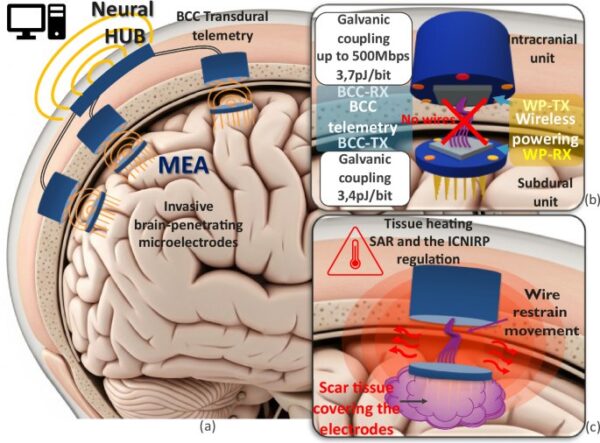
Researchers at imec, Eindhoven University of Technology and Erasmus MC propose a two-stage wireless architecture for intracortical BCIs: a transdural galvanic-coupled body channel link carries data from a free-floating microelectrode array to an intracranial unit, and a transcutaneous link then relays it outside the body. In phantom tests and ex vivo experiments on a human cadaveric head, the transdural link reached 500 Mbps at 20% duty cycling with bit error rates below 10⁻⁵. A built-in send-on-delta encoder (SODA) compresses data by up to 11.4x to cut thermal load, and brain-on-a-chip models showed no unintended neural activity. The study appeared in Communications Engineering on September 1, 2026.
Why it matters Data from high-density arrays already exceeds what implant radios can carry, and every wireless iBCI roadmap runs into the same bandwidth, power and heat wall. This work attacks all three in one architecture and validates it on a cadaveric head rather than in simulation alone, which makes it a credible building block for high-channel-count implants.

48-Subject Study Shows 3-Channel P300 Matches 8-Channel Performance

Researchers at Guangzhou Maritime University, Guangdong University of Technology and Guangzhou University in southern China combined a genetic algorithm with Bayesian linear discriminant analysis to pick a fixed, strongly generalizable three-channel subset from a conventional eight-channel P300 BCI, avoiding per-user recalibration. In offline and online virtual reality experiments with 48 healthy subjects, the three-channel system matched the eight-channel system on accuracy and information transfer rate, while equipment preparation fell from 30 minutes to 3, a 90% cut. NASA-TLX scores showed significantly lower mental and physical workload. The study was published in Biomimetics on September 1, 2026.
Why it matters Electrode setup cost is one of the main barriers keeping non-invasive BCIs in the lab. Showing in 48 users that a 3-channel montage holds accuracy while cutting preparation to a tenth of the time is directly relevant to consumer and rehabilitation deployments, where every minute of setup is a reason not to use the device.

© 2026 BCIwiki.com Digest Topics Tips Subscribe Revisions About