
/ EN

BCIwiki — Brain-computer interface news, research and industry database

Latest

September 2026

Neuracle Registers Cortical Electrode in China's NMPA Device Identifier Database

Neuracle Medical Technology (Shanghai) Co., Ltd. has registered a cortical electrode, model 1014-35, in the medical device unique identification (UDI) database of China's National Medical Products Administration (NMPA), under registration certificate Guoxiezhuzhun 20263120536. Neuracle's product line spans EEG acquisition equipment and implantable electrodes. The electrode belongs to an implantable EEG electrode kit (cortical electrode, blank electrode, electrode dilator, tunneler, torque wrench, lead fixation clip, fixation screws and electrode protective sleeve) that holds its own registration certificate and is also a component of an implantable BCI hand motor function compensation system. That system comprises a BCI implant, the electrode kit, an EEG signal transceiver, a pneumatic glove, a single-use surgical toolkit, and three software packages for EEG decoding, medical testing and clinical management.
Why it matters What was registered is not a complete BCI but a single cortical electrode, and the detail that matters is that its electrode kit is certified in its own right while also forming part of the implantable hand motor function compensation system, indicating the system is going through registration component by component; how complete its parts list is (implant, electrode kit, signal transceiver, pneumatic glove and three software packages) is a direct clue to how far it is from clinical use.
Passenger EEG Helps Self-Driving AI Spot Road Risks Early With 95.3% Balanced Accuracy

Researchers recorded passengers' EEG as they watched driving scenes in a highly automated vehicle, then trained models to judge whether a risk lay ahead and where the hazard appeared. A 3D-CRNN reached 95.3% ± 2.7% balanced accuracy in risk prediction and raised hazard identification from 80.9% to 85.0%. In cross-subject tests on passengers the model had not seen, balanced accuracy fell to 64.9% ± 8.5%, showing the approach is still some way from deployment.
Why it matters Using the passenger, not the driver, as the signal source sets this work apart from most brain-controlled vehicle research, but the 95.3% and 85.0% figures are within-subject and drop to 64.9% across subjects, so the model remains sensitive to individual EEG differences; the paper has been accepted by Automotive Innovation but is currently a preprint that has not been peer reviewed.

Preprint: Federated NEXUS-MI Cuts Motor-Imagery BCI Backbone Traffic by About 42%

Motor-imagery brain-computer interfaces vary widely between users and have little calibration data, and federated learning lets them share a model without uploading raw EEG. NEXUS-MI treats gateway synchronization as a joint learning-and-communication control problem: raw EEG and classifier heads stay local, while an edge coordinator maintains the shared backbone network. On the BCICIV-2a and OpenBMI datasets, communication-aware coordination cut server-to-client backbone traffic by about 42%, with small, implementation-dependent differences in cohort-average accuracy. Those averages masked individual vulnerability: on BCICIV-2a, losses relative to an ideal-link reference reached about 12 percentage points.
Why it matters Federated learning is usually pitched as a privacy fix, but this preprint treats it as a communication-scheduling problem in which gateway synchronization, stale-update admission and backbone download timing all shape individual accuracy; the 42% saving comes from backbone traffic rather than local EEG, and the more telling result is that cohort averages barely moved while some individuals lost up to 12 percentage points, so federated BCI evaluations that report only averages fall short and reliability must be judged per user.

Imagining Jogging Strengthens Sense of Owning a BCI-Controlled Avatar, Keio Team Finds

Participants steering a virtual avatar with a brain-computer interface reported a stronger sense that the avatar's body was their own when they imagined jogging than when they imagined opening their right hand, even though jogging imagery produced weaker EEG signals. Forward movement was driven by motor imagery-related sensorimotor rhythm event-related desynchronization from scalp EEG and direction by eye gaze, as participants guided a jogging avatar along a curved course before rating their embodiment in questionnaires. The researchers say neural signal strength and embodied experience can diverge, so the congruence between imagery and action should be weighed alongside standard decoding metrics.
Why it matters By measuring signal strength and felt body ownership separately, the study finds they diverge (jogging imagery produced weaker sensorimotor rhythm desynchronization but stronger avatar ownership), which makes imagery-action congruence a tunable design variable for BCI developers alongside decoding accuracy; the work involved a small group of healthy participants and has not been tested in patients.

1,145-Patient Meta-Analysis Finds Stronger Evidence for Robotic Stroke Rehab Than BCI

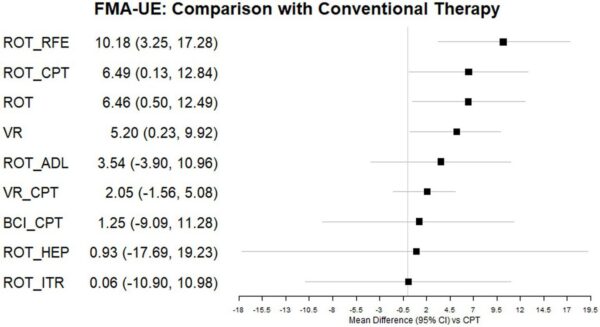
Which new technology does most for upper-limb recovery after stroke: virtual reality, robotics or a brain-computer interface (BCI)? A systematic review and network meta-analysis placed all three in a single evidence network, pooling 25 randomized controlled trials and 1,145 stroke survivors. The authors searched PubMed, Web of Science, the Cochrane Library and Embase from inception to October 2025, used conventional physical therapy as the common comparator in a star-shaped network, and applied a Bayesian random-effects model to estimate relative efficacy and calculate SUCRA rankings. Robot-assisted training produced the most robust findings, with two studies supporting robotics plus conventional physical therapy and three supporting robotics alone; only one BCI study yielded extractable data, too little to judge efficacy. The authors caution that the top-ranked intervention, robotics combined with rehabilitative functional electrical stimulation, rests on a single trial and should not be read as definitive evidence of superiority.
Why it matters Robotic training and BCIs are often lumped together in stroke rehab but had never been compared directly; with robotics on firmer ground and only one usable BCI study, patients and rehab clinicians choosing BCI training still lack comparable efficacy data.

Parkinson's Patients Learn to Control Deep Brain Stimulation Through a BCI Game

Researchers at the University of California, San Francisco (UCSF), a public research university known for its neuroscience work, had two Parkinson's disease patients train at home with a brain-computer interface (BCI) airplane-simulator game, learning to down-regulate cortical beta activity and thereby control the intensity of their own deep brain stimulation (DBS). The work, posted as a preprint on medRxiv on August 17, 2026, points to BCI applications in neuromodulation and to more personalized treatment for Parkinson's and other conditions; its conclusions have not yet been peer reviewed.
Why it matters The first demonstration that patients can learn to set their own intracranial stimulation without an external handheld controller, with two patients using chronic at-home training to drive closed-loop DBS; the approach could extend to personalized stimulation for other neuropsychiatric disorders, pending peer review.

FDA Clears Pascall Systems' EEG Software Under 510(k)

Pascall Systems, Inc. received U.S. Food and Drug Administration (FDA) 510(k) clearance for its Pascall Sensor Unit (PSU1) on August 19, 2026, with the agency finding the device substantially equivalent. The device is a Class II medical device under regulation number 882.1400, classification name Non-Normalizing Quantitative Electroencephalograph Software.
Why it matters A regulatory step for BCI signal acquisition and decoding: 510(k) clearance means the quantitative EEG software PSU1 can be legally marketed in the U.S., which bears directly on commercializing EEG analysis tools.

Generative AI Lowers the Bar for BCI Attacks, Putting Cognitive Autonomy at Risk

Researchers have mapped the brain-computer interface (BCI) attack surface along five dimensions (forged neural signals, desynchronization-based evasion, replay hijacking, "Vein Tapping" eavesdropping and embedded backdoors), which they group as "NERVE Attacks" and describe as orthogonal and together spanning the full BCI stack. Their EEGle framework, which the team is releasing to the community for building and verifying device security, surfaced 17 new neuro-specific attack instances and a stealth-versus-effectiveness trade-off in backdoor design. The authors warn that generative AI is lowering the barrier for non-expert attackers, with risks to cognitive autonomy, mental privacy and physical safety, from neural data exfiltration to malicious control of BCI-connected devices. The preprint, by Zahra Tarkhani, Georgios Akkogiounoglou, Lorena Qendro, Isabel Tscherniak and Anil Madhavapeddy, has not been peer reviewed.
Why it matters BCI security research lags well behind the rollout of neural prostheses and consumer headsets, largely because the field has treated BCIs as a signal-processing problem; this preprint layers the attack surface along the BCI stack and produces 17 reproducible attack instances with an automated framework, in effect a testable checklist. It has not been peer reviewed, and no third party has yet shown the attacks work on real hardware.

At-Home BCI Therapy Beats Home Exercise for Chronic Stroke Arm Deficits in Randomized Trial

Chronic stroke patients who used an at-home brain-computer interface (BCI) therapy system gained a mean 6.0 points on the Upper Extremity Fugl-Meyer Assessment after 12 weeks, versus 1.5 points for those on a home exercise program. Response rates were 55.5% and 9.6%, for a number needed to treat of 2.2. The trial also exposed the dropout problem in home-based studies: 17 of 42 control participants withdrew because they were dissatisfied with their group assignment.
Why it matters Because both arms trained at home, this randomized trial directly tests whether remote BCI rehabilitation beats current practice, and a number needed to treat of 2.2 means roughly one additional responder for every two patients treated; but with 17 of 42 control participants quitting over their assignment and only 62 patients in the final analysis, the effect may be overstated, and adherence emerges as a real weak point for home-based trials.

KU Leuven Team Finds EEG Tracking of Moving Objects Weakens Farther From the Gaze Point

Even when the eyes stay fixed on one point, the brain tracks moving objects in a video, and that tracking grows stronger with attention. But researchers at KU Leuven found that EEG tracking of an object's motion weakens the farther the object sits from the fixation point, meaning decoding methods that read attention from tracking strength may mistake where an object is for where attention is.
Why it matters Visual attention decoding is an emerging BCI approach built on the assumption that stronger coupling between brain signals and object motion means more attention; with eye-movement artifacts controlled, this study shows coupling also drops with distance from the fixation point, so coupling strength carries a positional confound that attention-decoding researchers will need to correct for.

© 2026 BCIwiki.com Digest Topics Tips Subscribe Revisions About