
/ EN

Endovascular BCI

8 entries

Endovascular BCIs deliver electrodes into cerebral blood vessels via catheter procedures, recording cortical signals without craniotomy. Synchron's Stentrode leads this approach with clinical trials in the U.S. and Australia.

September 2026

Synchron Stent Electrode Beats Scalp EEG per Channel in One ALS Patient

A participant with severe upper-limb paralysis caused by amyotrophic lateral sclerosis (ALS) wore an endovascular stent-electrode array and a scalp EEG cap at the same time, in the same session, while attempting ankle flexion and extension. Both recordings changed markedly during attempted movement, but the stent array showed stronger per-channel motor modulation and was unaffected by skull attenuation. Scalp EEG was more susceptible to eye blinks and jaw-muscle activity, while the stent array picked up prominent cardiac signals. Neither method reliably distinguished left from right ankle movement, leaving spatial localization an open problem.
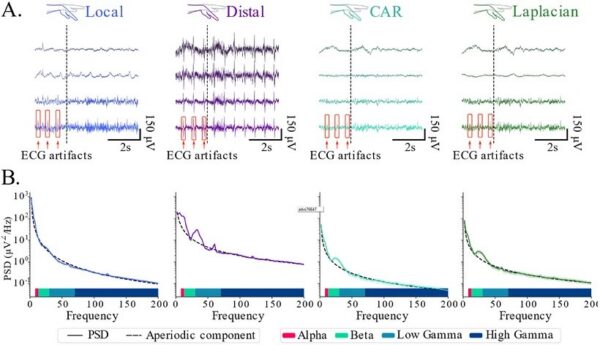
Carnegie Mellon Team Strips ECG Noise From Stentrode, Keeps Motor Signals

Stentrode, an endovascular brain-computer interface, often picks up electrocardiogram (ECG) artifacts. Researchers at Carnegie Mellon University and colleagues found that conventional re-referencing schemes reduce ECG artifacts but also diminish beta-band activity linked to movement. They applied band-limited independent component analysis (BL-ICA) as a spatial filter to remove ECG artifacts while preserving motor features. The study appeared in Advanced Science.

Endovascular EEG Records 3.7 Times the Power of Scalp EEG in 5 Patients

Endovascular EEG recorded approximately 3.7 times the power of concurrent scalp EEG in 5 patients undergoing an intracarotid amobarbital injection, known as the Wada test, and the nearest endovascular-scalp electrode pairs showed consistently higher coupling in every participant, a mean difference of 4.9 percentage points ranging from 1.8% to 7.6% across individuals and most pronounced at separations under 30 mm. Endovascular EEG has emerged as a brain monitoring technique that balances signal fidelity against invasiveness, the authors write, matching subdural recordings in bandwidth and signal-to-noise ratio in animal studies, but its signal properties have been sparsely quantified in people. All signals were preprocessed with artifact rejection and independent component analysis, then assessed with power spectral density, imaginary coherence, phase-locking value and amplitude envelope correlation.
August 2026

Endovascular Electrodes Evoke Cortical Responses

The study was published in Journal of neural engineering on August 13, 2026, presenting the first strength-duration characterization of cortical evoked potentials elicited by endovascular stimulation adjacent to the cerebellum. The authors note that electrical stimulation and neural recording underpin neural prostheses for restoring function and treating neurological disorders, but that clinical adoption is limited by the invasiveness of implantation, while the Endovascular Neural Interface offers an alternative by accessing intracranial targets through the cerebral vasculature. A polymer-based stent-electrode array was deployed into the left transverse sinus of an ovine model, and biphasic current pulses targeting the cerebellum were delivered via the stent electrodes while a subdural electrocorticography grid recorded cortical responses. Endovascular stimulation consistently evoked time-locked cortical potentials with early and late components at approximately 40 ms and 100 ms post-stimulation, and impedance monitoring confirmed electrode functionality and stability throughout. Strength-duration analysis revealed rheobase and chronaxie values, providing a quantitative basis for parameter selection and comparison with established intracranial stimulation modalities.
July 2026

Multimodal Imaging Workflow for Intraprocedural Targeting of Endovascular Stentrode Deployment

Researchers evaluated the technical feasibility of a multimodal imaging workflow for deploying Synchron's Stentrode endovascular brain-computer interface in a human head phantom. The workflow — thin-slice CT, transfer of DICOM data to an external core laboratory for target identification and marking, re-import of the marked CT, 3D rotational angiography, and registration with the marked reconstruction and intraoperative fluoroscopy — produced a dataset suitable for anatomical analysis, with the core laboratory marking the intended deployment region and the markings persisting through transfer and re-import, and the annotated CT fusing with 3D angiography without significant misregistration or artifacts. The authors say the workflow can generate intraprocedural targeting guidance for Stentrode deployment, as a preclinical technical validation.
June 2026

OYMotion and MicroPort NeuroScientific Partner on Endovascular BCI Rehab System

OYMotion and MicroPort NeuroScientific signed a strategic cooperation agreement on May 28, 2026 to jointly develop an interventional brain-computer interface rehabilitation system. The first product will be a multi-channel endovascular BCI that threads a signal-recording stent through the blood vessels to a target brain region, capturing intracranial electrical activity without opening the skull. MicroPort NeuroScientific will build the BCI system as a whole and OYMotion the limb side, with the pair targeting medical rehabilitation and human-machine interaction.
November 2025

Synchron Raises $200 Million Series D, Bringing Total Funding to $345 Million

Synchron raised a $200 million Series D led by Double Point Ventures, taking its total funding to $345 million. The company plans to use the capital to commercialize its Stentrode endovascular BCI, prepare pivotal trials and expand its AI and engineering teams. Synchron said 10 people with paralysis had received the implant in U.S. and Australian trials at the time of the announcement.
September 2024

Synchron Reports 12-Month COMMAND Results in Six U.S. Participants

Synchron reported 12-month results from the U.S. COMMAND early feasibility study in six people with severe chronic bilateral upper-limb paralysis. All participants met the primary safety endpoint of no device-related serious adverse event causing death or permanent increased disability, and motor-intent signals were converted into digital actions throughout the study. The disclosure was not a two-year pivotal-trial report.
© 2026 BCIwiki.com Digest Topics Tips Subscribe Revisions About