Tongji Hospital Performs Central China's First Fully Invasive BCI Implant
Summary
Surgeons at Tongji Hospital in Wuhan, central China, implanted a 256-channel brain-computer interface on 3 August using electrodes 2 to 3 micrometres thick, compared with semi-invasive arrays that are millimetres thick, sit outside the dura and carry eight contacts. Eastern China's Shandong performed its own first provincial case in late July. Hubei now covers all three BCI approaches clinically.
Why it matters
Back-to-back firsts in two provinces put invasive BCI beyond China's handful of national centres; the three superlatives attached to this case arrive without a manufacturer's name, and innovative medical device status is fast-track review, not market approval.
BCIwiki (bciwiki.com) — Surgeons at Tongji Hospital, part of Huazhong University of Science and Technology’s Tongji Medical College in Wuhan, implanted a brain-computer interface on 3 August 2026 in what the hospital calls central China’s first fully invasive BCI operation. The patient, a 55-year-old woman given the pseudonym Hu Damin in Chinese reports, was discharged on 13 August. A spinal cord injury two years ago left her with high-level paralysis; she could raise her upper arms slightly but had no movement in her fingers or wrists.
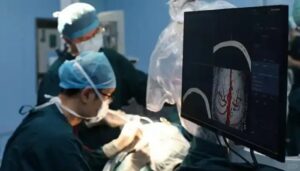 The hospital operated after assessment and with consent from the patient and her family. The operation was performed under a microscope by teams led by Tang Zhouping of neurology and Shu Kai and Hu Feng of neurosurgery. Eight ultraflexible electrodes, each just 2 to 3 micrometres thick, were passed through a burr hole about 1 cm across and placed in the motor cortex. Each electrode carries 32 contacts, giving 256 recording channels in total. For comparison, the report describes semi-invasive arrays as millimetres thick, sitting outside the dura, with only eight contacts. More information, Shu said, is what lets doctors and engineers decode a patient’s intent more accurately. The device is described as China’s first high-throughput, single-neuron-resolution BCI and as the least invasive fully implanted brain-control product currently available anywhere, holding innovative medical device designation from the National Medical Products Administration. It bypasses the damaged spinal cord, decoding intentions such as raising an arm or walking into commands for a robotic arm, a wheelchair, a cursor or smart home devices. Neither the product name nor the company behind it was disclosed. Tongji opened a BCI research institute in September 2025, which it says was the first at a Chinese hospital. On 31 March 2026 the Hubei provincial science and technology department approved the hospital to lead 12 organisations, among them Huazhong University of Science and Technology and Hubei Optics Valley Laboratory, in forming a provincial BCI technology innovation centre, positioned as China’s first comprehensive full-chain platform of its kind at provincial level and headed by Tang Zhouping, the hospital’s party secretary. By April 2026 the hospital reported more than 50 BCI-related clinical trials. With this operation, all three approaches — fully invasive, semi-invasive and non-invasive — are now in clinical use in Hubei. The patient will now connect to an external BCI system under hospital supervision, learning to control a cursor, a phone and a wheelchair by thought while training to rebuild signalling between brain and limbs and recover fine movement in her upper limbs. The report cites roughly 4 million people living with spinal cord injury in China, with about 90,000 new cases a year, 85 percent of them of working age.
Compiled by BCIwiki from public sources