

August 2026
ReCIL: Rehearsal-Based Class Incremental Learning for Cross-Subject Motor Imagery Classification
Researchers propose ReCIL, a rehearsal-based class incremental learning method for cross-subject motor imagery classification that lets a model learn new MI classes sequentially without retraining from scratch. Using Euclidean alignment to reduce cross-subject EEG distribution shift and global-local replay to preserve earlier-task knowledge, ReCIL achieved a good balance between plasticity and stability across three public MI datasets. The authors report it as the first study of cross-subject class incremental learning for MI classification.
July 2026
Bio-Inspired Methods Target EEG Robustness
A perspective review published in Computers in biology and medicine examines EEG non-stationarity across sessions, people, and recording conditions. It asks whether mechanisms that help the brain maintain functional stability can improve the robustness of brain-computer interface models. The review covers synaptic plasticity, homeostatic regulation, neural oscillations, and spiking representations, comparing bio-inspired approaches with conventional machine learning and transfer learning. It also considers hybrid designs that combine biologically grounded mechanisms with artificial neural networks. The author proposes operational definitions for bio-inspired, bio-plausible, and bio-realistic modeling, together with a minimum specification for continual EEG benchmarks. Because direct EEG evidence remains limited for several proposed mechanisms, the review stresses the need to distinguish empirical findings from hypotheses and future research directions.
June 2026
Injectable Antifouling Adhesive Hydrogel Enables Robust Neural Interfaces for Stable ECoG Recording
Researchers propose an injectable, in-situ-gelling multifunctional hydrogel to address the failure modes of micro-ECoG cortical recording — dural barrier disruption, cortical micromotion that weakens device-tissue coupling, and biofouling that triggers a foreign-body response. Combining dopamine-grafted sodium alginate with branched polyethyleneimine, the hydrogel forms a quasi-zwitterionic network that resists nonspecific protein adsorption and provides catechol-mediated wet adhesion, gelling rapidly under surgical-compatible conditions through dual macromolecular crosslinking without diffusible small-molecule monomers. Integrated with a 128-channel flexible micro-ECoG mesh array, the platform reduced glial activation and fibrotic encapsulation and preserved stable, high-fidelity cortical recording over the 3-week early chronic period. The authors say co-designing barrier repair, interface adhesion and antifouling in a single material can improve long-term function.
April 2026
China Hubei Approves a Provincial BCI Innovation Centre Led by a Hospital
On 31 March 2026 Hubei's provincial science and technology department approved the formation of a provincial brain-computer interface technology innovation centre, led by Tongji Hospital in Wuhan together with 12 organisations including Huazhong University of Science and Technology and Hubei Optics Valley Laboratory. Chinese reports describe it as the country's first provincial BCI platform positioned as comprehensive and full-chain. Its stated priorities are neural signal decoding, domestic sourcing of core components, and refining both non-invasive and implanted approaches. It is headed by Tang Zhouping, the hospital's party secretary.
December 2025
China Bills a Brain Implant Under a State-Set Price for the First Time
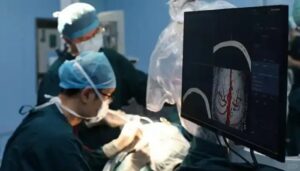
Tongji Hospital in Wuhan implanted a 64-channel high-throughput flexible electrode array made by Wuhan Neuracom into a 31-year-old man paralysed by a spinal cord injury on 26 November 2025. The procedure was charged under the country's first BCI medical service price schedule, issued by Hubei's healthcare security bureau in March 2025, which sets implantation at 6,552 yuan. China's National Healthcare Security Administration calls it the first BCI operation in the country carried out under a state-set price. This patient's costs were covered by research funding.
September 2025
Chinese Hospital Opens Its Own Brain-Computer Interface Research Institute
Tongji Hospital in Wuhan announced a brain-computer interface research institute on 5 September 2025, which it says is the first of its kind run by a hospital in China rather than by a university or a company. The institute covers basic research, clinical application and commercialisation, with the stated aim of building a full-chain BCI system spanning prevention, diagnosis, treatment and rehabilitation of neurological disease.