
/ EN

BCIwiki — Brain-computer interface news, research and industry database

Latest

May 2026

Trial Pairs iTBS With Motor Imagery BCI Training for Post-Stroke Arm Impairment

Guangdong Provincial Hospital of Traditional Chinese Medicine has registered a parallel-design interventional trial, ChiCTR2600124411, that plans to enroll 81 patients with unilateral upper-limb impairment after stroke in three groups of 27. Two groups receive intermittent theta-burst stimulation (iTBS) over the dorsolateral prefrontal cortex or the primary motor cortex, and one receives sham stimulation; all three undergo motor imagery BCI training. Primary outcomes are BCI decoding accuracy, the Fugl-Meyer Assessment and brain network topology. The trial was registered on May 12, 2026 and is not yet recruiting.
Why it matters The trial compares the same stimulation delivered to the motor cortex and to the prefrontal cortex to see which better supports motor imagery BCI training, and makes brain network topology a primary outcome in an attempt to explain how any benefit arises. The registration gives no stimulation parameters or course length and there are no results yet, so whether decoding accuracy and arm function improve will only be known once the trial is completed.
Binzhou Medical University Hospital Registers BCI Plus Electrical Stimulation Trial in Parkinson's Disease

The trial plans to enroll 40 patients with Parkinson's disease aged 40 to 80, randomized into 2 groups: one adds brain-computer interface rehabilitation training to functional electrical stimulation, the other receives functional electrical stimulation alone. Both arms train 20 minutes per day for the upper extremities and 20 minutes per day for the lower extremities, completing 12 treatment days within 2 weeks. The primary endpoint is a motor symptom rating scale, with diffusion tensor imaging, magnetic resonance spectroscopy, resting-state fMRI, and sleep, cognitive and mood scales as secondary endpoints, testing whether adding BCI training produces measurable change beyond motor symptoms.
Why it matters This is another trial in China pairing BCI training with functional electrical stimulation under a parallel control design in Parkinson's disease. The primary endpoint is a motor symptom scale, with secondary endpoints spanning imaging, metabolism, sleep and mood. Notably, BCI is framed as an add-on to electrical stimulation rather than a replacement; whether the design can show incremental value depends on how much effect 40 patients and a 2-week course can reveal.

Xuzhou Rehabilitation Hospital Completes Stroke BCI Trial With Modified Constraint Therapy

A trial at Xuzhou Rehabilitation Hospital Affiliated to Xuzhou Medical University paired a motor imagery brain-computer interface with modified constraint-induced movement therapy to restore upper-limb function after stroke. The hospital is a rehabilitation specialty facility affiliated with Xuzhou Medical University, and the combined approach is meant to test whether a BCI adds benefit on top of established rehabilitation training. It planned 40 participants, 20 in the combined group and 20 in the control group, with the first patient enrolled on December 24, 2025; the registry now lists the study as completed. The primary endpoint is the Fugl-Meyer Assessment for Upper Extremity, with the Wolf Motor Function Test and modified Barthel Index as secondary measures. Funding comes from the New Round of Xuzhou "Pengcheng Talent Program" — High-level Healthcare Talent Recruitment and Development Project, project number 2025TD14. No results are posted, so whether the combined approach beats constraint therapy alone remains unknown.
Why it matters The trial layers a motor imagery BCI on top of modified constraint-induced movement therapy, an established stroke rehabilitation method, to test whether the combination adds functional gain over constraint therapy alone. The first patient was enrolled in December 2025 and the registry now shows the study completed, meaning data collection has finished but results are not posted. For patients and rehabilitation clinicians, the number that matters is the Fugl-Meyer gap between the combined and control groups, not the hardware.

ChiCTR Registers Trial of BCI Plus tDCS in Disorders of Consciousness

A trial testing a brain-computer interface (BCI) combined with transcranial direct current stimulation (tDCS) in patients with disorders of consciousness was registered with the Chinese Clinical Trial Registry (ChiCTR) on May 7, 2026 under the number ChiCTR2600124127, and is now recruiting. The design, sample size and sponsor are not given in the record and would have to be checked against the original registration.
Why it matters In disorders of consciousness the interface doubles as the assessment: a patient who can drive a BCI at all is demonstrating awareness, so adding tDCS makes detection and treatment one procedure. This is China's first registered attempt at that combination, and it is already recruiting.

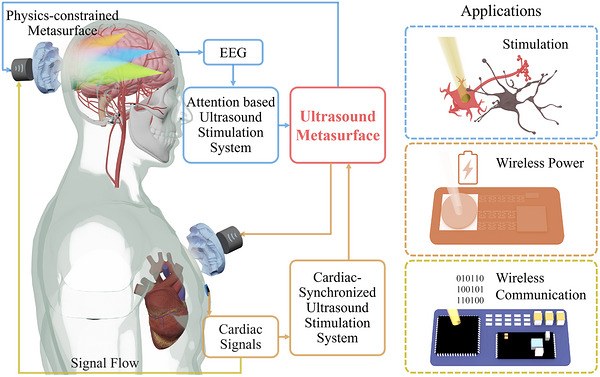
Integrated Ultrasonic Platform for Bioelectronic Control Through Biological Barriers Based on Metasurface

The study presents an integrated ultrasonic platform that delivers high-resolution, multi-point ultrasound energy through highly aberrating barriers such as the skull and ribs, with about ±6.5% intensity uniformity across foci, using a physics-constrained metasurface design framework, and demonstrates two adaptive stimulation paradigms — attention-gated and cardiac-synchronized stimulation. A dual-channel acoustic link sustains continuous transcranial wireless power and data streaming through a single ultrasonic metasurface, remaining robust even under a 400-fold power difference. The authors frame the platform as groundwork for next-generation ultrasound-based brain-computer interfaces (uBMI) and closed-loop bioelectronic therapies.
Why it matters Solving deep-tissue focusing and wireless power/data delivery in a single metasurface clears two obstacles — aberration and power — that have kept ultrasound-based BCIs short of closed-loop use.
April 2026

Bengbu Medical University Hospital Registers Multicenter Trial of MRI-Guided Temporal Interference Stimulation for Refractory Migraine

A randomized, sham-controlled trial will pair a non-invasive brain-computer interface with MRI-guided multichannel temporal interference stimulation in patients whose migraines resist medication. It plans to enroll 78 people aged 18 to 65, split evenly between real and sham stimulation, with headache frequency as the primary endpoint. The registration lists only design and bibliographic fields, so device details and actual enrollment remain unknown and efficacy has yet to be read out.
Why it matters Temporal interference stimulation has mostly been tested in animals and early human work; this hospital-led, multicenter, sham-controlled design with headache frequency as the primary endpoint moves it toward clinical validation in refractory migraine. The registration gives no device model and no actual enrollment figure, so 78 is the planned sample size and no results are available yet.

Feasibility of a Hybrid SSVEP-Motor Imagery BCI with Robotic Feedback for Stroke Upper Limb Rehabilitation

Researchers assessed the feasibility of a hybrid brain-computer interface that integrates motor imagery (MI) and steady-state visual evoked potentials (SSVEP) with robotic glove feedback for upper limb motor rehabilitation in 32 stroke patients, split into a conventional-treatment control group and an experimental group receiving 10- or 20-day BCI interventions. The experimental group showed considerable improvement in Fugl-Meyer scores over the control group, and the BCI achieved EEG classification accuracy up to 98.08% with stable operation; after longer training, accuracy rose, the laterality coefficient moved toward normal, and task-related brain connectivity strengthened. The authors say the hybrid system may overcome the limits of conventional therapy and single-modality BCIs.
Why it matters The study adds early evidence that combining two BCI modalities with robotic feedback can drive measurable Fugl-Meyer gains in stroke patients — an incremental but clinically concrete step beyond single-modality rehabilitation BCIs.

ChiCTR Registers Trial of Early BCI Training After Stroke Reperfusion

The Chinese Clinical Trial Registry (ChiCTR) has logged a study of the safety and efficacy of early brain-computer interface training given after reperfusion therapy in patients with acute ischemic stroke, an attempt to pin down when in the recovery window such training should start. Registered on April 27, 2026 as ChiCTR2600123548, the trial has not begun recruiting, and design, sample size and sponsor are absent from the record carried by the WHO International Clinical Trials Registry Platform (ICTRP) and must be read from the original registration.
Why it matters Moving BCI training into the window right after reperfusion, a phase Chinese trials rarely target, puts safety ahead of efficacy as the gating question, which is exactly what the registration says it will measure.

ChiCTR Registers Multicenter Trial of BCI Mindfulness Meditation in Chronic Tinnitus

The Chinese Clinical Trial Registry (ChiCTR) has logged a multicenter randomized controlled trial testing whether brain-computer interface-based mindfulness meditation relieves the symptoms of chronic tinnitus. Registered on April 23, 2026 as ChiCTR2600123258, the trial has not begun enrolling patients, and its design, sample size and sponsor must be read from the original registration record. It is the first multicenter registration to combine BCI with mindfulness meditation for chronic tinnitus, moving the approach from single-center exploration toward multicenter validation.
Why it matters The step that matters is design rather than indication: moving from single-center exploration to a multicenter randomized trial is where a neurofeedback-style intervention either survives site variation and controls or quietly does not.

Shanghai Yangzhi Rehabilitation Hospital Registers Trial of rTMS-Enhanced Motor Imagery BCI for Post-Stroke Upper Limb Dysfunction

A trial registered with the Chinese Clinical Trial Registry combines low-frequency rTMS with motor imagery brain-computer interface therapy, using conventional physical rehabilitation as the control, with the Fugl-Meyer upper extremity scale as the primary endpoint. The study has three parts: Part I compares BCI therapy with conventional rehabilitation, while Part III compares three rTMS protocols. It plans to enroll 213 participants, with first enrolment set for May 1, 2026; recruitment has not yet begun.
Why it matters The trial puts two interventions side by side: motor imagery BCI therapy against conventional rehabilitation, and three rTMS protocols — low-frequency, high-frequency, and a high-plus-low combination. It targets upper limb dysfunction after stroke, a persistent rehabilitation challenge, and its Part III specifically enrolls patients at high risk of "BCI blindness," suggesting the investigators are trying to address why some patients cannot use a BCI effectively. It plans 213 participants with first enrolment set for May 2026, but recruitment had not started when the registry record was last updated, so no results exist yet.

© 2026 BCIwiki.com Digest Topics Tips Subscribe Revisions About