

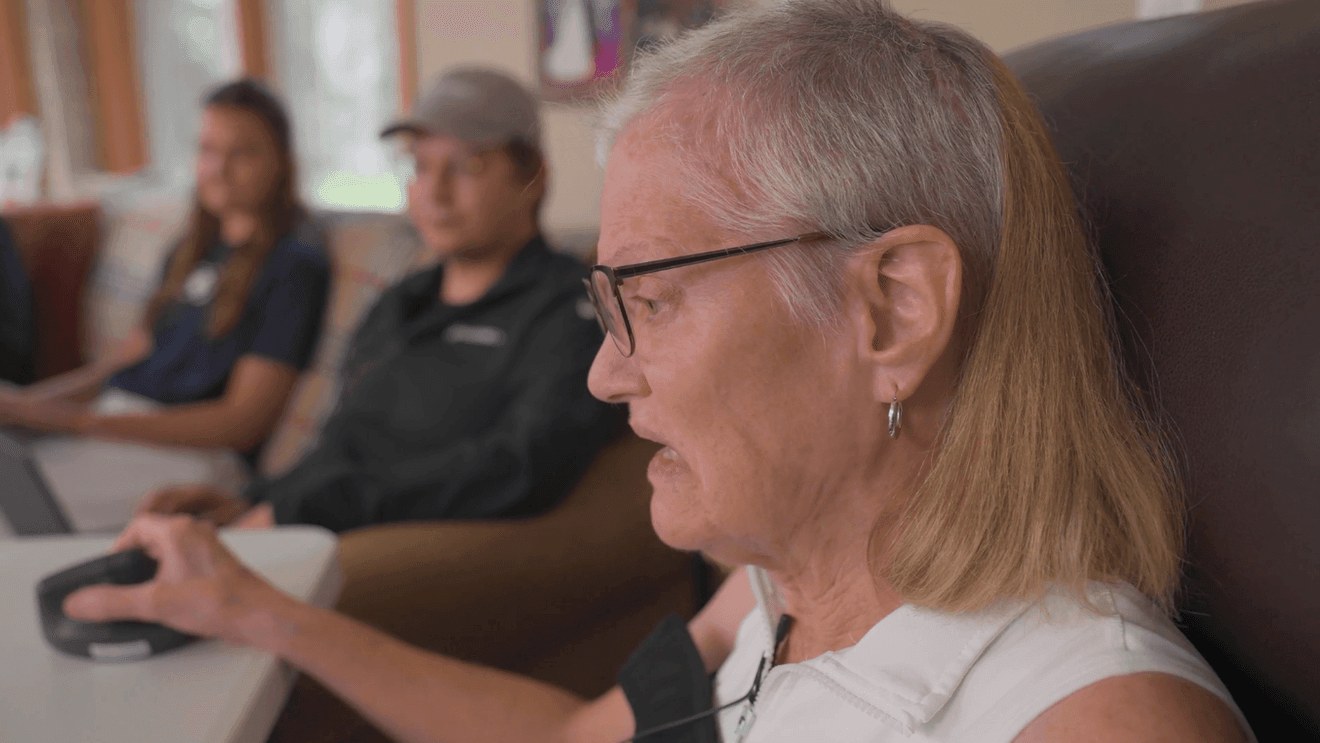
BCIwiki (bciwiki.com) — Austin-based Paradromics said its first human participant is using brain activity to generate her own words, answer open-ended questions and communicate with family in real time through the company's Connexus brain-computer interface, according to Neurotech Pub. The participant, a Michigan woman living with a progressive motor neuron disease that has severely limited her speech, spoke through synthesized voice and text during a live phone call with her grandchildren. Her first freely chosen decoded sentence was "Okay, I have a lot to say." Paradromics CEO Matt Angle said the system decoded that sentence in real time, word for word, with no errors.
The Connexus device was implanted in June 2026 by neurosurgeon Dr. Matthew Willsey and his team at the University of Michigan, in a surgery that took about four hours and marked the device's first use as a long-term human implant. Willsey said the team made a craniotomy to open a window in the skull and guided the array to the part of the precentral gyrus — loosely, the motor cortex — that controls the muscles used to pronounce speech. The implant is about the size of a dime and carries 421 platinum-iridium micro-wires on its edge designed to record signals from individual neurons. A lead runs beneath the skin to a power-and-data unit in the participant's chest, which communicates wirelessly through intact skin with an external receiver and computing system.
Paradromics said the system also detects distinct neural patterns tied to attempted speech and imagined speech. The company says it is now decoding the participant's attempted speech in real time, a step toward natural, flowing conversation through a brain-computer interface. Connexus remains an investigational device in a clinical trial, part of the FDA-approved Connect-One early feasibility study, and Paradromics plans to follow the participant for six years to study the device's safety, durability and real-world usefulness. The company said it is recruiting more participants for the Connect-One study.