/ EN

Intracortical Electrodes

23 entries

Intracortical electrodes are inserted directly into brain gray matter to record single neurons and local field potentials, forming the core hardware of invasive BCIs. This topic tracks signal stability, biocompatibility, and long-term implant performance of Utah arrays, Neuropixels, and flexible probes.

September 2026

4,096-Channel μECoG Array Maps Brain Function During Surgery With 91.3% Channel Yield

During removal of a right parafalcine meningioma, surgeons placed four Layer 7 μECoG arrays, 4,096 electrodes in total, on either side of the central sulcus and recorded somatosensory evoked potentials under 5 contralateral stimulation conditions. Using a 2 MΩ impedance cutoff, 3,739 channels were usable, a 91.3% yield; phase-reversal latencies were 19, 21, 25, 26 and 25 ms, consistent with the standard intraoperative mapping performed in the same operation. The researchers caution that the setup provides dense spatial sampling rather than submillimeter physiological resolution: measured responses were correlated across roughly 3–4 mm of cortex.

Paradromics Implant Lets First Participant Speak Her Own Words in Real Time

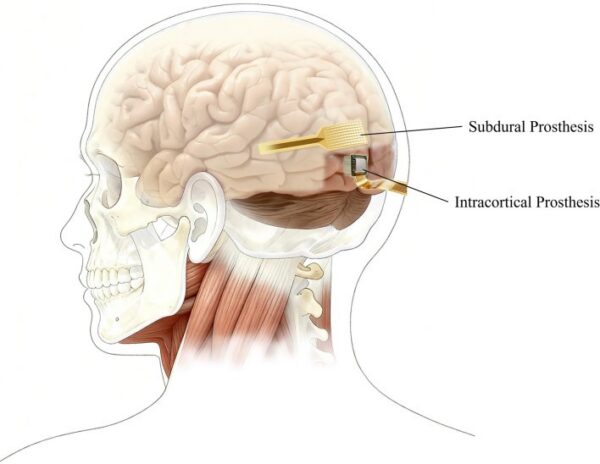
A Michigan woman who had nearly lost the ability to speak to motor neuron disease used Paradromics' Connexus device, implanted on the surface of her brain, to turn brain signals into words of her own choosing in real time and to talk with her family. The 421 platinum-iridium microwires at the edge of the device record signals from individual neurons, and software decodes them into text and synthesized speech. The work is part of the FDA-approved Connect-One early feasibility study; Connexus remains an investigational device, and the company plans six years of follow-up to assess safety and durability.

Pretraining Cuts Labeled Data Needed for BCI Decoding by Over 90%

Training a decoder to read brain signals usually means collecting a large labeled dataset from every new subject, which is slow and a burden on patients. The proposed method, MAPA, first runs self-supervised pretraining on unlabeled intracranial EEG recordings pooled across subjects, then transfers to new ones. The difficulty is that electrode contact placement and neuroanatomy vary from person to person, so MAPA adds two spatial encodings, an anatomical region embedding and a relative positional encoding, to a standard masked autoencoder. In cross-subject tests, about 164 labeled trials were enough to reach the accuracy that otherwise takes 3,500. The team reports that MAPA set new best results on the Neuroprobe benchmark in all three settings, within-session, cross-session and cross-subject, without fine-tuning, suggesting that calibration for implanted BCIs could become much shorter.

EEG Motor-Imagery BCI Steers Wheelchair Prototype, With SVM Decoding at 90.7%

A research team built an EEG motor-imagery brain-computer interface and connected its decoder to a physical differential-drive wheelchair prototype, offering people with severe motor impairments a non-invasive means of control, though the uncertainty of EEG decoding has long hindered such systems from driving physical actuators. Using Filter Bank Common Spatial Pattern features on a public dataset, the team compared support vector machine (SVM), k-nearest neighbors and linear discriminant analysis classifiers; SVM reached 90.7% mean accuracy, and 85.9% when replayed on an independent dataset through a hardware-in-the-loop setup. Confidence-based command validation raised accuracy among accepted commands to 97.6%, at the cost of accepting only 60.7% of them. Layered safeguards (confidence gating, self-terminating steering, transition braking, communication timeout supervision and a hardware emergency cutoff) limit the consequences of decoding errors.
August 2026

Liquid Gallium in 3D Microneedles Cuts Impedance 1,000-Fold, Records Spikes

A team from the University of Utah, Kangwon National University and the University of Georgia describes a silicon-free route to neural microelectrode arrays: soft polymeric 3D microneedles are printed by two-photon polymerization, then turned into electrodes by injecting liquid gallium into the hollow channels. A newly defined retention number predicts whether the gallium stays put under physiological conditions. Coating the surface with gold nanoparticles and PEDOT doped with tetrafluoroborate cut impedance by roughly 3 orders of magnitude, and in vivo recordings in an invertebrate model captured neural spikes with no gallium leakage. The study was published in ACS Sensors on August 31, 2026.
July 2026

Spatial Proteomic Analysis of Antimicrobial Therapeutic-Releasing Intracortical Probes

The study uses spatial proteomics to assess tissue around non-functional intracortical microelectrodes implanted for four weeks in mice, measuring neuronal integrity, immune-cell activation and local cytokine expression around probes coated with drug-loaded, controlled-release titanium dioxide nanotube array (TNA) coatings. The authors note that blood-brain barrier disruption can translocate gut-derived bacteria to the implant site and sustain chronic inflammation, and that the TNA coating's therapeutic loading and controlled release further damp residual neuroinflammation. They conclude that TNA offers a multifunctional, tunable interface for locally regulating the neuroimmune microenvironment, a step toward long-term reliable intracortical recordings.

Ruthenium Oxide Electrode Coating Supports 25 Weeks of Intracortical Stimulation

Researchers evaluated ruthenium-oxide-coated amorphous silicon-carbide microelectrode arrays during 25 weeks of intracortical microstimulation in rodents. Perception thresholds stabilized at about 0.4 nC per phase per electrode by week nine, behavioral performance remained around 91%, and reliable sensation persisted through week 25.

Targeting Grasp-Related Cortical Areas for Intracortical Brain-Machine Interfaces

For a C5 tetraplegic participant, the study integrated anatomical, functional and vascular imaging with preoperative 3D modeling to optimize placement of intracortical microelectrode arrays for grasp-related motor decoding. Anatomical MRI, diffusion-weighted imaging and task-based fMRI identified grasp-related cortex while avoiding vasculature and speech-critical regions; Quicktome software refined target selection using structural connectivity and functional activation data, and 3D-printed skull and cortex models supported surgical planning. Functional imaging highlighted the anterior intraparietal sulcus (AIP), ventral premotor cortex (PMv) and inferior frontal gyrus (IFG); arrays placed in AIP and PMv subregions 6v and 6r reached a combined classification accuracy of 96%.

Multi-Layer Brain-Mimicking Phantom for Neural Interface Implantation Testing

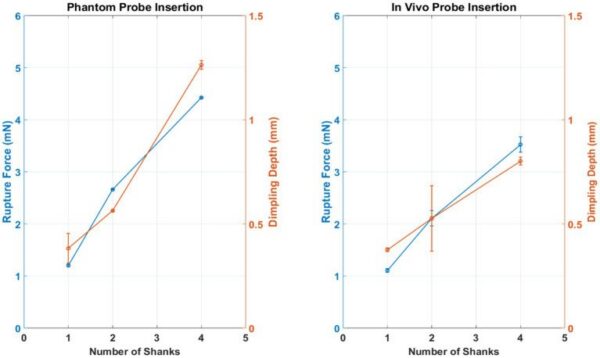
Researchers developed a reproducible multi-layer brain-mimicking phantom that replicates the dimpling and rupture forces of rodent pia mater and dura mater during neural interface implantation, built from a 0.5% agarose skin layer, a 1.01% agarose pia layer and a pre-stretched PVC dura layer assembled in a simple benchtop process. Tested with a cantilever force system on microwires of 12–100 µm diameter (tungsten and stainless steel, various tip geometries) and segmented silicon probes, the phantom produced results within the range of in vivo Sprague-Dawley rat data with significantly lower insertion variability than in vivo testing. The authors say its modular design — layer thickness and stiffness can be tuned for different species or devices — makes it a low-cost early screening platform that can accelerate neural implant development while reducing animal use.

Nuclear Electromagnetic Pulse Inhibits Rat Primary Motor Cortex LFP Bands

A study examining the potential brain risk of BCI electrodes exposed to strong electromagnetic fields applied nuclear electromagnetic pulse (NEMP) irradiation to rats with implanted brain electrodes and recorded local field potentials (LFPs) in the primary motor cortex (M1). At 200 kV/m, NEMP inhibited the alpha and delta LFP bands in resting rats, an effect linked to front-gate coupling between the pulse and the electrode, with the coupled current stimulating the brain and affecting its state of consciousness; the authors frame the work as early animal data for BCI electromagnetic protection.

SpikeGadgets Takes Neuropixels Recording Wireless in Freely Moving Animals

SpikeGadgets has released wireless dataloggers compatible with Neuropixels probes, letting an animal carry the entire recording system and write high-density probe data straight to onboard storage instead of down a cable. Four studies over the past year used the setup in bats, rats and marmosets, and their findings are reshaping long-standing assumptions about hippocampal replay, prefrontal sequence coding and vocal communication.
June 2026

Exploring Synergies in Brain-Machine Interfaces: Compression vs. Performance

Using implantable brain-machine interface (iBMI) data from a non-human primate two-dimensional finger task, the study tests whether brain-muscle synergies improve decoding performance and generalization. Principal component analysis (PCA), demixed PCA (dPCA) and non-negative matrix factorization (NMF) all compressed brain-muscle data effectively with minimal decoding-accuracy loss, but none improved performance through denoising or enhanced cross-task generalization. The authors conclude that extracting synergies alone does not yield a better or cleaner control space for linear decoding, and call for larger samples and more muscle channels.
January 2026
September 2025

Neuropixels Ultra Doubles Neuron Yield With 6-Micrometer Site Spacing

A Neuron paper describes Neuropixels Ultra, which packs 6,144 switchable recording sites at 6-micrometer center-to-center spacing while reading 384 channels simultaneously. In mouse visual cortex recordings, neuronal yield increased by more than twofold. The study also improved subcellular signal detection and cell-type classification, but it did not report simultaneous recording from 10,000 neurons.
August 2024

Neuralink Details Thread Retraction and Surgical Changes in PRIME Study

Neuralink said thread retraction in its first PRIME participant temporarily reduced BCI performance before the threads stabilized and performance recovered. For the second implant, the team reduced brain motion during surgery and narrowed the gap between the implant and the brain surface. The company reported no thread retraction in the second participant at the time, but it did not publish channel-attrition rates or a formal interim safety report.
November 2021

FDA Grants Breakthrough Status to Blackrock Neurotech's MoveAgain BCI

The FDA granted Breakthrough Device designation to Blackrock Neurotech's MoveAgain BCI System on November 16, 2021. The investigational system combines an implanted array, neural decoding and wireless output with the goal of allowing people with severe paralysis to control digital and assistive devices. The designation can expedite development and review but is not market approval.
© 2026 BCIwiki.com Digest Topics Tips Subscribe Revisions About