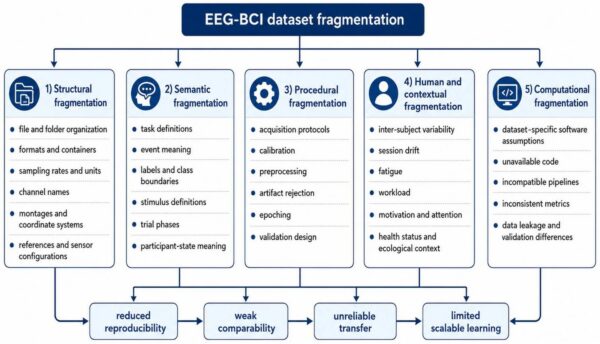
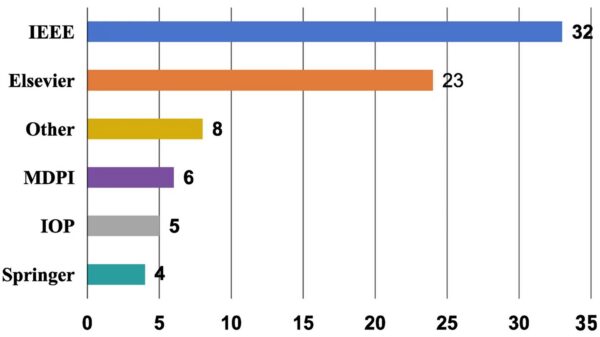
Public datasets for EEG-based brain-computer interfaces (BCIs) keep multiplying, but electrode layouts, task definitions, preprocessing and participant records differ from study to study, making the data hard to reuse across datasets and the results hard to replicate. This review screened 16,920 records down to 129 publications, mapped the fragmentation across structural, semantic, procedural, human/contextual and computational layers, and scored reporting transparency against 10 criteria, with a median score of 9. Data availability was stated in 61.2% of the papers; code or pipeline availability in just 20.9%. Existing standards, ontologies, software platforms and transfer-learning methods each solve part of the problem, the authors conclude, but none yet delivers full semantic interoperability.
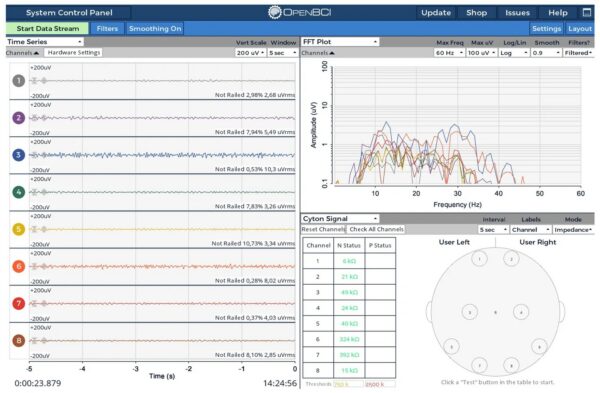
Researchers paired an 8-channel OpenBCI Cyton board and an EEG cap laid out on the international 10-20 system with a Meta Quest 2 headset to capture motor imagery and attention signals, reaching up to 90% subject-specific online classification accuracy with the EEGNet model when the signal was stable. The work targets cognitive control training for attention-deficit/hyperactivity disorder (ADHD), building EEG sensing into a virtual reality (VR) serious game so users can regulate their mental state in real time; earlier approaches mostly relied on hardware-heavy multichannel systems and did not combine motor imagery with attention levels. The team also documented artifacts from high impedance, channel saturation and mechanical tension from the headset strap, showing that a low-cost setup is usable only once skin-electrode impedance and mechanical interference are under control. This is a single-subject feasibility study with no clinical evaluation.
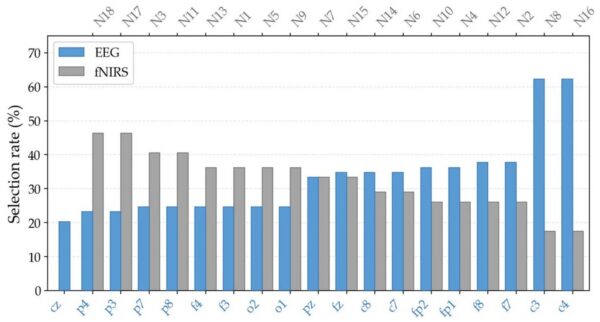
Combining EEG with functional near-infrared spectroscopy (fNIRS) did not make brain-controlled electrical stimulation more accurate in a blinded randomized trial of 16 healthy volunteers. The hybrid and EEG-only groups showed no statistically significant differences in real-time three-class recall, sense of agency, attention or physical comfort; median recall was 53.5% in the hybrid group and 57.3% with EEG alone. The researchers also released the full EEG-fNIRS dataset.
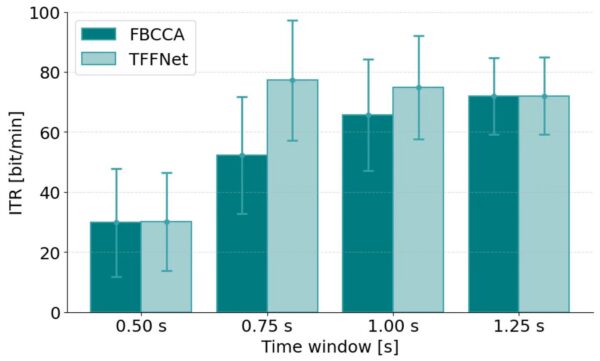
Researchers at the University of Naples Federico II in Italy report that the SSVEP-TFFNet deep-learning model outperforms filter bank canonical correlation analysis (FBCCA) at classifying steady-state visual evoked potentials (SSVEP) recorded in extended reality (XR), where headset visuals degrade EEG quality. They used an open XR benchmark dataset of 30 subjects and 1200 trials acquired with Microsoft HoloLens 2. Cutting the montage from 8 channels to 6 or 4 left performance close to the full set, supporting lightweight, wearable XR-BCI designs.
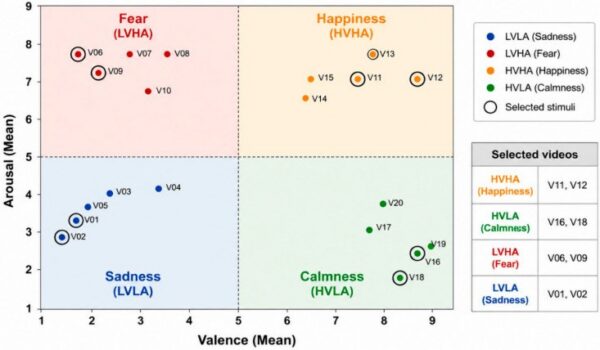
Researchers at Walailak University in Thailand tested EEG-based emotion recognition under auditory stimulation, scoring valence and arousal. Discrete wavelet transform features reached 0.88 accuracy when classifiers were trained and tested on the same subject, but leave-one-subject-out evaluation fell to near chance, exposing how far EEG emotion signatures differ between people. Few-shot adaptation closed part of that gap: with 75% of a new subject's calibration data, functional connectivity features reached 0.77.
A review published in Sensors surveys RNN, VAE, GAN, and Transformer architectures used for motor imagery BCI classification, along with their key challenges.