/ EN

BCIwiki — Brain-computer interface news, research and industry database

Latest

August 2026

Roadmap Counts More Than 150 Children Worldwide With Implanted BCIs

Researchers report that more than 150 children worldwide have received implanted brain-computer interfaces, a number expected to grow quickly as the devices reach the market. A 2026 paper in Neurorehabilitation and Neural Repair spells out a roadmap for pediatric iBCI development, including work from the first International Virtual Summit on Implanted BCIs for Children with Complex Needs and workshops at the 11th International BCI Society Meeting. It highlights unresolved questions about early-life implantation and pediatric indications that must be answered before the technology is deployed widely in children.
Why it matters Adult iBCIs are approaching commercialization while pediatric indications remain nearly untouched. A developing brain, the reversibility of long-term implants, and who gives informed consent are all different questions in children than in adults.
Seven Chinese Ministries Put Brain-Machine Tech in Elder Care Product Plan

Seven Chinese ministries, led by the Ministry of Commerce and including the National Development and Reform Commission and the Ministry of Industry and Information Technology, jointly issued implementing opinions on expanding and upgrading consumer goods (《关于推动商品消费扩容升级的实施意见》). In a section on products for older adults, the document calls for stronger R&D on key technologies and core components and for wider use of brain-machine integration and artificial intelligence in age-friendly products and rehabilitation aids. Brain-computer interfaces have until now figured mainly in China's science and industrial planning documents; framing them as consumption policy aimed at two named product categories is new, and the text was published in the State Council's policy document database, the central government's official repository for such documents.
Why it matters Elder care and rehabilitation aids are the two BCI-adjacent markets with a payer other than a research grant, so naming brain-machine integration in a consumption document rather than another innovation plan is the more commercially meaningful placement.

Shenzhen Drafts China's First BCI Industry Rules, Requiring Separate Brain Data Consent

The Shenzhen Municipal Bureau of Science, Technology and Innovation (深圳市科技创新局) in southern China and the city's Bureau of Justice have opened public consultation on draft regulations to promote the brain-computer interface industry in the Shenzhen Special Economic Zone, a status that carries authority to write binding local rules of the city's own. According to Jiemian News, a Chinese business news outlet, the draft defines a BCI as technology that opens an information channel between the brain and external devices for coordinated interaction between biological and machine intelligence, and states that the municipal government shall write BCI industry development into the city's economic and social development plan and its science and innovation plan. On data, the report says processing brain data and other sensitive personal information would require separate written consent from the individual, alongside strict compliance with national rules on cross-border data transfer; legislating specifically for the BCI industry in special economic zone regulation form is a first in China.
Why it matters Local legislation written for a single emerging technology industry is uncommon, and this draft touches both industrial support and the harder questions of brain data and ethics. The requirement of separate written consent for brain data is the provision with real teeth.

Review Charts the Shift From Rigid Silicon to Soft Brain Implant Electrodes

Implantable brain-computer interfaces are shifting from rigid silicon architectures to soft, structurally adaptive systems built for seamless, long-term integration with neural tissue, according to a review of flexible electrode materials and structural design published in SmartMat on August 31, 2026. Breakthroughs in materials science and micro/nanofabrication have given this generation of devices mechanical compliance, robust interfacial adhesion and high-fidelity signal acquisition that earlier designs could not reach, the review says. Long-term stability at the electrode-tissue interface remains one of the core bottlenecks for invasive BCI.
Why it matters The bottleneck for invasive BCI has long been the electrode rather than the decoder: whether it can work stably in the brain for years decides whether the approach is viable at all. This review maps the engineering options.

Liquid Gallium in 3D Microneedles Cuts Impedance 1,000-Fold, Records Spikes

A team from the University of Utah, Kangwon National University and the University of Georgia describes a silicon-free route to neural microelectrode arrays: soft polymeric 3D microneedles are printed by two-photon polymerization, then turned into electrodes by injecting liquid gallium into the hollow channels. A newly defined retention number predicts whether the gallium stays put under physiological conditions. Coating the surface with gold nanoparticles and PEDOT doped with tetrafluoroborate cut impedance by roughly 3 orders of magnitude, and in vivo recordings in an invertebrate model captured neural spikes with no gallium leakage. The study was published in ACS Sensors on August 31, 2026.
Why it matters Soft electrodes have been held back by fabrication: silicon processes constrain geometry and flexible materials resist 3D microstructuring. Combining 3D printing with liquid metal addresses both at once. Validation is limited to an invertebrate model, but the route is relevant to anyone designing electrodes for chronic implantation.

Memory Prosthetics Near First-in-Human Trials

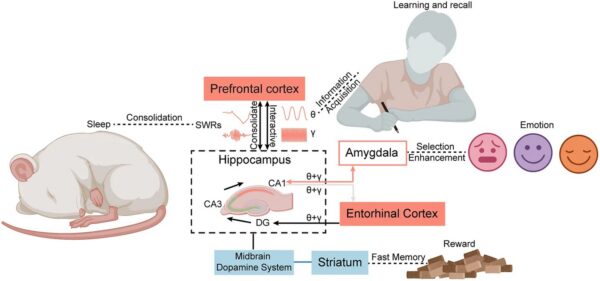
Memory prosthetics — closed-loop brain-computer interfaces that decode hippocampal activity and deliver adaptive stimulation — are moving from animal proof-of-concept toward first-in-human trials, according to a review in iScience. The authors argue that chronically implantable systems require co-design of three subsystems that have been treated in isolation: biocompatible electrode interfaces, on-chip neuromorphic computation, and closed-loop control hardware. The review maps neuroscientific findings such as theta-phase tracking, theta-gamma coupling and sharp-wave ripple detection onto engineering specifications for latency, sampling and charge injection, and onto materials requirements for impedance, switching endurance and chronic stability. It also flags where small-cohort clinical results have been over-generalized.
Why it matters Memory prosthetics sit among the hardest problems in invasive closed-loop BCI, and the bottleneck has long been materials and hardware rather than algorithms. This review translates neuroscience timescales into concrete impedance, endurance and charge-injection targets for two materials families, which is more actionable than another roadmap paper.

UT Dallas Team Quantifies How Overlapping ICMS Activation Volumes Erode Discrimination

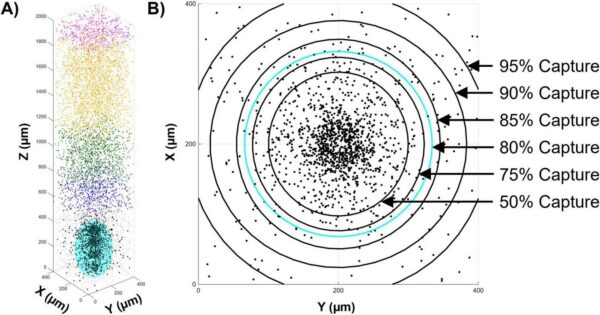
Researchers at the University of Texas at Dallas paired a biophysically realistic computational model with rat behavioral data and found that discrimination accuracy falls off exponentially as the neuronal activation volumes evoked by intracortical microstimulation (ICMS) overlap (R² = 0.88). With minimal overlap, an intersection-over-union below 1%, rats averaged 85% accuracy, while IoU above 20% left them near chance. The work, published in Frontiers in Computational Neuroscience, gives a mechanistic basis for setting electrode spacing in sensory neuroprosthetics.
Why it matters Sensory neuroprosthetics have been scaling contact counts on the assumption that more electrodes mean finer sensation; this argues the ceiling is set by overlapping tissue volumes rather than contact number, so past a point extra electrodes buy nothing and may cost discrimination. It hands array designers a spacing criterion they can compute instead of discovering it in an animal study, though the thresholds come from rats and may not transfer to human cortex.

BCIs in Elderly Care: Review of 177 Studies Maps Six Ethical Themes

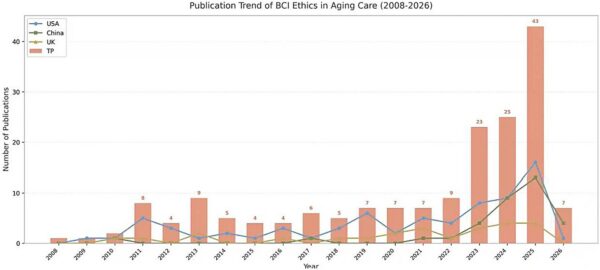
A systematic review in Frontiers in Digital Health screened 12,423 records and analyzed 177 studies of brain-computer interfaces in elderly care, identifying six recurring ethical themes: privacy and data security, informed consent and autonomy, personhood and identity, technical risk and safety, equity and access, and risk-benefit trade-offs. The authors argue those risks are built into the technology's interaction logic rather than sitting at its margins: decoding uncertainty can turn into care misjudgment, the inferability of neural data extends privacy exposure into psychological territory and power asymmetry, and technology-mediated communication strains trust and accountability. Responsible deployment, they conclude, requires embedding ethical principles systematically into care processes.
Why it matters Ethics reviews of BCI usually stop at a list of concerns. This one adds a three-level frame, spanning human-computer interaction, interpersonal communication and public opinion, and maps each issue onto a specific elderly-care scenario, which makes it usable as a checklist for institutional policy rather than another literature map.

ERP-XTTN: Calibration-Free ERP Decoder Comes within 0.025 AUROC of the Best Baseline

Researchers at the University of Colorado Boulder have built ERP-XTTN, a cross-attention model that classifies event-related potentials (ERPs) in users it has never seen, with no per-user calibration. Across three public datasets and eight ERP components, it trailed the best baseline by 0.025 AUROC on average using only three channels. The work appeared in the Journal of Neural Engineering.
Why it matters Calibration is the tax every consumer-facing EEG product pays, and closing the gap to 0.025 AUROC on three channels is the combination, no setup plus a cheap headset, that a shipping product actually needs. The paper also lays down the first epoch-level leave-one-subject-out benchmark on ERP CORE, which may matter as much as the model, since cross-subject claims have had no common yardstick.

Xi'an Jiaotong Team Uses Inkjet-Printed Conductive Patterns to Align Neural Cells

Researchers at the Second Affiliated Hospital of Xi'an Jiaotong University in northwestern China and the Key Laboratory of Biomedical Information Engineering of the Ministry of Education have built an in vitro screening platform combining electrospun PLCL with inkjet-printed reduced graphene oxide (rGO) and growth-factor micropatterns. Because it varies conductive, biochemical and topographical cues together, the platform can evaluate printing parameters and electric-field strength in a single system. Under 150 mV/cm direct-current stimulation, PC-12 cells showed more neurite-like outgrowth and better alignment than with no stimulation or at 300 mV/cm.
Why it matters The useful result is non-monotonic: more field is not better, since 300 mV/cm underperformed 150 mV/cm, which points to a dose window rather than a maximize-and-see approach to stimulation design. The platform itself is the other contribution, a bench-level way to screen electrode material, surface chemistry and field strength together before anything goes near tissue.

© 2026 BCIwiki.com Digest Topics Tips Subscribe Revisions About