/ EN

BCIwiki — Brain-computer interface news, research and industry database

Latest

July 2026

Lower-Limb Motor Imagery Shows Lateralized EEG

An EEG study finds that unilateral lower-limb motor imagery and motor execution elicit similar lateralized neural activity patterns, extending a lateralization pattern long known in the upper limb to the lower limb.
Why it matters Among the first to systematically confirm a shared lateralized neural basis between lower-limb motor imagery and execution, the study fills a gap left by lateralization research focused on the upper limb, and its event-related potential and functional-connectivity findings offer guidance for feature selection in lower-limb motor-imagery BCIs.

A Novel Deep Learning Approach for Privacy-Preserving Encoded EEG-Based BCIs with Clinical LLM Applications

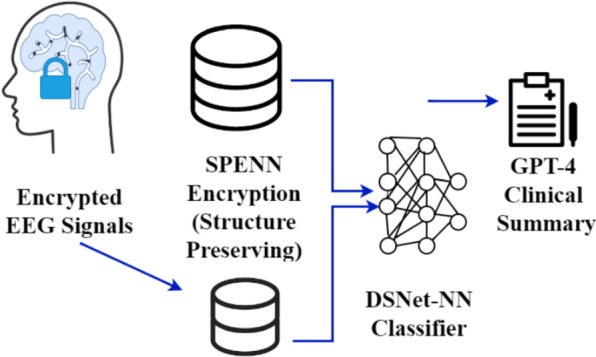
The study presents DSNet, a deep denoising structure-preserving neural encoding network that classifies privacy-preserving encoded EEG without decryption. Common spatial pattern (CSP) features are converted to irreversible neural codes — an irreversible neural transformation designed for privacy rather than a formal cryptographic guarantee — and two deep-learning architectures (a feedforward network and a recurrent RNN) classify in the encoded feature space. On public datasets, DSNet-NN exceeded 87% accuracy for every subject, outperforming the RNN variant and baselines while staying resilient to simulated privacy attacks; the study also integrated GPT-4 to generate clinical-style summaries from model outputs.
Why it matters Classifying on irreversible, privacy-preserving EEG codes without decryption — while still topping 87% per subject — attacks the privacy-versus-utility trade-off that has kept raw neural data out of clinical pipelines.

Passive BCI Decodes VR Intent With Eye Gaze

Researchers combined electroencephalography (EEG)-based passive brain-computer interface (BCI) with eye tracking to decode users' interaction intent in real time during dynamic VR gameplay, reaching 69.64% accuracy in the online closed-loop phase.
Why it matters Most VR interaction still depends on explicit controller input; this is the first real-time demonstration of EEG-based passive BCI combined with eye tracking decoding interaction intent during dynamic VR gameplay, with online closed-loop accuracy well above chance — a step toward more natural immersive human-computer interaction.

BIOSerenity Trains EEG Models on Jean Zay, Finds Scaling Diverges From Language AI

French neurotech company BIOSerenity ran three months of large-scale EEG AI training experiments on Jean Zay, France's most powerful supercomputer for research, including a 300-million-parameter model trained on 110,000 hours of EEG data across 64 GPUs. It also fully trained two model families, Mercury and Neptune, in three sizes each, from about 13 million to 100 million parameters and on about 5,000 to 40,000 hours of data. Neptune improved as it scaled up while Mercury did the opposite, its smallest version performing best, a sign that brain-signal AI does not scale the way language models do; the results have not been peer-reviewed.
Why it matters A rare public scaling study on EEG, and the result cuts against the default assumption that foundation-model recipes carry over to brain signals, since architecture rather than data volume decided the outcome here.

Nuclear Electromagnetic Pulse Inhibits Rat Primary Motor Cortex LFP Bands

A study examining the potential brain risk of BCI electrodes exposed to strong electromagnetic fields applied nuclear electromagnetic pulse (NEMP) irradiation to rats with implanted brain electrodes and recorded local field potentials (LFPs) in the primary motor cortex (M1). At 200 kV/m, NEMP inhibited the alpha and delta LFP bands in resting rats, an effect linked to front-gate coupling between the pulse and the electrode, with the coupled current stimulating the brain and affecting its state of consciousness; the authors frame the work as early animal data for BCI electromagnetic protection.
Why it matters Electromagnetic safety is an under-studied risk for implanted BCIs in high-field environments, and this early animal data on how NEMP affects cortical activity gives the field its first reference point for electromagnetic protection.

Implanted Neural Interfaces Track Glioma Progression in Mice

Researchers at Coherence Neuro Global, Inc. and other institutions have used implanted neural interfaces to track glioma growth in freely behaving mice over time. Across several mouse strains and glioma models, tumor progression went with elevated gamma-band activity in the tumor microenvironment, and machine learning models read tumor burden off the chronic recordings, with gamma trajectories predicting individual growth rates. The work was posted to bioRxiv on July 9, 2026, and has not been peer reviewed.
Why it matters This inverts the usual purpose of an implanted array, using it as an in-body oncology sensor rather than a movement decoder, and a continuously measurable growth signal is something neither imaging cadence nor biopsy can supply, provided the gamma correlation holds outside mouse models.

Preprint: Facial Movements in Rodents Predict Cortical Activity and BCI Performance

Harvard Medical School researchers report that spectral analysis of facial movements in rodents predicts both cortical activity and performance on brain-machine interface tasks, a possible biological basis for better neural prosthetic control. The work is a preprint and has not been peer reviewed.
Why it matters A methods flag for decoder benchmarking: if facial movement spectra alone track cortical activity and task performance, some of what BCI decoders are credited with reading may be behavior rather than intent — though the evidence is rodent-only and not yet peer reviewed.

Neurosom Wins US Patent for Bayesian EEG Source Mapping and Stimulation Targeting

Neurosom announced it has been granted a patent for a method that combines Bayesian statistical modeling with personalized EEG data and brain atlas models to achieve "super-resolution" in locating the origins of brain electrical activity, potentially improving the guidance of transcranial electrical stimulation (TES). The patent, titled "Method for Bayesian Super-Resolution of Electroencephalographic Source Analysis and Transcranial Electrical Stimulation" (US Pat. No. 12,663,866), was announced on July 9, 2026.
Why it matters Non-invasive stimulation is limited less by hardware than by not knowing what it is hitting, so a granted patent on individualized source localization stakes out the targeting layer where closed-loop TES products will have to compete.

Preprint: Functional Ultrasound Imaging Through a Human Cranial Window Maps Motor Effector Encoding

A preprint shows that functional ultrasound imaging (fUSI), read through an acoustically transparent cranial-window implant, reliably resolved multi-body-part and single-digit movement encoding in one participant's primary sensorimotor cortex, with maps consistent with classical somatotopy and single-trial decoding supported across sessions; analysis of key decoding voxels suggested different Brodmann areas encode single-digit movement differently. The researchers argue fUSI can map motor representations at submillimeter resolution, filling a key gap in humans between invasive electrophysiology and non-invasive blood-flow imaging; the work has not been peer reviewed.
Why it matters fUSI's submillimeter mapping through a cranial window targets the resolution gap between invasive electrodes and non-invasive imaging — a potential new, minimally invasive recording route for BCIs, albeit one still at preprint stage.

Shandong Bids to Be China BCI Testing Hub

Sixteen departments in China's Shandong province, led by the Health Commission, issued the Work Plan for Accelerating Clinical Translation and Application Innovation of Brain-Computer Interfaces, document number Lu Wei Yi Zi [2026] No. 13, dated July 7, 2026 and released on July 8. It is the only provincial BCI document led by a health authority and Shandong's second after the science department's industry plan. The plan advances a positioning it summarises as validated in Shandong, applied globally, working through an alliance, scenarios, policy and industry follow-through. Targets rise in four steps: an operating clinical research alliance in 2026; about 20 core technology breakthroughs and 30 technology SMEs by 2027; at least 30 alliance members, more than 20 foreign and domestic teams setting up validation bases, more than 30 multicentre projects and a 2 billion yuan industry by 2028; and a national validation cluster by 2030.
Why it matters The only provincial BCI document led by a health commission, aimed squarely at the clinical evidence bottleneck. The framing of validation in Shandong for global application is unusual: the province is trying to occupy one link of the value chain through patient volume and trial capacity rather than manufacturing. It also carries industrial targets, including a 2 billion yuan sector by 2028, so it is not a purely clinical plan.

© 2026 BCIwiki.com Digest Topics Tips Subscribe Revisions About