
/ EN

BCIwiki — Brain-computer interface news, research and industry database

Latest

July 2026

INBRAIN and Microsoft Team Up on AI for Neurology and BCI

Barcelona-based INBRAIN Neuroelectronics said it will work with Microsoft on AI for neurology and brain-computer interfaces, combining INBRAIN's neuroscience, bioelectronics and AI work with Microsoft's cloud and AI infrastructure. INBRAIN's graphene-based neural interface is being developed as an adjunctive therapy for Parkinson's disease; it received FDA breakthrough device designation in 2023 and entered its first-in-human study in the fall of 2025.
Why it matters The value of the deal turns on stage: INBRAIN's graphene interface is already in first-in-human testing, so any gain from cloud-scale AI in closed-loop neuromodulation should show up in clinical data rather than in a roadmap.
Beihang and Tsinghua Team Fuses EEG, Video and Motion to Flag VR Cybersickness

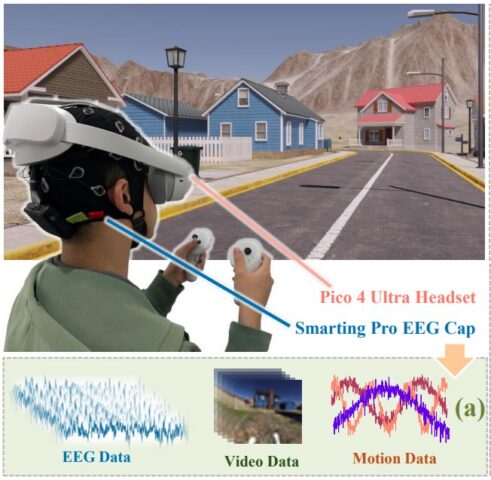
Researchers at Beihang University and Tsinghua University in Beijing built a multimodal contrastive learning framework that pairs EEG with synchronized video and motion data to detect cybersickness in virtual reality, representing the EEG as a connectivity graph and using an attention-based encoder to map the video and motion streams onto the same structure. Fusing all three signals separated cybersick from non-cybersick states more cleanly than any single modality or pair, and the model automatically pruned prefrontal connections unrelated to cybersickness. The setup used mBrainTrain's Smarting PRO 32-channel wireless EEG system and a Pico 4 Ultra headset, with 29 healthy adults navigating a VR scene under their own control.
Why it matters Cybersickness caps how long anyone will wear a headset, and the useful finding here is that EEG holds up during active navigation, where motion artifact usually degrades it — though with 29 healthy adults and no validation in a shipping product, this is a method result, not a feature.

Preprint: MRI Grey Matter Loss May Predict Who Can Control an ECoG BCI in ALS

A preprint from the Utrecht-BCI Lab at the UMC Utrecht Brain Center in the Netherlands, the invasive-BCI group led by Nick Ramsey, asks why some people with ALS control an implanted brain-computer interface (BCI) better than others. It found that preservation of grey matter in the motor cortex is associated with higher-quality brain signals, suggesting an MRI-based measure could help identify who is a suitable candidate for implantation. The preprint was posted to medRxiv on June 23, 2026 (DOI 10.64898/2026.06.23.26355654).
Why it matters ALS implant programs have no accepted way to predict who will actually be able to drive the device, so a structural MRI marker — if it survives peer review and a larger cohort — would change enrollment criteria before it changes surgery.

BIOSerenity's E1 Foundation Model Posts Strong Results on Four Clinical EEG Tasks

French medtech company BIOSerenity has built an EEG foundation model, BIOSerenity-E1, pre-trained self-supervised on more than 4,000 hours of recordings, and reports strong results on four clinical tasks: normal/abnormal classification, Alzheimer's disease detection, pediatric sleep staging and seizure detection. The normal/abnormal algorithm is already built into a CE-marked medical device, and the seizure-detection algorithm is in clinical evaluation. The work will be shown as a poster at the 8th Journées de Neurophysiologie Clinique in Grenoble, France.
Why it matters The four benchmarks matter less than the regulatory position: one head of this pretrained model already sits inside a CE-marked device, which puts foundation-model EEG on the clinical side of the line and, if it holds, cuts how much labelled data each new indication needs.

Beijing Tongren Hospital Registers Observational Study of Clinical Needs for Invasive Visual BCI

The study involves no implant and tests no device. It asks 50 adults with acquired blindness what existing assistive devices get wrong, and what they would want from a vision-restoration implant. Outcomes span demographics and economics, quality of life, clinical features, satisfaction with current aids, and design requirements for an invasive visual brain-computer interface. Participants must be at least 18, have only weak or no light perception in both eyes, and have lost their sight after birth; congenital blindness is excluded.
Why it matters Most visual BCI research starts from engineering or surgical questions. This one starts by asking patients what they want. It breaks demand down into quality of life, satisfaction with current aids, and design requirements, targets 50 participants, and excludes congenital blindness, signaling that the researchers care about expectations among people who lost sight after birth. Such data solve no technical problem, but they shape which functions a future device prioritizes.

China's MIIT and Six Ministries Issue BCI Industry Development Guidelines

Seven Chinese ministries led by MIIT issued guidelines targeting breakthroughs in core BCI technologies by 2027 — including electrodes, chips, and integrated devices at internationally competitive levels — with accelerated deployment in manufacturing, healthcare, and consumer markets. By 2030, the plan calls for cultivating 2–3 globally influential BCI companies and building an internationally competitive industry ecosystem.
Why it matters China's first national-level policy document dedicated to the BCI industry — it signals a shift from local pilot programs to a coordinated national push for industrialization.

Bio-Inspired Methods Target EEG Robustness

A perspective review published in Computers in biology and medicine examines EEG non-stationarity across sessions, people, and recording conditions. It asks whether mechanisms that help the brain maintain functional stability can improve the robustness of brain-computer interface models. The review covers synaptic plasticity, homeostatic regulation, neural oscillations, and spiking representations, comparing bio-inspired approaches with conventional machine learning and transfer learning. It also considers hybrid designs that combine biologically grounded mechanisms with artificial neural networks. The author proposes operational definitions for bio-inspired, bio-plausible, and bio-realistic modeling, together with a minimum specification for continual EEG benchmarks. Because direct EEG evidence remains limited for several proposed mechanisms, the review stresses the need to distinguish empirical findings from hypotheses and future research directions.
Why it matters Beyond surveying bio-inspired ideas, the review proposes operational definitions and a minimum continual-EEG benchmark, helping turn long-term BCI robustness into a testable research program.
June 2026

FDA Clears Universal Brain UB ERP System

The FDA cleared Universal Brain's UB ERP System on June 30, 2026, finding it substantially equivalent under submission number K253767 through the traditional 510(k) pathway. The agency classifies it as Non-Normalizing Quantitative Electroencephalograph Software, a Class II device under regulation 882.1400, with neurology as the assigned review panel. Event-related potentials are obtained by averaging EEG time-locked to stimuli; components such as P300 serve both clinical assessment and the classic paradigms behind noninvasive BCI spellers.
Why it matters Worth noting for the pathway more than the product: ERP analysis reached the US market as non-normalizing quantitative EEG software rather than as a device category of its own, which is the regulatory route BCI-adjacent signal tools are likely to keep taking.

FDA Clears Ceribell Monitor for Bedside EEG Recording

The FDA cleared the Ceribell Monitor on June 30, 2026, finding it substantially equivalent under submission number K261101 through the traditional 510(k) pathway. The agency classifies it as a Reduced-Montage Standard Electroencephalograph, a Class II device under regulation 882.1400, with neurology as the assigned review panel. It is one of several Ceribell clearances in the same period; the product line is built around rapid reduced-montage setup for bedside recording in emergency and critical care.
Why it matters Several clearances in the same window read as a company scaling a product line rather than testing a concept, the phase in which bedside EEG competes on setup time and staffing rather than on signal quality.

FDA Approves Label Changes for Saluda Medical's Spinal Cord Stimulators

The FDA approved a premarket approval (PMA) supplement, S039, from Saluda Medical Pty, Ltd. on June 29, 2026, covering the CAP24 Paddle Lead, Passing Elevator, Evoke CLS (REF 3042), Clarity Programming Application (CPA) and RECAP Viewer. The supplement is a labeling change touching indications, instructions for use, shelf life and trade name rather than an original approval of a new device; the products carry the generic name 'stimulator, spinal-cord, totally implanted for pain relief.' Saluda Medical is an Australian company whose Evoke system is one of the few closed-loop spinal cord stimulators on the market.
Why it matters Routine paperwork on its face, but a labeling supplement is where a device's permitted indications, instructions and shelf life are actually fixed, and Evoke is one of the few closed-loop spinal cord stimulators on the market, so what it may claim is worth tracking by anyone building feedback-controlled neuromodulation.

© 2026 BCIwiki.com Digest Topics Tips Subscribe Revisions About